I am now a published fiction author!
It's a small start, but it's a start: Warp + Weave, the science fiction and fantasy magazine for Utah Valley University, has published my short story, "Lightness," in its latest issue.
A little under 5,000 words, this story is about a 13-year-old boy who has lost something dear to him, and how he deals with that.
You can download the pdf at this link:
http://pdfsr.com/pdf/stainer-lightness.pdf
Showing posts with label Language. Show all posts
Showing posts with label Language. Show all posts
Thursday, May 31, 2018


Thursday, January 28, 2016
Thoughts from reading the Song of Roland
Well I read it. Or most of it. I read the Norton Anthology condensed version through at least, and I'll have to beg Suzannah's indulgence for this. Her review is much more detailed than mine (partly since she read the whole thing), but I want to share some of my impressions here.
Having already read the "fanfic" that came from this work, what struck me first and foremost when I read The Song of Roland was its ancient tone. I know I was reading in translation, but I felt through the translation the same tone that I have discerned in Francis Magoun's translation of the Kalevala - or in the Heaney and Chickering translations of Beowulf. Or the various translations of Homer that I've read.
I also had a Mormon moment while reading it: at the end, when Charlemagne laments how hard his life is, I thought of Mosiah 29:33:
I really like Umberto Eco's essay "Dreaming of the Middle Ages" (in Travels in Hyperreality - affiliate link, you can get it pretty cheap), where he breaks down "Ten Little Middle Ages" of modernity, mentioning Torquato Tasso and Ludovico Ariosto as examples. I definitely felt the difference between Ariosto's "Spaghetti Western" epic and the original chanson de geste. Even through translation, Roland felt more barbaric - and Germanic. I thought more than once of Beowulf (and the Sagas): noble swords with their names and lineages, loving descriptions of fancy armor, long-winded boasts and harangues, even the bit about Roland having plenty of work to do when surrounded by the enemy - that was classic Saga wryness. It was interesting to see so much of that still manifesting in an 11th century work (though I remind myself that the Sagas themselves were being written down at the same time).
And the other thing: no sex. Orlando Furioso and The Faerie Queene, with all their sex, remind me of fantasy scenes by Frank Frazetta (also mentioned in Eco's essay), as well as Larry Elmore and Boris Vallejo and Julie Bell (not so different from Ingres' famous scene of Ruggiero and Angelica, really). The Song of Roland to me is . . . more like a Bolt Thrower album cover, maybe? At least in the battle scenes.
Maybe that's not quite fair. But so much violence! Njal's Saga has that famous scene where Skarp-Hedin splits Thrain's skull as he skates by, so that teeth clatter onto the ice - I thought of that as I read Roland, which in parts was like that scene amplified and repeated at Peter Jackson levels of absurdity. Eyes flying out of their sockets, brains coming out of ears, blood pouring down over armor . . . I won't lie, it all made me a bit sick.
Some years ago I read Millennium; A History of the Last Thousand Years by Felipe Fernandez-Armesto (which you can get used
for quite cheap on Amazon - another affiliate link) and was struck by his mention of "aristocratic thuggery" and "noble hoodlums" in early medieval Europe. I reflected on this as I read the story's depictions of gruesome slaughter and callous hatred (though tempered by tears and grief beyond what modern sensibilities would expect or even accept). As a 16-year-old, when I was supposed to be reading this for my high school Humanities class, I probably would have thought the battle scenes were just awesome: I loved medieval and fantasy violence so much at that age.
by Felipe Fernandez-Armesto (which you can get used
for quite cheap on Amazon - another affiliate link) and was struck by his mention of "aristocratic thuggery" and "noble hoodlums" in early medieval Europe. I reflected on this as I read the story's depictions of gruesome slaughter and callous hatred (though tempered by tears and grief beyond what modern sensibilities would expect or even accept). As a 16-year-old, when I was supposed to be reading this for my high school Humanities class, I probably would have thought the battle scenes were just awesome: I loved medieval and fantasy violence so much at that age.
I still enjoyed reading it now, and wish that I had read it at age 16. Reading Suzannah's comments on it have helped me to appreciate it more finely. So thanks, Suzannah, for the challenge! The Sayers translation of Roland is firmly on my wish list, and I look forward to next year's epic.
Having already read the "fanfic" that came from this work, what struck me first and foremost when I read The Song of Roland was its ancient tone. I know I was reading in translation, but I felt through the translation the same tone that I have discerned in Francis Magoun's translation of the Kalevala - or in the Heaney and Chickering translations of Beowulf. Or the various translations of Homer that I've read.
I also had a Mormon moment while reading it: at the end, when Charlemagne laments how hard his life is, I thought of Mosiah 29:33:
And many more things did king Mosiah write unto them, unfolding unto them all the trials and troubles of a righteous king, yea, all the travails of soul for their people, and also all the murmurings of the people to their king; and he explained it all unto them.
I really like Umberto Eco's essay "Dreaming of the Middle Ages" (in Travels in Hyperreality
- affiliate link, you can get it pretty cheap), where he breaks down "Ten Little Middle Ages" of modernity, mentioning Torquato Tasso and Ludovico Ariosto as examples. I definitely felt the difference between Ariosto's "Spaghetti Western" epic and the original chanson de geste. Even through translation, Roland felt more barbaric - and Germanic. I thought more than once of Beowulf (and the Sagas): noble swords with their names and lineages, loving descriptions of fancy armor, long-winded boasts and harangues, even the bit about Roland having plenty of work to do when surrounded by the enemy - that was classic Saga wryness. It was interesting to see so much of that still manifesting in an 11th century work (though I remind myself that the Sagas themselves were being written down at the same time).And the other thing: no sex. Orlando Furioso and The Faerie Queene, with all their sex, remind me of fantasy scenes by Frank Frazetta (also mentioned in Eco's essay), as well as Larry Elmore and Boris Vallejo and Julie Bell (not so different from Ingres' famous scene of Ruggiero and Angelica, really). The Song of Roland to me is . . . more like a Bolt Thrower album cover, maybe? At least in the battle scenes.
Maybe that's not quite fair. But so much violence! Njal's Saga has that famous scene where Skarp-Hedin splits Thrain's skull as he skates by, so that teeth clatter onto the ice - I thought of that as I read Roland, which in parts was like that scene amplified and repeated at Peter Jackson levels of absurdity. Eyes flying out of their sockets, brains coming out of ears, blood pouring down over armor . . . I won't lie, it all made me a bit sick.
Some years ago I read Millennium; A History of the Last Thousand Years
by Felipe Fernandez-Armesto (which you can get used
for quite cheap on Amazon - another affiliate link) and was struck by his mention of "aristocratic thuggery" and "noble hoodlums" in early medieval Europe. I reflected on this as I read the story's depictions of gruesome slaughter and callous hatred (though tempered by tears and grief beyond what modern sensibilities would expect or even accept). As a 16-year-old, when I was supposed to be reading this for my high school Humanities class, I probably would have thought the battle scenes were just awesome: I loved medieval and fantasy violence so much at that age.I still enjoyed reading it now, and wish that I had read it at age 16. Reading Suzannah's comments on it have helped me to appreciate it more finely. So thanks, Suzannah, for the challenge! The Sayers translation of Roland is firmly on my wish list, and I look forward to next year's epic.
Wednesday, January 20, 2016
Can I make a fortune as a writer? A rant.
I regularly get messages in my inbox from people offering to sell me the secrets of success. Today one of them offered access to a free training session on how to become a published author in ninety days.
I see this kind of thing and I think: how strange it is that in a cultural environment resting on the foundations of Gutenberg and grammarians, we should see a situation prevail which reminds me of antiquity: in order to publish a book, why, all you have to do is hack out your ideas and release them to the world! - Except now we don't have an environment of scarcity: modern societies aspire to universal literacy and publishing doesn't require a staff of slave scribes or even a contract with a printing press.
Let me tell you why I'm skeptical. As someone who has been writing for 20 years, I know how much work it takes to write well. I estimate that I'm about three-quarters of the way to the million words that it takes to gain mastery of the craft - and I have deliberately underestimated. People tell me I write well. Sometimes I let myself believe it. Sometimes I say so myself on a cover letter, because I have to admit that compared with many other people, I do.
But that's because I have worked at it so much. And I know that good writing entails rewriting. This is especially true for creative writing, but anything that seeks to be of real use is going to have to go through a critical eye and get rearranged. I've written my share of relatively dry and utilitarian stuff but even for that I didn't publish first drafts.
Thousands of people write 50,000 words in 30 days every November. But that doesn't mean their drafts are ready to be published. Reputable advice about NaNoWriMo will reassure you that when you're "finished," your book will suck. And that's ok, because now you can take the time to edit, revise and rewrite, to get it ready to publish. Some NaNo-ers like to try to get this done within the year following the completion of their first draft. To do that in two months?
When I was a faculty member at a certain university, I took part in a semester-long writing workshop. Right off the bat I was disappointed by the message that the presenter gave: don't worry about trying to say something original, she said, just join the conversation. I thought: well, isn't that what the Internet is for - for people to just sound off and repeat the same conversations over and over until at some point hopefully they get off and graduate?
I've since come around to her way of thinking to a point: "ring the bells that still can ring, forget your perfect offering" and all that. But here's the thing: even operating on such a premise, the article that I wrote - and published - through that program went through peer reviews. It got rejected twice before I got it into shape fit for publishing.
I look at these people who say they've gotten rich publishing ebooks that they wrote in no time and I think, what on earth can they be writing? If it's fiction or poetry or even personal essay I would rest easier: creative writing thrives on the endless permutation of themes, characters and questions. For current events there's journalism.
But from what I see, I strongly suspect that what many of these people are writing is "content" that you could have from other books already published, if you simply took some time and care at the library. That would mean that the fortunes of these few depend on the hurried laziness of the many who would rather pay a few bucks for convenience than do any serious investigation.
Blogging is to blame for this in great degree, I'm sure. I might also be inclined to point a finger at NaNoWriMo, but I think it's more than bias born of affection that gives me pause there. For although I have read the success stories about the people whose NaNo novels get published - and read - the emphasis I see in NaNoWriMo's promotions is far more weighted on the personal fulfillment of accomplishing the writing for yourself, and honoring your creativity. I don't see the same mentality of "look how easy it is to make loads of money!" Because - well, imagine this! - people who have a story to tell aren't always in it for the money. And maybe the people who care about quality of prose and rigor of thought aren't out to get rich either.
Much of the blame for this I would also lay at the feet of the Prussian-derived public school systems, but I think that might be another story. And I'm sure someone could lead an informative discussion about the nature of newspaper journalism in relation to all this.
I don't know if I should be disturbed at this or not: I'm charitable enough, I suppose, that I look at these cheerleaders for the drop-out-and-travel-the-world-by-publishing-ebooks (or an affiliate marketing blog) lifestyle and I think: is there a possibility this might not be just another variant of the Get Rich Quick Scheme? To their credit, I do read from affiliate marketers who say that it took months to see results from their efforts. There are even some like this guy who project a gruff persona to try to drive away the lazy people who just want to plug into the system and get paid without making an effort.
Again and again I find myself reflecting on the curious case of Nehor, as recorded in the Book of Alma: a guru of positive thinking and a gospel of prosperity, he got so angry when an old man argued against his ideas that he killed him. And his followers perpetrated some of the most ruthless atrocities of their time.
So I see these smiling guys who can't seem to put together a sentence without using the word "awesome" or "amazing" and I think, what would they be like when cornered? What claws and fangs would come out if they found that someone was putting their ebooks to their natural use and copying them for free?
There's more that I can and want to write about this, but it might take several more posts and/or a dissertation.
I see this kind of thing and I think: how strange it is that in a cultural environment resting on the foundations of Gutenberg and grammarians, we should see a situation prevail which reminds me of antiquity: in order to publish a book, why, all you have to do is hack out your ideas and release them to the world! - Except now we don't have an environment of scarcity: modern societies aspire to universal literacy and publishing doesn't require a staff of slave scribes or even a contract with a printing press.
Let me tell you why I'm skeptical. As someone who has been writing for 20 years, I know how much work it takes to write well. I estimate that I'm about three-quarters of the way to the million words that it takes to gain mastery of the craft - and I have deliberately underestimated. People tell me I write well. Sometimes I let myself believe it. Sometimes I say so myself on a cover letter, because I have to admit that compared with many other people, I do.
But that's because I have worked at it so much. And I know that good writing entails rewriting. This is especially true for creative writing, but anything that seeks to be of real use is going to have to go through a critical eye and get rearranged. I've written my share of relatively dry and utilitarian stuff but even for that I didn't publish first drafts.
Thousands of people write 50,000 words in 30 days every November. But that doesn't mean their drafts are ready to be published. Reputable advice about NaNoWriMo will reassure you that when you're "finished," your book will suck. And that's ok, because now you can take the time to edit, revise and rewrite, to get it ready to publish. Some NaNo-ers like to try to get this done within the year following the completion of their first draft. To do that in two months?
When I was a faculty member at a certain university, I took part in a semester-long writing workshop. Right off the bat I was disappointed by the message that the presenter gave: don't worry about trying to say something original, she said, just join the conversation. I thought: well, isn't that what the Internet is for - for people to just sound off and repeat the same conversations over and over until at some point hopefully they get off and graduate?
I've since come around to her way of thinking to a point: "ring the bells that still can ring, forget your perfect offering" and all that. But here's the thing: even operating on such a premise, the article that I wrote - and published - through that program went through peer reviews. It got rejected twice before I got it into shape fit for publishing.
I look at these people who say they've gotten rich publishing ebooks that they wrote in no time and I think, what on earth can they be writing? If it's fiction or poetry or even personal essay I would rest easier: creative writing thrives on the endless permutation of themes, characters and questions. For current events there's journalism.
But from what I see, I strongly suspect that what many of these people are writing is "content" that you could have from other books already published, if you simply took some time and care at the library. That would mean that the fortunes of these few depend on the hurried laziness of the many who would rather pay a few bucks for convenience than do any serious investigation.
Blogging is to blame for this in great degree, I'm sure. I might also be inclined to point a finger at NaNoWriMo, but I think it's more than bias born of affection that gives me pause there. For although I have read the success stories about the people whose NaNo novels get published - and read - the emphasis I see in NaNoWriMo's promotions is far more weighted on the personal fulfillment of accomplishing the writing for yourself, and honoring your creativity. I don't see the same mentality of "look how easy it is to make loads of money!" Because - well, imagine this! - people who have a story to tell aren't always in it for the money. And maybe the people who care about quality of prose and rigor of thought aren't out to get rich either.
Much of the blame for this I would also lay at the feet of the Prussian-derived public school systems, but I think that might be another story. And I'm sure someone could lead an informative discussion about the nature of newspaper journalism in relation to all this.
I don't know if I should be disturbed at this or not: I'm charitable enough, I suppose, that I look at these cheerleaders for the drop-out-and-travel-the-world-by-publishing-ebooks (or an affiliate marketing blog) lifestyle and I think: is there a possibility this might not be just another variant of the Get Rich Quick Scheme? To their credit, I do read from affiliate marketers who say that it took months to see results from their efforts. There are even some like this guy who project a gruff persona to try to drive away the lazy people who just want to plug into the system and get paid without making an effort.
Again and again I find myself reflecting on the curious case of Nehor, as recorded in the Book of Alma: a guru of positive thinking and a gospel of prosperity, he got so angry when an old man argued against his ideas that he killed him. And his followers perpetrated some of the most ruthless atrocities of their time.
So I see these smiling guys who can't seem to put together a sentence without using the word "awesome" or "amazing" and I think, what would they be like when cornered? What claws and fangs would come out if they found that someone was putting their ebooks to their natural use and copying them for free?
There's more that I can and want to write about this, but it might take several more posts and/or a dissertation.
Monday, January 11, 2016
Read old books! - The Song of Roland
It's no secret to any regular reader of this blog that I like old books, along with old music. Nearly five years ago (about the time I started to listen seriously to Bach church cantatas) I posted about reading the Italian Renaissance classic Orlando Furioso (the Waldman prose translation). In the years since I've also worked my way through two and a half books of The Faerie Queene
 . (Those are affiliate links, by the way, and there's another to come.)
One of these years I really have been meaning to write a paper to present at Life, the Universe and Everything about how these poems (especially OF and its predecessor) are essentially works of Renaissance fanfic based on the Song of Roland. My problem is that my perfectionism holds me back: "nothing I say will be original," I tell myself, forgetting that 75% of what is said in any panel discussion isn't original either (drawing not only on my LTUE experience but also on the professional archivists' conferences I used to attend).
Well, I'm getting closer to that, because Suzannah over at Vintage Novels has put out a challenge for a read-along of the Song of Roland. It amazes me that I have come this far without reading it (along with the The Poem of the Cid , which I have in paperback, for heaven's sake), but better late than never! And having failed so miserably at NaNoWriMo this year, I figure maybe this is a way for me to redeem myself.
Currently I'm going between the Frederick Goldin translation in my Norton Anthology and the C.K. Moncrieff at Project Gutenberg. Since I prefer prose translations I'm spending most of my time with the Goldin. Right off the bat I noticed the familiar medieval caricature of Islam: pagans who worship not only "Mahumet" but the Greek god Apollo too. Not sure how that was supposed to work, but it's serving to me as a reminder of the unreliable narrator principle, along with the truth that artistic merit (and documentary value) is separate from factuality or social virtue.
(the Waldman prose translation). In the years since I've also worked my way through two and a half books of The Faerie Queene. (Those are affiliate links, by the way, and there's another to come.)One of these years I really have been meaning to write a paper to present at Life, the Universe and Everything about how these poems (especially OF and its predecessor) are essentially works of Renaissance fanfic based on the Song of Roland. My problem is that my perfectionism holds me back: "nothing I say will be original," I tell myself, forgetting that 75% of what is said in any panel discussion isn't original either (drawing not only on my LTUE experience but also on the professional archivists' conferences I used to attend).
Well, I'm getting closer to that, because Suzannah over at Vintage Novels has put out a challenge for a read-along of the Song of Roland. It amazes me that I have come this far without reading it (along with the The Poem of the Cid
, which I have in paperback, for heaven's sake), but better late than never! And having failed so miserably at NaNoWriMo this year, I figure maybe this is a way for me to redeem myself.Currently I'm going between the Frederick Goldin translation in my Norton Anthology and the C.K. Moncrieff at Project Gutenberg. Since I prefer prose translations I'm spending most of my time with the Goldin. Right off the bat I noticed the familiar medieval caricature of Islam: pagans who worship not only "Mahumet" but the Greek god Apollo too. Not sure how that was supposed to work, but it's serving to me as a reminder of the unreliable narrator principle, along with the truth that artistic merit (and documentary value) is separate from factuality or social virtue.
Wednesday, December 30, 2015
To live between a rock and a hard place in between time
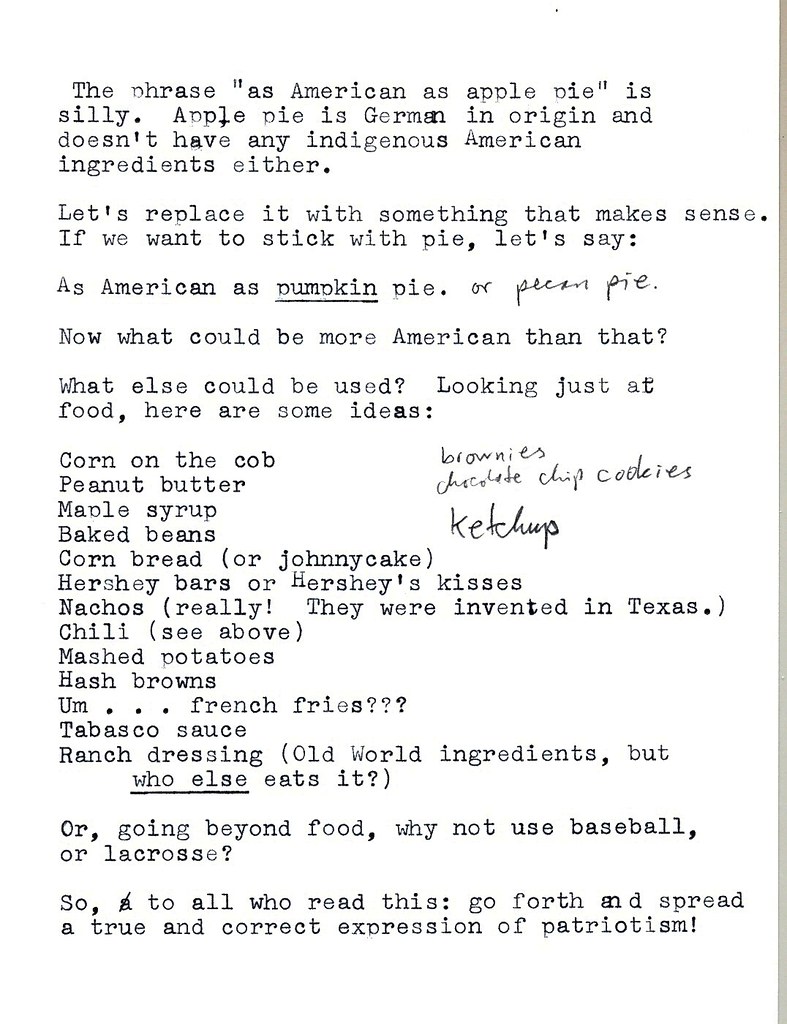
-I really had meant to do more posts on my typewriter, I really had.
I have meant to do many things, and making excuses has never been one of them. But dealing with all the demands on my time ("too many hands on my time," as the Canadian poet also wrote), seeing how I fail at meeting them all, and seeing the hard choices I have to make, maybe I can continue to be patient and forgiving with others when they fail to gratify some of my wishes for time spent with them.
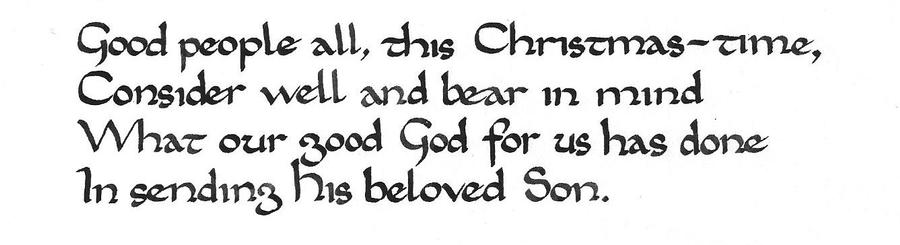
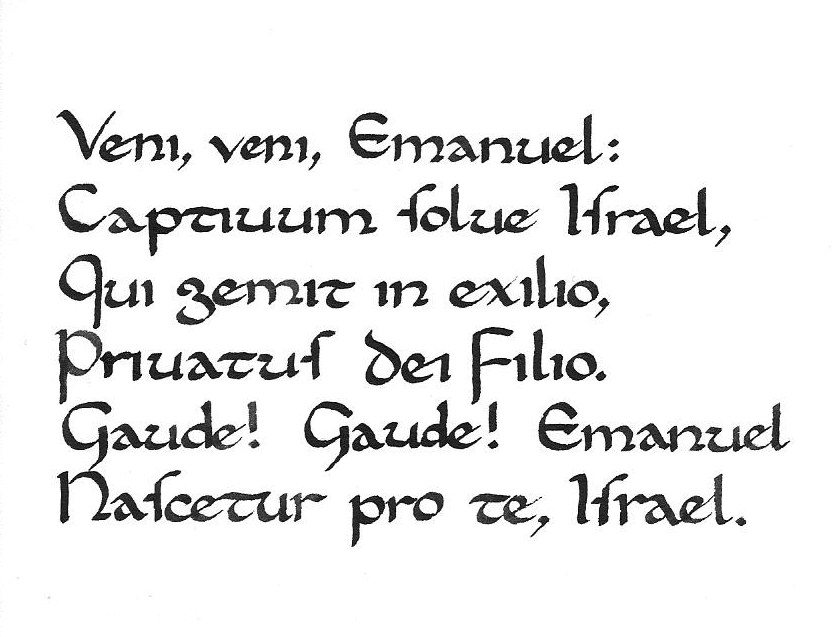
I haven't finished any of my planned Christmas calligraphy projects this year, but I'm going to post some calligraphy of Christmases past. Looking back over my work, I can see that I have improved my technique, even though I still have much room for more improvement.
First, a section of the Wexford Carol, one of my favorites, that I did - oh, probably three years ago.
And this one, from about the same time, showing the same shaky penmanship and indecisive long "s" (though I'm not sure how much better my current forms are):
Finally, a translation of the Magnificat, which I did as a gift for someone, also in 2012. This was a bit of work: I translated it into one of the languages in the novel I'm writing, which required some last-minute invention of words and grammar, and then I had to write the thing out carefully and neatly. At least in this script you have no other specimen to judge it against. Here it is, enjoy!

Wednesday, September 23, 2015
Typecast: two original haikus
Haiku is not a form that I've done much with, but here are two I've written:


Wednesday, February 5, 2014
White Boy Fantasy with Potatoes (no typecast this time, sorry)
An adolescent's concept of the
middle ages, or an adolescent boy's concept: how many are like mine?
A lot of my imagination has always centered around food, and my
fantasies of Medieval meals owed their bulk to the pot roast dinners
we often had in my family while I was growing up. There seemed
something anachronistic and archaic about a huge hunk of meat on a
platter; I think this is universal, judging by the portrayals I've
seen in popular media and the wide appeal of turkey drumsticks at
Renfaires. Eating large quantities of meat is typically understood
as a manly taste, and there is something nearly exclusively masculine
about the appeal of a mythical Dark Ages that goes hand in hand with
an enjoyment of fantasy role-playing games and their derivative
fiction, as well as the accompanying art that teeters on the edge of
the pornographic. It's more cave man than anything, and that
adolescent male attraction to the Dark Ages has little to do with
chronology and almost everything to do with the shagginess that
Umberto Eco astutely pointed out in “Dreaming of the Middle Ages.”
Cave men with castles for caves and iron swords instead of flint
axes. Yet somehow their women achieve modern nutrition and hygiene.
(A
Dungeons & Dragons manual I once had, Creative Campaigning,
suggested setting a campaign in a stone age and included a reduced
magic system to go along with the primitive conditions. I now think
that's totally backward: the more primitive the technology and
economy, the more pervasive the magic. That game designers should
fail to see that speaks to the psychological, historical and
mythological ignorance of their society.)
Since
in my childhood home we generally had mashed potatoes and gravy with
pot roast, I took for granted the Medieval character and even
provenance that I projected on them. Not just mashed potatoes but
those soggy ones that have been cooked with beef and onions in a slow
cooker, absorbing the juice. The whole package of meat, onions and
potatoes, whether the meat stays in a chunk or gets cut up for stew,
is unconsciously imported into masculine fantasies. In the past few
years I've done NaNoWriMo there's been a running joke about stew on
the fantasy forum, stemming probably from a question in David J.
Parker's Fantasy Novelist's Exam: “Do you not realize it takes
hours to make a good stew, making it a poor choice for an 'on the
road' meal?”
Even
to this day, when I hear or read the word “Lombard” I have to
fight to keep the taste and feeling of mashed potatoes and Tabasco
sauce out of my mouth. That particular association comes from
history books I read when I was 17: the fall of the Roman Empire, the
barbarian invasions, the desert fathers. But they said nothing about
food, so all throughout I held in my mind a picture of barbarians
newly established in appropriated Roman castelli, eating mashed
potatoes. This was also shortly after I had taken a great liking to
Tabasco sauce and often put it on my mashed potatoes, mixing it in
until they turned pink. So for me the Dark Ages came to taste like
two American things that were unknown in Europe at that time. I
didn't know that; I had only the vaguest idea of the history of food
and didn't realize how enormously important staple food crops are in
economy, technology and politics, what a difference potatoes really
made in Europe in the modern era. My interest in history was a means
to an end of fertilizing fantasy; it still is to a great extent, as I
think it should be for everyone if the world is to change for the
better. But my fantasies then were more narcissistic than the
utopian dreams that my spiritual conversions have since engendered,
and I had less factual knowledge to help me emerge from the
ethnocentric Anglo-American adolescent dreams that I swam in.
So
I didn't know the difference between old world and new world crops.
I don't want to pin the whole rap for that on Tolkien: as a mythical
world, Middle Earth has no reason to pretend to any historical
accuracy, being a mythical creation (and Sam cooking rabbit stew in
Ithilien makes sense in its context).
But
the way the fantasy genre has evolved since then has led to the
irresponsible behavior lampooned so well in the Fantasy Novelist's
Exam: trying to copy your inspirations without doing your research.
Over the past few years there's been a lot of debate online about the
race or color of characters in fantasy fiction vis-a-vis “historical
accuracy.” I haven't dug deeply into that or followed very
closely, mostly because it has always seemed self-evident to me that
if you're writing or playing fantasy then you don't need to be
“historically accurate.” But if you are writing a fantasy
actually set in medieval Europe, then you're obligated to take into
account the relations of trade, religion and scholarship that brought
people of different races in contact with each other then and there.
As a teenager I got an education about Saracens from Judith Tarr's
Ars Magica. That novel was published in 1989, and of course
Ursula LeGuin's Earthsea novels with their multiracial cast
are even older, and not beholden to any concerns for historical
accuracy, whatever shallow resemblance their props might have to
medieval stuff.
Is
the stereotype of a medieval European fantasy landscape – full of
castles, monsters, knights errant and damsels in distress all white – more of a notion in the
minds of amateur male authors than a reflection of how the genre
really goes? It might go back to Ariosto after all, as I mentioned
in a previous post: Orlando Furioso is a classic adolescent
male fantasy and its European point of view recoils in disgust from
black characters and even paints the Princess of Cathay as blond.
But I'm not well-read in modern fantasy; I hardly touched it for
years until I started on Robert Jordan's Wheel of Time series
about 11 years ago. It was a welcome re-entry for me because of all
that it does right: a multi-racial cast, world-wide trade networks
over millennia of history (so potatoes, tobacco etc. make sense,
though he keeps maize and tomatoes isolated in the desert to add
color in winking asides), and only the most superficial resemblance
to “medieval Europe.” It's such a popular series I guess I
figured it was typical of how the genre developed while I wasn't
looking (I wonder if he was inspired at all by Delany's subversive
Return to Neverÿon
series with its blond barbarians and child empress).
I fear I'm wrong, based on what I have read from people about what is considered “typical” fantasy – people who I assume have read much more of it than I have. I might like to call it something like White Boy Fantasy with Potatoes: adopting medieval trappings like long swords, armor and castles, and even trying to make these as “accurate” as you can, while blithely including in your misty “northern European” setting blatant anachronisms like potatoes (or pumpkins, like I saw in the Gargoyles TV cartoon series), sewers, cheap soap, or the grosser absurdities like chicks in chainmail . . . but keeping everyone white (with the possible exception of black-skinned evil underground elves) because, forsooth, there were no black people in northern Europe “back then!” This does deserve criticism as narrow-minded: there's not much excuse for it in this century, and I think it's the real butt of Parker's jokes in his exam, much more than Robert Jordan's feminist heroines. White Boy Fantasy with Potatoes might draw from Tolkien, but it leaves off from the mythic resonance that gave his work its sense, settling its roots more in modern American experience. WBFwP is a product of 20th century industrialized middle-class teenage life, along with drive-through fast food, high school romance movies and prog rock. It's gratifying to think that I might extrapolate from my own psychic experience to understand the appeal of a typical and popular genre, but it's sad to think that it should be so typical.
I
have to state that my experience with fantasy as a teenager was more
with gaming than fiction, and I wonder how many others have
experienced similar. The “Fantasy Novelist's Exam” takes obvious
aim at the practice of importing game mechanics into novels, as in
the series built on the D&D franchise: Dragonlance,
Forgotten Realms and probably others that I don't know about.
I read Dragonlance books as a teenager and I bristled when
others dissed them. At the time I found a lot of value in them (I
liked them much more than Forgotten Realms which I abandoned
halfway through the first volume). I don't know what I would think
of them if I were to re-read them now; my intent here isn't to judge
their literary value. I believe that, whatever literary value they
may achieve, they still ought to be considered as belonging to the
gaming world, separate from “the fantasy genre” as a whole,
inasmuch as authors working in the wider genre, though they may be
building from common tropes, have more leeway than those who are
bound to a set of game mechanics. Some things are more appropriate
for games than for novels, and I've become convinced that what makes
for good gaming and good fiction are usually opposites.
How
many of the authors writing in the freedom of the wider fantasy genre
have really taken that leeway though? Again, my ignorance. I turned
my back on the genre because I judged it as I have seen it judged by
others: overrun by white boys who want to rove through northern
European or North American-looking settings, slaying monsters
(including orcs who sound like Turks, or is it the other way
around?), eating meat and potatoes, and making love to centerfold
models in fur or chainmail bikinis – all without encountering
inconveniently different people who would challenge the comfortable
demography of their actual suburban lives. I might have judged
unfairly; I would like to think so – again, I'd like to think that
those white boys (whom I can totally empathize with, alas) are mostly
the fans and amateur writers rather than the published authors.
But
whatever the genre's past might have been, I'm discovering exciting
new work by authors like N.K. Jemisin, whose Hundred Thousand
Kingdoms I recently read. There's some fantasy for you! - drawn
from an obviously wide foundation in psychology, politics, economics;
and a rich life experience of living, working and studying in many
places. I've recently read others whose settings are modeled on
earthly history and geography away from the misty wilds: the eastern
Mediterranean for Megan Whalen Turner, and the urban Renaissance for
Rachel Hartman. They show evidence of conscientious historical
research and that is gratifying, even if they come across more as
fenced gardens than as worlds (how much more do I have a right to
expect? The pioneers of the novel form itself didn't do years of
exhaustive world-building: they focused on a few people in one time
and place). There seems to be a growing appreciation for
historically-modeled fantasy, which is what I started trying to write
over 10 years ago. I'd better finish it soon; I'd hate to miss the
right moment to get it published.
Thursday, October 6, 2011

Wednesday, August 31, 2011

Wednesday, August 3, 2011
Alliterative verse 1
I like alliteration. And this past spring I started trying to write alliterative verse according to classical Old-Middle English structure (which you can read about here).
This is hard to do. My attempts so far show the typical features of beginning poetry: most of my attention goes to fitting the form, so that I'm not as free to express what I might be feeling or wanting to say. I can try to steer the point or argument of the poem in a general direction, but I'm still mostly a back-seat driver, with the form at the wheel, sometimes taking turns I didn't intend.
Still, this specimen might not stink too badly, so I'm sharing it.

This is hard to do. My attempts so far show the typical features of beginning poetry: most of my attention goes to fitting the form, so that I'm not as free to express what I might be feeling or wanting to say. I can try to steer the point or argument of the poem in a general direction, but I'm still mostly a back-seat driver, with the form at the wheel, sometimes taking turns I didn't intend.
Still, this specimen might not stink too badly, so I'm sharing it.

Monday, July 25, 2011
Sunday letters
For some time now I have been writing letters to family on Sunday evenings, and although I lapse occasionally, it has become such an enjoyable practice that I try to keep it up. I highly recommend it, especially if your local NPR station carries Hearts of Space on Sunday evenings.

Thursday, March 31, 2011


Wednesday, January 26, 2011


Thursday, January 13, 2011
Typecast: fun with scripts


First, Reformed Gothic. Roman equivalents are below, with IPA symbols in brackets. And you can see the source for this script here.

And here, a 19-letter version of a Counterfactual Roman alphabet.

I reserve no copyrights for these. I want people to write with them.
Friday, October 22, 2010
Quillcast: Chocolate
Someone asked me for my drinking chocolate recipe, so I decided to write it out with a quill on spiffy paper in an anachronistick fashion. Although it is sloppy (in conception and execution) and blotted, I am putting it here to share with the world, or at least the handful of folks who might read this blog.
Usually my quill writing is neater than this. I blame my haste, which in turn led to carelessness in trimming my pen . . . and the fine Southworth paper, which, although it looks dandy, has a rough texture that a quill doesn't seem to like. It has a superficial resemblance to old-fashioned laid paper but it's not the same thing.
Oh well, anyway, here it is. As has become common with Blogger not liking my images, click to enlarge.
I reserve absolutely no copyright whatever for this.


Usually my quill writing is neater than this. I blame my haste, which in turn led to carelessness in trimming my pen . . . and the fine Southworth paper, which, although it looks dandy, has a rough texture that a quill doesn't seem to like. It has a superficial resemblance to old-fashioned laid paper but it's not the same thing.
Oh well, anyway, here it is. As has become common with Blogger not liking my images, click to enlarge.
I reserve absolutely no copyright whatever for this.


Monday, October 11, 2010

Thursday, March 4, 2010
Twenty twelve-year-olds and a typewriter
What happens when you get a bunch of twelve-year-olds around a manual typewriter? It's not quite an infinity of monkeys . . .

Thursday, October 29, 2009
Thursday, March 12, 2009
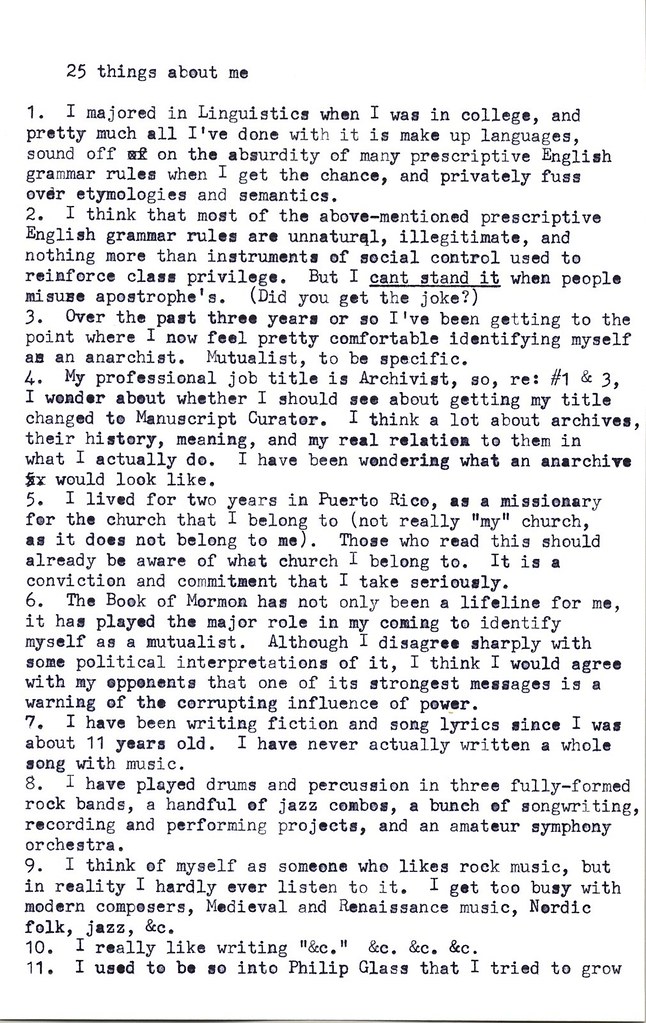
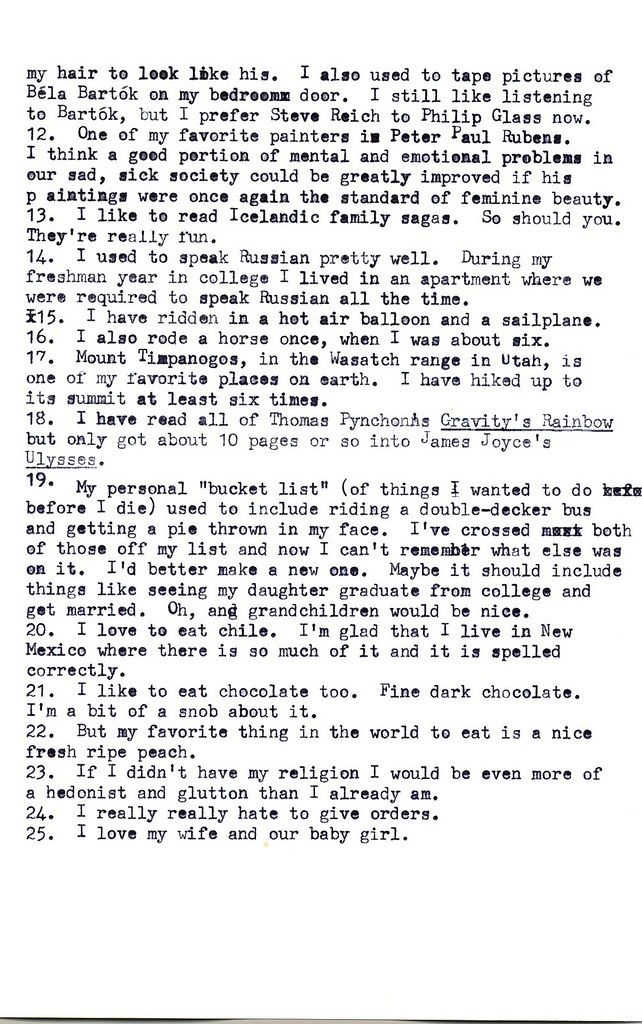
Laggard typecast: 25 things
So, after the "25 things about me" sensation has swept the nation, I finally wrote one up.


Thursday, April 24, 2008


Subscribe to:
Posts (Atom)