(I took the header picture of a Common Loon resting on a pond in Utah on its way north in June of 2015. It was in transition from winter to summer plumage.)

Translate - I dare you. Then make a comment on the funny errors the translator made.

Showing posts with label Faith. Show all posts

Wednesday, May 23, 2018

Magic and Religion: an LDS Perspective

I wrote these two blog posts for the Jung Society of Utah; unfortunately their website seems to have just gotten hacked and I can't link to my posts there at the moment.  Also, I had to cut the length of my second post to publish on their site.  Here I'm posting its original version.


Magic and Religion: an LDS perspective, Part 1


Far away, across the fields
The tolling of the iron bell
Calls the faithful to their knees
To hear the softly spoken magic spell
-Pink Floyd: “Breathe (Reprise),” Dark Side of the Moon

Christianity has an uneasy relationship with magic, to greater or lesser degrees among its branches. Mormons are some of the wariest of all, which is ironic when you consider the origin of the Church of Jesus Christ of Latter-Day Saints. The regions of North America that nurtured this faith have also hosted folk magic practices for hundreds of years. Since the rise of various new age movements, notably Wicca and Neopaganism, modern aspirants to magic have been attracted to these homegrown systems. In response to this, people who work to preserve these traditions take pains to point out that they are firmly based in Christianity, and are not to be taken for any kind of crypto-paganism. The purpose of all these charms, incantations and concoctions was to bring about miracles – usually healing – by the power of God.

Along with this went a very real belief in and fear of witchcraft: if God could give power through special rituals, then so could the Devil, and much of the work of a Cunning Person (of whatever tradition) is to protect against evil enchantments. (As a side note, the notorious “heavy metal sign” with the index and little fingers extended comes from an Italian gesture of protection against the “evil eye.”)

Mormon attitudes to magic range from dismissive to fearful, with a healthy dose of defensiveness along the spectrum. Such defensiveness is perfectly understandable: the difference between “faith” and “miracles” on one hand and “magic” on the other looks entirely relative from a psychological perspective. Much depends on what words are chosen to describe phenomena and experiences – and who chooses those words. Any given group may identify its practices and rituals as religion and others' as magic – and in so doing, project its shadow.

And it came to pass that there were sorceries, and witchcrafts, and magics, and the power of the evil one was wrought upon all the face of the land
- Mormon 1:19

These are they who are liars, and sorcerers, and adulterers, and whoremongers, and whosoever loves and makes a lie. These are they who suffer the wrath of God on earth. These are they who suffer the vengeance of eternal fire.
Doctrine and Covenants Section 76: 103-105

Church members should not engage in any form of Satan worship or affiliate in any way with the occult. ‘Such activities are among the works of darkness spoken of in the scriptures. They are designed to destroy one’s faith in Christ, and will jeopardize the salvation of those who knowingly promote this wickedness. These things should not be pursued as games, be topics in Church meetings, or be delved into in private, personal conversations.’ (First Presidency letter, Sept. 18, 1991).
-Handbook 2: Administering the Church, the Church of Jesus Christ of Latter-Day Saints

Official teaching holds that Satanic minions do in fact roam the world seeking to do mischief, and in popular understanding, “messing with magic,” even experimenting with common divination tools like Tarot cards or Ouija boards is a perfect way to open the door to such mischief. While Joseph Smith canonized instructions on how to tell if an otherworldly messenger is trustworthy or not (Doctrine and Covenants Section 129), and the early days of the Church were noted for angelic visitations and dramatic manifestations of spiritual gifts (like speaking in tongues), in today's church that sort of thing is greatly downplayed.

Still, from a psychological perspective many rituals and practices still exist in the LDS Church that could be considered magical. The Mormon version of the Eucharist lacks the dogma of transubstantiation but is still seen as a potent renewal of baptism, itself a ritual that enacts a transformation of the soul through a symbolic enactment of death and rebirth.

Mormon fear of magic goes along with a general unease with ceremony. For the most part the really important thing in Mormon ordinances is the faith and worthiness of those taking part. As such, the working of miracles through faith in Mormon belief might not look very magical: “no foolish wand-waving or silly incantations.” Though there are points of mechanical procedure that are prescribed with some precision, in the non-secret rituals these are minimal to the point of austerity.

The secret rituals are another matter (and Mormons get touchy about the use of the adjective “secret” even though it fits). These are understood as a gift of power from heaven which enable a soul to reach its final destination in unity with God. And then there is the remarkable “Patriarchal Blessing.” The title, so unfortunate to modern ears, is a metaphor of Abraham, Isaac and Jacob and their prophetic blessings to their sons. The practice offers an individual a private prophecy to help direct their life, given by a man with a special calling (in the early days of the Church, such men were referred to as “evangelists").

Describing these rituals as “magic” might seem very disrespectful or offensive to those who identify strongly with the tradition. While a psychological imagination can see the kinship between magic and religion, some believers find this hard to take: Dr. Jung constantly defended himself against accusations from Christian clergy that he reduced the message of our faith to nothing more than a working of the mind.

Jung's work gets it from both sides: believers who resent their faith practice sharing any names with what they regard as devilish counterfeits, and skeptics who despise magic and religion alike as a pathology unbecoming enlightened and civilized people.


Since Jung's great work was the reconciliation of opposites, I write in service of that goal.


Magic and Religion: an LDS perspective, Part 2


In 1994 the journal Dialogue published an article by Dr. Lance Owens“Joseph Smith and Kabbalah: The Occult Connection.” One of Owens' sources was Early Mormonism and the Magic World View by D. Michael Quinn – who had been excommunicated the year before. Quinn's work had been used as source material for the popular anti-Mormon comic book The Visitors, so Owens was hitting a nerve.  The mid 1990s in the Utah Mormon culture zone were also marked by lingering fears of Satanic cults (anyone who lived in Provo at the time probably heard all sorts of urban legends about goings-on in the old Academy building before it was renovated as the new city library). The word “occult” had picked up plenty of negative baggage through popular media already, and the use of it in such a context at such a time was bound to ruffle some feathers, as Owens himself anticipated.

In 1996 William J. Hamblin wrote a footnote-laden dressing-down of Owens' article. In pointing out its scholarly shortcomings he elegantly missed the real point, because after all the purpose was not only to deflect suspicion of any “occult” connection to Joseph Smith's experience or mission but to continue deprecating and depreciating any similarities between the two at all – similarities which I for one came to find inspiring rather than alarming. It took another nine years for the Mormon establishment to come around to admitting Joseph Smith's magic background, after a fashion: in Richard Bushman's authorized biography Joseph Smith: Rough Stone Rolling we read that “Magic and religion melded in Smith family culture” (p. 50) and there is even a frank admission of the seerstone “blending magic with inspired translation” of the Book of Mormon (p. 131). Even so, Bushman downplayed the association, casting magic as a “preparatory gospel” for Smith's prophetic calling (p. 54).

The original meaning of the word “occult” after all being “hidden,” it would behoove us Mormons to consider how often our unique scripture mentions hidden knowledge. One striking example comes from the “Word of Wisdom”:

And all saints who remember to keep and do these sayings, walking in obedience to the commandments . . . shall find wisdom and great treasures of knowledge, even hidden treasures (Doctrine and Covenants Section 89:18-19, my emphasis)

We might consider Alma's sermon to the Zoramites, with a beautiful metaphor of a Tree of Life growing in each individual soul (Alma 32), the gnostic experiences of several Lamanite rulers (Alma 19, 22), and disciples of Christ at the time of his visit (3 Nephi 26, 28). Sometimes people shared what they learned through their experiences, sometimes they were told to keep it a secret, like Nephi (1 Nephi 14:28), Alma the younger (Alma 12:9), Mormon (3 Nephi 26:11), the Brother of Jared and Moroni (Ether 4).

Our religion is of God, their magic is of the Devil – this is too easy an accusation to make. Even in the Book of Mormon there are several instances of the true prophets being accused of deceiving people by their “cunning arts” (1 Ne 16:38), “the power of the devil” (Alma 15:15), and “the cunning and the mysterious arts of the evil one” (Helaman 16:21). Accusations, labels, meanings, are so easily used as weapons against those whom a group fears or distrusts, that an earnest truth-seeker can't afford to take such words at face value.

A psychological understanding, or a psychological imagination, helps us understand that magic and/or the occult is a way of engaging with the unconscious or the realm of the imaginative (one modern practitioner calls it the science of experiencing Truth). To recognize this means to admit the close kinship of magic and religion as branches from the same root – indeed interchangeable depending on one's point of view. There can be two ways of dealing with this: 

  1. a fundamentalist rejection of any religious expression outside one's own, 
  2. or a curiosity about the different ways that Truth is perceived and sought from different perspectives.

If the theologian really believes in the almighty power of God on the one hand and in the validity of dogma on the other, why then does he not trust God to speak in the soul?  Why this fear of psychology?  Or is, in complete contradiction to dogma, the soul itself a hell from which only demons gibber?  (Jung: Psychology and Alchemy, Collected Works Vol. 12, p. 19)

In a series of lectures on the gnostic myth of Sophia, Dr. Owens talks about this secular age and its intolerance for transcendence. Fueled in part by absurd fundamentalist insistence on impossible dogmas as fact, a rationalist attitude has grown which pathologizes myth and gnosis (an attitude reflected by Korihor, one of the most notorious figures in the Book of Mormon). To believe in any religion or myth in light of modern scientific knowledge requires setting aside or overcoming both the rationalist dismissal of myth and the fundamentalist dismissal of fact.

When we open our mind to the possibility of revelations of something from outside the secular or even religious ego – and if we also open our minds to a pragmatic means of measuring the claims of such revelations based on the criteria given in Alma 32 – then we have the opportunity to see the dogmas of our professed creeds with new eyes: to recognize their value as myth (here I would also recommend Dr. Owens' lectures on Tolkien's mythopoeia). This means ceasing to disparage or even define myth as false distraction from truth, and instead seeing it as a way to approach Truth. This is how we can truly recognize the value of others’ myths, and our own.

No matter what the world thinks about religious experience, the one who has it possesses the great treasure of a thing that has provided him with a source of life, meaning, and beauty and that has given a new splendour to the world and to mankind. He has pistis and peace. Where is the criterion by which you could say that such a life is not legitimate, that such experience is not valid and that such pistis is mere illusion? Is there, as a matter of fact, any better truth about ultimate things than the one that helps you to live? (Jung: Psychology and Religion - Collected Works vol. 11, p. 113)


We might evaluate the ways our neighbors engage with myth and the psyche by truly perceiving the fruits of their actions rather than relying on rumor or applying the yardstick of dogmatic correctness like a punishing rod. We may still have the option of holding out faith in metaphysical facts concerning the “ultimate things,” but even if that loses traction to a more pragmatic approach, might we not find that the humility, empathy, respect and compassion we gain in return is after all the treasure our faith enjoined us to seek?

Those who found these posts interesting might also be interested in a pagan's view of Joseph Smith in this article.

Sunday, September 10, 2017

Quest cooking: Rice pilaf

Yesterday I decided that too much time had passed since I'd used my rocket stove, so I cooked a simple meatless pilaf on it.  It had been a while since I'd done rice on this stove.

Here's what I put in:
About a tablespoon of ghee
Half a yellow onion, sliced
A carrot, sort of julienned
Salt
Cumin (about a half teaspoon?)
Two cardamom pods, shelled and ground
Red chile (a teaspoon or two, my hand slipped) - in honor of a departed sister of mine who used to live in New Mexico, may she rest in peace
1 cup basmati rice
1 2/3 cups water

Here are some pictures, taken by my sweetie.


Tending the flame while sauteeing the onions.  For the initial hotter flame I used twigs cut from our quince bush earlier this year.

Carrots and spices waiting to go in

After frying the dry rice with the vegetables and spices for a bit, add water . . .

. . . stir, and simmer over a lower flame for about 15 minutes.  For the lower flame I used dead branches cut from our plum tree, about half an inch thick, two at a time.
By moving the pot around the stove every so often I hoped to avoid getting a burned spot in the middle.  I still got a darkened spot, but despite what it looks like here it wasn't really burned, and didn't adversely affect the flavor of the dish.
At church we've been attending a meeting dedicated to emergency preparedness (something that Mormon culture can sometimes take to extremes).  With recent events reminding us both of the necessity to be prepared for disruptions of all kinds and the appropriateness and limitations of different strategies for this, I want to keep my skills up in strategies not only for preparedness where we live, but also self-reliance and voluntary simplicity.  I'm glad we have neighbors on our street who are also interested in this kind of thing.

Monday, November 21, 2016

Quill/brasscast: Thoughts about roots, cut short

I wrote this with a quill and with two metal nibs, trying out some "new" old paper, while keeping track of a two-year-old.


Sunday, August 14, 2016

More heart's blood

I mentioned in a previous post a regrettable decline in pioneer values that I perceive in the developing towns along the Wasatch Front.  Where I live you can see a curious mix of old houses in reasonably good shape, decrepit buildings where closed businesses once stood, and newer stores, office buildings and roads built to accommodate and encourage the post-industrialist consumer lifestyle of today.  It is always sad to me to see how often the older buildings with a cozier, more human, more convivial spirit to them get left to decay and then swept aside, or re-purposed: along one length of a principal street are several lovely old houses that now hold retail businesses (existing perhaps tenuously) or professional offices.

To me this is all a betrayal and defeat of the vision that settled this area, and to my view an honest assessment of the current social and economic order of the Mormon heartland must confess that we have a sad state of affairs.  Land that could be productive, used to house people in modesty, industry and communal self-reliance is regularly parceled out to build luxurious dwellings at obscene prices.  Small businesses feel they must curry favor with the trendy whims of indifferent consumers in order to survive: it is harder and harder to count on a robust spirit of 2 Nephi 26:30 to keep any enterprise afloat (and you can just forget about verse 31).

An unreflective enthusiasm for a gospel of growth and prosperity gives carte blanche to expressions of arrogance and greed that are embarrassing and insulting to an idealistic viewer.  I think it no coincidence that Hugh Nibley wasn't allowed to fulfill a career of scholarly inquiry and social criticism in peace without his persona and legacy being yanked into extremes of adulatory folklore and allegations of the most sordid private sins: our culture has little tolerance and less use for principled and consistent critiques.  And attempted critiques regularly veer into reactionary political stances, which I also find very sad and self-defeating.

But I realize too that self-reliance is hard, and not exciting or sexy.  I think a great deal of the consumer mindset that produces such callous effects worldwide in fact is rooted in the desire for miraculous deliverance: how wonderful it is, after all, to see something like a new restaurant arise from the ground, and to spread its large printed advertisements across the land for miles, with no effort from me!  Is it not something like an experience of grace, to be able to simply walk into a clean, climate-controlled, brightly-lit and fragrant space, with nothing required of me other than to be served, to make my selection, and then have the freedom to leave in search of another similar environment?  Granted, we have to pay for the things we get here, but beyond the money we part with for specific goods and services, the larger message is of this abundance from above and afar: these brands, these buildings, this infrastructure comes to us, lifts us up, and asks nothing more of the worthy among us other than an attentive duty to the specialized abstracted tasks laid out before us in yet another climate-controlled and brightly-lit space.

I think that all this truly fees like heaven to many, many people, in an unconscious or at least little-examined way.  My conscience, in exercise with my intellect, is still set against it, but I have a clearer understanding of it now.

Friday, July 1, 2016

Zhneshtotmatlitszeth-n'

Today I'm feeling grateful for not taking a bad path in my life.

This has to do with the kind of music I listen to. Music is such an important part of life for so many of us that it's important to be mindful of what music we're listening to and why. I feel good about the music I listen to, which gives my life more richness than I can know. I know I take it for granted most of the time, especially now with the internet.

When I was young I was in danger of going down a wrong path with my music, allowing other people to shape my listening choices in regrettable ways.

I'm talking about rock and roll.

Specifically, I'm talking about how some people tried to stop me from listening to rock and roll, and for a while I was in danger of following their misguided warnings.

I was young and impressionable when I first heard scandalized reports of the evils of rock music: bands with names like Black Sabbath and The Grateful Dead – horrors! It wasn't quite like the movie Footloose – I didn't live in a small town and the church had no problem with dancing (of the right kind), but the knee-jerk fear of the strange and different was just as strong at home and at church. I remember telling my younger sister that rock and roll was devil worship and that I wasn't going to listen to it.

I didn't keep that resolution for very long, for two reasons: my older sister's discovery of MTV and my older brothers' record collection that they left behind when they went away to college. It was a treasure trove, full of Led Zeppelin, Rush, Yes and the like. And as my sister continued to sneak views of MTV at night, she started buying more records of the bands she was hearing: mid-80s stars like Ratt, Cinderella, Poison, Def Leppard, Guns n Roses . . . my parents were very worried. I could tell that there was illicit subject matter in some of the stuff, but I had no clue that “Pour some sugar on me” was supposed to be a sexual metaphor, and I thought that Van Halen must be heavenly messengers after I watched the video of the Blue Angels stunt flying to “Dreams.”

This went on for some years, and as adolescence eroded my innocence I did sometimes suffer pangs of conscience for listening to some of the music that I did. Every once in a while I had to confront some explicit warnings from the authorities. Some I could shrug off without too much guilt, like my youth leader who thought that Queensrÿche's nifty logo looked Satanic. Others were harder to ignore.

One Sunday when I was 17, the Priests' Quorum lesson consisted of a recorded talk by some minor general authority about the perils of inappropriate music. I don't remember the who or when or where the talk had been recorded, but I had heard plenty of this kind of thing over the years, and progressing through my youth I had developed quite a selective ear for the rock music I liked so much. I knew the Rolling Stones were right out, of course, because of the story of Gene R. Cook talking to Mick Jagger on an airplane and hearing out of Mick's own mouth that their music was calculated to drive teens to have sex. (You can read about this in several places, for example here and here.)

In truth, I've always found the Rolling Stones a bit boring, so that wasn't really a problem. I had put aside a lot of rock and especially pop music that I decided was not worth my time – in fact, my 18th year of life was when I was most heavily into Rush and Queensrÿche, and had decided that a lot of other rock music just didn't measure up to those standards. Not to mention that I could see how many of my youth leaders, in being worried about heavy metal, completely missed the more blatant sexual messages in the more mild-sounding pop music they listened to.

So I was feeling pleased with myself as I listened to this talk, and allowed myself a bit of arch amusement at this old guy's immoderate hysteria about rock music, and then he dropped the bomb. He mentioned a song that everybody knew about which had the hidden lyric “Here's to my sweet Satan.” He mentioned this as an example of the really dangerous rock music out there that we just couldn't afford to dabble with.

But he didn't name the song or the group!

I was seized by doubt. Who was it? I didn't ask if anyone in the room knew; I wasn't that outspoken. Besides, I was truly afraid of finding out: what if it was a band I really liked? What if it was Rush? I could already tell that Neil Peart was skeptical about God, and there was that 2112 album cover with the pentagram. I had come to terms with Neil's expression of his beliefs in his lyrics, and I didn't listen to "Ghost of a Chance" or "Anthem."  I could forgive Neil for not believing in God, I could even forgive him from preaching selfishness in his youth, but what if . . .

No, it couldn't be Rush. Could it? Well then who? Maybe it was Black Sabbath? I didn't listen to them, only “Iron Man” when it came on the radio.

The question sat at the back of my mind for years. I wanted to know who had done it, but at the same time I didn't, just in case I might find out that I really had been dangling from the devil's hook unknowing for years. So over 20+ years of the World Wide Web I've never looked it up online – until just a few days ago.

Actually, I stumbled across it, as I was reading about something else, viz: the recent lawsuit brought against - and won by - Led Zeppelin for copyright infringement, for the opening riff of “Stairway to Heaven.”  (I won't discuss that in this post.)

I feel like I'm late to the party in discovering this weird little nugget in The Greatest Song in the World, but, it's sad to admit, I have a history of unease with “Stairway to Heaven” and Led Zeppelin generally. The first time I heard it (I was young and impressionable) was with a family member who was analyzing the lyrics and mentioned the possibility that instead of being a song with a Good Message, as seemed plain to me, it might actually be a song with a Bad Message. In other words, what if that “piper” were really the Devil? She never said anything about the supposed hidden message in the recording; I don't think she had heard about it.

And that album cover – well, it was certainly mysterious, wasn't it? Kind of spooky, with those arcane-looking sigils. My due respect for Led Zeppelin was retarded by that initial suspicion, so that the timeless wonder and quality of their music took a long time to erode my wary defenses. On the way, of course I heard a bit of schoolyard and lunchroom rumors (though never the one about the backmasked message): “dude, they wrote the song while they were high on some drug.” “Isn't that song about the devil or something?” “Didn't they sell their souls to the devil?” In the pre-internet information-scarce environment of public schools, any scandalous rumor seemed as likely to be true as the next. It didn't help that I saw a record-burning on the news with Led Zeppelin albums prominently displayed.

By the time I was 17, I had shed almost all of my unease or guilt at listening to Led Zeppelin – I had taped just about all of their songs that got regular radio airplay, and I spent my senior skip day listening to my brothers' old Zep LPs (including #4) on a friend's turntable. Never let your schooling get in the way of your education.

If I had been told at that age that “Stairway to Heaven” had the hidden message “Here's to my sweet Satan” in it, I don't know what I would have done. I mean, I might not have been able to play it backwards for myself to check, but knowing how credulous I was I might have believed it. And that might have caused me even more psychic retardation. As it was, I got rid of a CD I bought of symphonic arrangements of Led Zeppelin songs when I was in my early 20s partly because the artwork made me uncomfortable. It was too . . . magical. I regret getting rid of that CD, partly because of my silly squeamishness, partly because the crushing rendition of “Kashmir” was worth the price alone.

Because the thing is, of course, Led Zeppelin is magical! Good British lads, they tapped into the same rich soil of Faerie that J.R.R. Tolkien did in their own way – after all, Tolkien was one of their big inspirations. I've written already about how much I loved fantasy fiction and role-playing as a teenager, and during that time I vehemently defended these hobbies against the accusations of Satanism that came from “ignorance andprejudice and fear.” I assuaged my feelings of guilt at listening to “Stairway to Heaven” with the thought that a new day dawning with laughter echoing in the forests could be understood not only as an image of the Millennium but also sounded like Bilbo and his buddies having a great time in the Shire (I'd be willing to bet my lunch tomorrow that Plant was thinking of something out of Tolkien when he wrote that line). Forests echoing with laughter sounds like the kind of world I would like to live in.  I want to pack my bags for the Misty Mountains!

If I had had cause to believe seriously that all of this was really tainted by an earnest profession of allegiance to Satan I might have turned decisively and ventured too far down the path away from all that: away from the color, vitality and wonder found in so many creative expressions influenced by or alluding to magic, whether labeled as fantasy or otherwise. I might never have picked up Robert Bly or Joseph Campbell or Carl Jung; I might have decided to really sever my relationship with fantasy fiction for good and all, I might have never started listening to King Crimson . . . who knows, I might have even decided that Harry Potter was of the Devil.

I don't like to think of myself in such a state.

Fortunately, my exposure to this strange and amusing sonic coincidence has come at a stage in my life where I'm more skeptical than I've ever been and also seldom shocked or offended by anything I see, hear or read. And I had already been inoculated against taking backmasking seriously. When I first heard about the “my sweet Satan” hidden message I thought the man was talking about a subliminal message that you might have to turn the sound up or speed up or slow down to hear, not a silly backwards thing. I don't know if I misheard or misremembered, or if the speaker was misinformed and simply took his bad information as a reliable report not needing any questions. I'm more inclined to believe the latter.

Being curious, I've still done my own investigation. I've heard the section of “Stairway to Heaven” backwards, listened to it slowed down, made phonetic transcriptions, heard multiple versions and gotten to the bottom of how that vocal line can sound like “my sweet Satan” backwards. Because I do have to admit: hearing it for the first time was unnerving. After all, hearing any human speech backwards gives an uncanny effect (as David Lynch exploited to hair-raising effect in Twin Peaks). If your mind is primed to hear “Satan” it's possible to assign that word to three utterances in the clip. This whole thing has been a good chance for me to reflect on what I learned in Linguistics about the brain's way of picking meaning out of sound, and the weird things that can result when we impose our need for pattern recognition on random stuff (think of A Beautiful Mind, for example). For years I've enjoyed reading mis-heard song lyrics, and the other day I just about wet my pants laughing to this video of Orff's “O Fortuna.”

Back to "Stairway."  Listening closely and repeatedly – as digital technology makes possible – shows that only the first utterance that you might parse as “Satan” really comes close to having all the right sounds. The others are really just “say” - reversed from “yes” and “fiy” reversed from “if” pronounced with a diphthong. But the glottal stop that Robert Plant started each does sound like a hasty N in reverse, giving those backwards utterances a resemblance to the Standard American pronunciation of “Satan.” In the first (or the last) Robert Plant led off from the glottal stop with a little nasal hum before articulating the dental fricative in “there's still time.” On the reversal that sounds like an N, giving the backwards “there's” a really close resemblance to “Satan,” priming the ear for the “yes” and “if.” Since he pronounces “time” more like “tom” the vowel keeps its purity in reverse and can sound like “my” or “mah” instead of “miah.” That makes it easier to hear “sweet” instead of the “tleet” that's really going on. The L is slightly rounded too, and with some aspiration (the common leaky articulation) of T forwards, there's your SW resemblance backwards. Also the background instruments obscure the vocal sounds, giving an even more vague input for the mind to try to process into something. With such mushy uncertainty, the pattern-making mind could fill in all sorts of weird things – like the nonsense of the rest of the supposed hidden message.

If it had been recorded today, someone might have parsed the reversal as “jest my tweet Satan.” Whatever meaning anyone might extract from that could make as much sense as that silly toolshed. (Now if it had been seeing something nasty in the woodshed, we might have a case here. Though I can't think of any lyrics that would make any sense to backmask “I saw something nasty in the woodshed.” The closest I can get is “the stove and tea, it's on, meat sauce, yeah.”)

Now why anyone would think that the mind's desperate attempts to make sense of backwards singing should mean that those improvised meanings are actually assimilated unconsciously going forward is hard to imagine . . . until you remember that people who come up with these kinds of scenarios aren't generally in the habit of thinking scientifically or even critically.

I feel silly admitting a need to have done so, but feels good to fully debunk this rumor through my own sonic/linguistic analysis. Like a Hogwarts wizard dispelling a boggart, I say “Riddikulus!” and laugh.

And I play the song for my children, glad that they are hearing it in its glory, without prejudice.

Sunday, March 20, 2016

The Provo City Center Temple

This afternoon my sweetie and I attended the dedication of the new Provo City Center Temple.  It was done in three sessions and we attended the third, broadcast into a meetinghouse in the town where we live that isn't Provo: I don't think there were regular church meetings anywhere in Utah today, at least not along the Wasatch Front.

They made such an effort to let as many take part in the dedication because this temple has a unique history.  It was built in the shell of an old building that used to be a tabernacle.

The old Mormon pioneer tabernacles are some of my favorite things.  I don't know how many survive now, but for years I've thought I'd like to take a tour of them.  They're essentially large meeting halls, with two levels of seats, and are often used for cultural events as well as church meetings.  The big dome-topped Tabernacle on Temple Square is probably the most famous, and the biggest (at least before the humongous conference center was built).  But the buildings I'm talking about are more like the smaller Assembly Hall on Temple Square.  Several of them were built with Gothic Revival architectural style or influence.

I loved the Provo Tabernacle, ever since moving back to Provo in 1994 and attending various concerts there.  When I heard the news of the fire that gutted it in 2010 I was devastated, as were countless others.  And I thought: the Church should restore it, but it probably won't.  So I was also glad with countless others when the plans were announced the following year to not only restore it, but to turn it into a Temple.

We went through it during the open house, and I have never been in another Temple that I have found as beautiful or moving.  The stained glass windows, the decorative motif of four-petaled flowers, quartered circles . . . dare we even say, crosses?  And all the wood!  There's wood everywhere, stained a rich warm homey brown.  We call Temples the House of the Lord, and this one really does feel like God's living room.  The pictures linked above don't really do it justice.

I can't deny feeling a certain sense of loss at this beauty - flawless and immaculate, but cozy - being reserved for a Temple instead of in a building kept open to public access.  I comfort myself with the thought of the other tabernacles still standing.  And it's also comforting to see a Temple displaying more hobbit-like charm than the cold white-on-white austerity that has been the norm for so long.  I like to think that it's a sign that the culture of the Church is changing for the better.

It's slow though.  There are complex meanings and signals I see in a place like this.  Mormons love luxury, even when they're indulging in pioneer fantasies, and I see a perfect example of that in the interior of this building.  I believe in comfort, in abundance, in wealth, even - but I believe in it as an ideal to be socially made and shared.  And as I see it, that was the ideology that drove those pioneers to make such improbable structures in their frontier settlements.  For a group of people in a place with no infrastructure to speak of to pool their resources and coordinate their labor to raise the most beautiful buildings they could, in brick or even granite, instead of slapping up cheap board facades . . . I understand and share the indignation that Mormons felt when the railroads brought the Gentile rabble from the east with their piddly, trashy saloons.

The tabernacles stand to me as a signal of hope in the promise of collective and cooperative enterprise, an ideal that our culture has for the most part turned away from with a multitude of blindly individualistic sneers, simultaneously gentrifying and uglifying what was supposed to be a Zion society.  To see those empty brick walls held up and filled with something that is so obviously a tribute to the spirit of those early days (even if the work of building was done by hirelings instead of by community effort), and offered up to God, is another sign of hope in my eyes.

Wednesday, February 3, 2016

"It's hard to be humble . . . when you're Danish"

I'm still working on my grandmother's research notes.  Today I'm in the local library, with a carrel by the window and Dietrich Fischer-Dieskau singing Schubert on my headphones.  It's nice.

I just found some notes she took from William James - I like William James.  I had started to read The Varieties of Religious Experience a couple of years ago, and this reminds me I ought to try to finish it.  (You can get it for free on Project Gutenberg.)

These notes were bundled with some drafts she had written about Danish history.  My great-grandmother was born in Utah to parents who had recently immigrated from Denmark - Scandinavia supplied a huge number of Mormon immigrants in the early days.  My great-great-grandfather, in fact, was called as a missionary to southern Minnesota (where I also lived for 12 years) and met many fellow Danes there.

So my father has one Danish grandparent, and my mother does too.  And I can feel a certain pride in that heritage when my grandmother wrote: "Denmark came to appreciate and give worth to peace.  She developed ways by which peace could be maintained without aggressiveness in conquest and control of other nations."

I have felt a lot of pride in my Danish heritage and hope to go visit Denmark some day.  I continue to be curious about what Grandma thought and wrote concerning the history of Salina.  Many times I've reflected on what a shock it must have been for inhabitants of a prosperous green low land bordering the sea, to find themselves in a dry landlocked country with red cliffs towering over their new homes.  I think that's one of the distinguishing oddities of American history in general: how many groups of people have tried to adapt ways of life that evolved in certain environments, to new environments that are radically different. 

Thursday, January 28, 2016

Thoughts from reading the Song of Roland

Well I read it.  Or most of it.  I read the Norton Anthology condensed version through at least, and I'll have to beg Suzannah's indulgence for this.  Her review is much more detailed than mine (partly since she read the whole thing), but I want to share some of my impressions here.

Having already read the "fanfic" that came from this work, what struck me first and foremost when I read The Song of Roland was its ancient tone.  I know I was reading in translation, but I felt through the translation the same tone that I have discerned in Francis Magoun's translation of the Kalevala - or in the Heaney and Chickering translations of Beowulf.  Or the various translations of Homer that I've read.

I also had a Mormon moment while reading it: at the end, when Charlemagne laments how hard his life is, I thought of Mosiah 29:33:


And many more things did king Mosiah write unto them, unfolding unto them all the trials and troubles of a righteous king, yea, all the travails of soul for their people, and also all the murmurings of the people to their king; and he explained it all unto them.

I really like Umberto Eco's essay "Dreaming of the Middle Ages" (in Travels in Hyperreality - affiliate link, you can get it pretty cheap), where he breaks down "Ten Little Middle Ages" of modernity, mentioning Torquato Tasso and Ludovico Ariosto as examples.  I definitely felt the difference between Ariosto's "Spaghetti Western" epic and the original chanson de geste.  Even through translation, Roland felt more barbaric - and Germanic.  I thought more than once of Beowulf (and the Sagas): noble swords with their names and lineages, loving descriptions of fancy armor, long-winded boasts and harangues, even the bit about Roland having plenty of work to do when surrounded by the enemy - that was classic Saga wryness.  It was interesting to see so much of that still manifesting in an 11th century work (though I remind myself that the Sagas themselves were being written down at the same time).

And the other thing: no sex.  Orlando Furioso and The Faerie Queene, with all their sex, remind me of fantasy scenes by Frank Frazetta (also mentioned in Eco's essay), as well as Larry Elmore and Boris Vallejo and Julie Bell (not so different from Ingres' famous scene of Ruggiero and Angelica, really).  The Song of Roland to me is . . . more like a Bolt Thrower album cover, maybe?  At least in the battle scenes.

Maybe that's not quite fair.  But so much violence!  Njal's Saga has that famous scene where Skarp-Hedin splits Thrain's skull as he skates by, so that teeth clatter onto the ice - I thought of that as I read Roland, which in parts was like that scene amplified and repeated at Peter Jackson levels of absurdity.  Eyes flying out of their sockets, brains coming out of ears, blood pouring down over armor . . . I won't lie, it all made me a bit sick.

Some years ago I read Millennium; A History of the Last Thousand Years by Felipe Fernandez-Armesto (which you can get used for quite cheap on Amazon - another affiliate link) and was struck by his mention of "aristocratic thuggery" and "noble hoodlums" in early medieval Europe.  I reflected on this as I read the story's depictions of gruesome slaughter and callous hatred (though tempered by tears and grief beyond what modern sensibilities would expect or even accept).  As a 16-year-old, when I was supposed to be reading this for my high school Humanities class, I probably would have thought the battle scenes were just awesome: I loved medieval and fantasy violence so much at that age.
I still enjoyed reading it now, and wish that I had read it at age 16.  Reading Suzannah's comments on it have helped me to appreciate it more finely.  So thanks, Suzannah, for the challenge!  The Sayers translation of Roland is firmly on my wish list, and I look forward to next year's epic.

Wednesday, December 30, 2015

To live between a rock and a hard place in between time


-I really had meant to do more posts on my typewriter, I really had.

I have meant to do many things, and making excuses has never been one of them.  But dealing with all the demands on my time ("too many hands on my time," as the Canadian poet also wrote), seeing how I fail at meeting them all, and seeing the hard choices I have to make, maybe I can continue to be patient and forgiving with others when they fail to gratify some of my wishes for time spent with them.

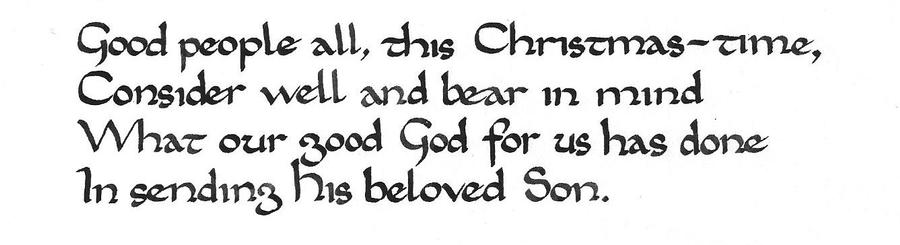
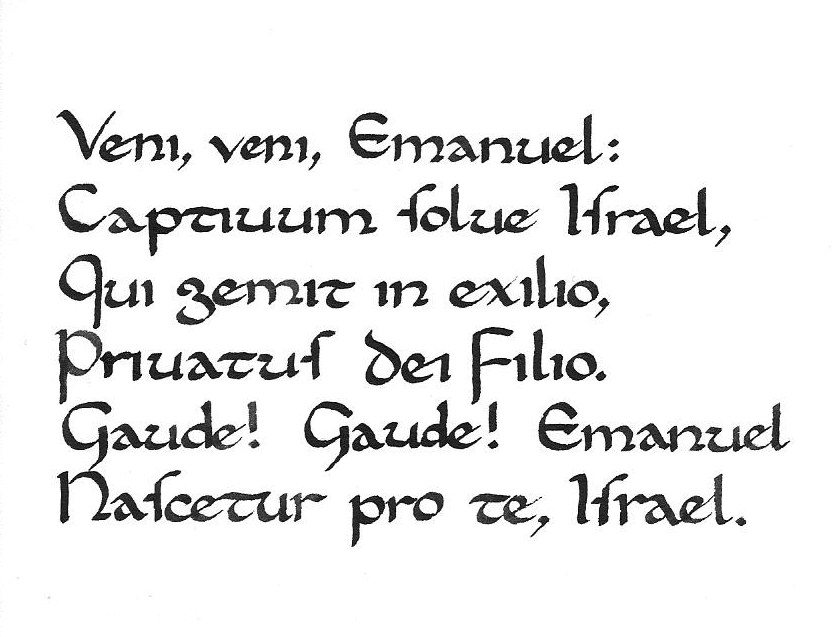
I haven't finished any of my planned Christmas calligraphy projects this year, but I'm going to post some calligraphy of Christmases past.  Looking back over my work, I can see that I have improved my technique, even though I still have much room for more improvement.

First, a section of the Wexford Carol, one of my favorites, that I did - oh, probably three years ago.

And this one, from about the same time, showing the same shaky penmanship and indecisive long "s" (though I'm not sure how much better my current forms are):


Finally, a translation of the Magnificat, which I did as a gift for someone, also in 2012.  This was a bit of work: I translated it into one of the languages in the novel I'm writing, which required some last-minute invention of words and grammar, and then I had to write the thing out carefully and neatly.  At least in this script you have no other specimen to judge it against.  Here it is, enjoy!

Wednesday, December 2, 2015

My grandmother's unfinished work (including a scanned typewritten page)

Lately I've been going through some old family papers.  There was a time, not so long ago, where I worked full-time as a professional archivist.  Since then I've kept my hand in with some side projects, and this is the latest one.  As with any project involving personal or family papers, there are easier parts (like sorting letters) and then there are the perplexities - in this case, my grandmother's writing.

My paternal grandmother was born in Salina, Utah (how many of you reading this have heard of it?) and had an expansive and curious mind.  She wrote poetry, drew and painted, as her time allowed while raising children and keeping house, and when her children were grown she went back to school, where she planned on writing a Master's thesis on the history of her hometown.  She never finished it, but she left a quantity of handwritten notes and drafts, including many typewritten pages with corrections and revisions.  Working with all this has reminded me forcefully of a collection I worked with in my former archives job: the manuscripts and research notes of another woman who had attempted to write a history of her hometown and left it unfinished at her death.

I wrote about it on another blog I maintained at the time, commenting on the tendencies I saw in her methods and the affinities I saw with my own.  My grandmother left behind much fewer notes and drafts - at least, much less material has come to me - but working with them is of course much more interesting to me.  I recognize in myself a wish that she showed to address a wide range of questions within the scope of what might seem a discreetly-defined subject.  Her research into her hometown's history seems to have swung wide to accommodate various reflections on sociology, economy and theology - not surprising, really, when you consider Salina's history as a Mormon Pioneer town.


I think that the work my grandmother left undone was motivated by either the same spirit or a similar one to what has been working in me for several years.  In my case, I'm attempting to express my ideas in fiction, and while I don't know how early on my grandmother began her work, I think of my age and my life responsibilities, and I don't want to let the rest of my life go by without finishing.  Maybe this can be one more motivator for me: to finish this for her sake as well as everything else.

Sunday, October 18, 2015

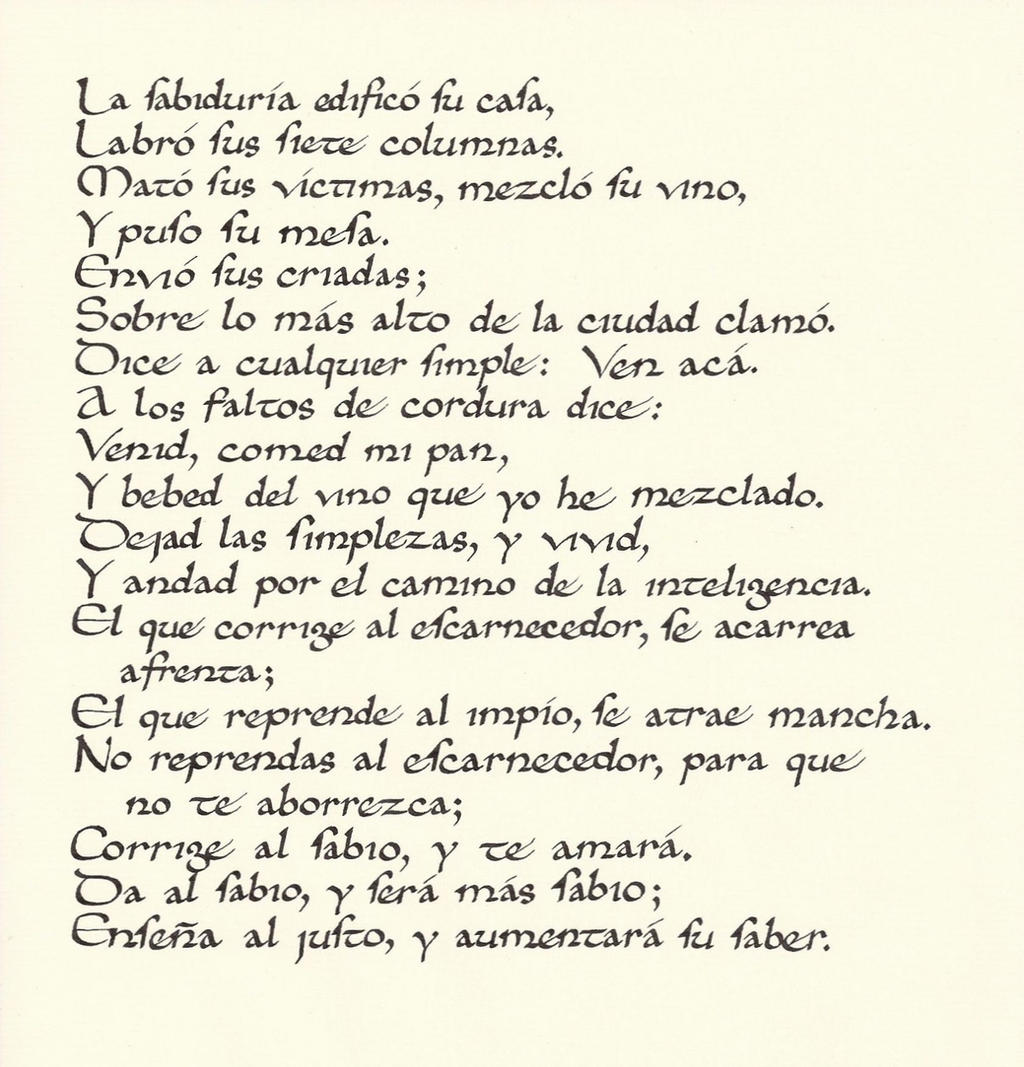
Quillcast: calligraphy: Proverbs 9 excerpt in Spanish

Chapter 9 of Proverbs has been one of my favorite passages of scripture since the summer of 1996 when I was reading through the Old Testament during a course of intensive ministerial training.  I've lettered it in English, and I'll do so again, I expect.  But I've also been wanting to letter more quotes in Spanish.  So here is the first part of Proverbs 9 from the 1960 Reina-Valera version.


Yes, I did this with a quill pen, one that I made myself.  (If you're interested in learning how to do really old-fashioned calligraphy, you can buy a quill pen from me on eBay or Etsy.)  It has taken me about six years to get to my current level of skill in lettering, and I'm still looking to improve.

Saturday, November 22, 2014

Typecast: Spiritual struggle


If you know any teenagers I highly recommend The Teenage Liberation Handbook by Grace Llewellyn.  There used to be an easily accessible PDF online, but I think it got taken down.

Saturday, July 19, 2014

A talk I gave in church last year

 Brace yourselves, because I'm going to tell a J. Golden Kimball story. Like all folklore, this has several versions. Here's one.

One day Elder Kimball was waiting for a chance to cross the street near Temple Square. When he thought the coast was clear he stepped into the street, but at that moment a car whooshed by him, narrowly missing his leg. Shaking his fist at the retreating car he shouted “Damn you!  Have you no respect for the priesthood?”

I'm going to approach the topic of priesthood by talking about respect, and about authority. Now there was a time when an idea of “respect for authority” was very important to me, but those days are gone. My growing respect for children of God has broken down my misplaced reverence for the authority they have a bad habit of presuming. At the same time though, my respect for the priesthood has strengthened, and in the next few minutes I'll try to explain this.

There is cause for confusion in the word “respect,” the first of several that I will dissect. The original Latin meaning – to look back – has grown several branches after being grafted into our mongrel tongue. In one sense it can mean treating someone partially – with exclusive favor, as a result of their wealth, class, ethnicity, credentials, whatever. The apostle James warned against this in his letter to the primitive Church. When Cornelius was converted, Peter had a vision that showed him that “God is no respecter of persons,” in other words, not one to show partiality. “All are alike unto God,” we read from Nephi. In Luke we read from Mary, mother of Jesus: “He hath scattered the proud in the imagination of their hearts. He hath put down the mighty from their seats, and exalted them of low degree.”

God is not impressed by whatever priesthood titles we claim either, as is clear in the final segment of Section 121, that essential text for proper priesthood conduct amplifying the words of Peter and James: “God resisteth the proud, but giveth grace unto the humble.”

It seems that for every abstract concept expressed by our language, there are pure and corrupt meanings. Someone recently wrote a definition of respect that covers a wide span, and rings true for me:

“To respect is to understand that the other person is not you, not an extension of you, not a reflection of you, not your toy, not your pet, not your product. In a relationship of respect, your task is to understand the other person as a unique individual and learn how to mesh your needs with his or hers . . . Your task is not to control the other person . . .”

In this sense I am satisfied that our Heavenly Father respects all of us quite deeply, particularly children. Let us never forget the special attention Jesus showed to them.

Modern revelations are quite clear about the Lord's respect for our agency. Alma the younger caught himself in a sinful wish to make everyone repent, which came from his commendable missionary zeal. I would never accuse him of unrighteous dominion, but he reminds us how easily even our love for others can erase our respect for them. He looked back and remembered that the choices other people made were not really his business: his business, and ours, is to perhaps bring a soul to repentance. Not to force a man to heaven, nor to demand that others recognize my right to their favor. You look again and see children of God for what they are: spirits which, in kinship with God, naturally wish to follow God's will. A true dominion is born from such respect, flowing “without compulsory means” from spirits who know that your love for them is stronger than death. For some, that takes a long time.

But this is available to all who will take the time to watch themselves as King Benjamin urged. You really can respect people even without feeling the slightest admiration toward them. In fact, does not admiration also lure us toward a corruption of true respect? Because to regard someone as an ideal figure denies their full dimensions as a fellow human being.

And of course, when we watch ourselves, we see also the sin in trying to control or impede another's life as revenge for hurting our feelings or not giving us what we want.

“Without compulsory means.” That phrase is one of my strongest anchors. William Blake wrote: “prisons are built with stones of law,” which you could parse as a powerful paraphrase of Paul: “the letter killeth, but the spirit giveth life” (2 Cor 3:6). Compulsion spawns defiance as your hand casts a shadow in the light: much of what we call “discipline” is a fundamental insult to a spirit that comes, as another William, Wordsworth, wrote:

“from God, who is our home:
Heaven lies about us in our infancy!
Shades of the prison-house begin to close
Upon the growing Boy” . . .

May God have mercy on us all.

If you grow up being “compelled in all things” (Section 58:26), with scant chance to develop beyond the role of slothful servant, it becomes very difficult to find out who you really are. The concept that command and comply is the bedrock of human society sets a course which, depending on your temperament, leads to a role of oppressor or oppressed – or both. You may come to believe that all your feelings are dependent on external approval, and then you will be ripe for the picking by con artists. I speak from experience, and that might help you understand the source of my own authority problem.

There is no shortage of people willing to tell you what they think you should do. But telling you “all things what ye should do” belongs to the words of Christ, given by the Holy Ghost, which, as Nephi reminds us, is a gift we all receive after baptism.

Questioning authority in fact has good scriptural precedent: “trust no one to be your teacher nor your minister,” says Alma, “except he be a man of God, walking in his ways and keeping his commandments” (Mosiah 23:14). He said this to a group of people who had just fled from their kingdom after breaking the law of their sovereign. What's more, this sovereign operated under what, by all indicators, was a theocratic order. When he went against the principles of righteousness he didn't do away with priests, he “consecrated new ones . . . such as were lifted up in the pride of their hearts” (Mosiah 11:5). And most of the people, used to following a king as a religious authority, were “caught in a snare” (Mosiah 23:9). No wonder Alma did his best to deprogram the 450 who broke away: “stand fast in this liberty wherewith ye have been made free,” he said, “trust no man to be a king over you” (verse 13). Years later, king Mosiah the second dismantled the monarchy that had been in place for half a millennium, “that the burden should come upon all the people, that every man might bear his part. . . . Therefore they relinquished their desires for a king, and became exceedingly anxious that every man should have an equal chance throughout all the land; yea, and every man expressed a willingness to answer for his own sins. ”

Joseph Smith had his own authority problems, so I count myself in good company. “It is a love of liberty which inspires my soul” he said, “civil and religious liberty to the whole of the human race. Love of liberty was diffused into my soul by my grandfathers while they dandled me on their knees.” (Teachings: Joseph Smith, Chapter 29) And of course we have Captain Moroni's memorable letter to Pahoran: “we know not but what ye yourselves are seeking for authority . . . behold, I do not fear your power nor your authority, but it is my God whom I fear” (Alma 60:18, 28).

Authority, dominion, lordship, power, and related words: they all have histories, and they bear the scars of history. Throughout this web of interconnected meanings you'll find the same divergence between pure and corrupt. On the one hand, trust in the wisdom and goodwill of a respectful, exemplary elder; and on the other, the meddlesome impulse to despise or violate the agency of others.

You can follow a trail from the word “authority” through “author” and back to the Latin auctor, which, being interpreted, is "enlarger, founder, master, leader," literally "one who causes to grow,” cognate, in fact, with “augment.” While our “authority” has strayed from that meaning, you can discern traces of the concept in, for example, the way an author brings forth a book.

Hold that thought while I bring up a use of “authority” in library science – because if I wasted a ruinous sum of money on an advanced degree in that field, I might as well use it here. Actually I'm rather grateful to have learned the concept called authority control in library school. It's basically this: in order to help people find the book they're looking for, you have to come up with a standardized way of describing them. This means not only fixing the spellings, but all sorts of really picky specifications on how you phrase names and subjects. It's kind of like making sure that all the keys and locks are shaped just so, in order to open the right doors at the right time.

I think of such catalog control as a very crude mimic of something like DNA, which causes things to grow into the dazzling array of living things that we're so blessed to share the earth with. An analogy is irresistible here to the personal tree of life that Alma the younger called on the Zoramites to grow in their souls: Christ as the author of our faith causes this to grow within us as we “nurture it with great care” (Alma 32:37). But even with all of our nurturing we recognize that we are not the force behind the growth. We have authority to nurture and welcome the growth that proceeds from an eternal auctor, which is beyond mortal reach. “The wind bloweth where it listeth, and thou hearest the sound thereof, but canst not tell whence it cometh, and whither it goeth” (John 3:8).

All this is to try to invite our immersion in the lesson that Section 121 laments men's slowness to learn. We know it intellectually of course, but that is no guarantee at all that we will internalize it. It takes time and courage to quiet the mind enough to sift through all the inherited ideologies, bad habits, our comfortable illusions about ourselves, even the well-meaning praise of others, and get to touch on those “principles of righteousness” that hold the key to controlling and handling the powers of heaven, which show humanity's proudest achievements as mere child's play.

I mean no disrespect to the holy act of child's play!

The priesthood on the earth is a sort of apprenticeship, and as part of that, our master calls us, at a young age, to assume roles that seem beyond our years. Considering etymology again, we may recall that “deacon” comes from a Greek word meaning “servant;” and our modern English “priest” may be traced back to the word the Greek-speaking saints of Jesus' dispensation used for “elder.” We still call young men to be “elders” when our society has just legally recognized their adulthood: the Lord calls up a maturity which earthly powers too often fail to recognize or allow.

I remember my dear old mission president – whom we all loved so much that none of us wanted to disappoint him – asking us not to use the word “greenie” anymore and reminding us that we all have eternal spirits. “Let no man despise thy youth” - we remember the young age at which Joseph Smith had his first vision. We see examples of temporally young people rising to greatness throughout history. If we all can take upon us the name of Christ, then surely a boy of 12 can take on a role of greater age and wisdom than the state imagines.

How to take it on, how to shape our locks to fit these keys of age, assume the ageless splendor of our eternal spirits?

The maturity of the world, which discouraged children from bothering an important man like Jesus, is of limited use in this question. The principles of righteousness that Joseph Smith named are worthy of quiet and careful consideration by everyone, alone, from time to time. This list bears comparison with Paul's list of fruits of the Spirit in his letter to the Galatians: look it up, there's homework for you. I feel a resonance between all of these and Alma's teachings. How can you trust anyone to be your teacher or minister, unless that person shows persuasion, long-suffering, gentleness and meekness, love unfeigned, kindness, and pure knowledge? How can you trust someone unless you see them as lacking hypocrisy and guile?

The priesthood is administered on earth through a kind of authority control that we call keys. Keys are essential for opening locks, and often we lock doors or chests because there is treasure inside. The key is a device, a tool that allows you to get at what you're after. To quote an ancient Chinese archivist, in one of several translations:

Shape clay into a vessel;
It is the space within that makes it useful.

Priesthood keys may be conferred on a man quite easily at the right time, just as learning to read in an alphabetic script is simple when undertaken at the right time. To what end do we learn to read, or add and subtract, or build elaborate catalog schemes? Because they are keys that unlock treasures of knowledge. Without a clear framework to encode that knowledge, the lack of order would obstruct learning. Still, the treasures of knowledge are what give life to the letters; without those what good would it do to manipulate abstract marks, or worse, to subordinate our souls to strict structures?

I hope that the application of this metaphor is readily apparent, because it's time to close, and I wanted to close with one more thing about keys. I call to mind again the passage in 2 Nephi 32 that I mentioned earlier: “Do ye not remember that I said unto you that after ye had received the Holy Ghost ye could speak with the tongue of angels?”

John the Baptist told Joseph and Oliver that the Aaronic Priesthood holds the keys of the ministering of angels, and I am convinced that a significant part of this comes in the form of the acts of service we do for others. Certainly my family has been blessed abundantly by mortal angels who sit in this room and others. Their love has gained our gratitude, and I thank them for magnifying the priesthood.

 So let us all, in this apprenticeship of the priesthood, aspire to the errand of angels.

Thursday, February 27, 2014

Some thoughts after reading The Fountainhead

(One of these days I'll get back to typecasting.)

So I finally read The Fountainhead. I stayed up past 1 in the morning to finish it, and in fact I even cried at several points throughout. I want to buy my own copy of it and underline passages and write all sorts of things in the margins.


This book has been staring at me for about 20 years from library shelves, mostly through the editions with Art Deco covers. Those were terrifying Apollonian arrows pointing to a destiny that I put off for too long (like Thomas Pynchon, but that's another story). So finally I checked out a copy from the local library and got sucked in. Today, a day after reading it, I wrote the following.


Producers and parasites. In the Fountainhead Ayn Rand shows (somewhat melodramatically, but that isn't a bad thing) model characters or characters as models of these principal types in their purity. I find myself unable to dispute the core of the principles in their purity, but what I think is the cause for worry about Rand isn't the truth in the “selfishness” that is essential to every individual soul (and I want to write more about that, also parse Lehi's “men are that they might have joy” in relation to this), nor is it the core principle of whether one produces or not. Of course in real life when one person produces something and the rest of us benefit. I think of Robert Fripp's words: “Music so wishes to be heard that it calls on some to give it a voice and some to give it ears.” Civilization has been around long enough to make the manifestations of these principles – in pure and perverted forms – so complex that applying them to real-life situations entails doing everything you can to trace each economic interaction and relation back to its roots. This is why mainstream partisan politics are so dissatisfying, and why TV news and talk radio are such dismal ways to try to be informed about what's going on in the world and what you can do about it. This is also why parlor politics rarely if ever gets beyond a ritualistic bashing of everyone's favorite imagined villains, backed up with appeals to everyone's favorite authorities.


I've certainly seen Ayn Rand cast as a villain, a Korihor-like prophetess of greed and callousness. In the purity of her concepts, I accept that she wasn't advocating racism nor greed for money and power (at least not in The Fountainhead). On the contrary, she exposed those as betrayals of self, mere variations of “second-handedness.” So why does she get such a bad reputation? I haven't studied her Objectivist philosophy, so I don't know what else she wrote that attracted such ire, but I intuit the following scenario repeating countless times: a man goes out and makes a load of money in some business, reads Rand, and then says: look, I have made stuff, employed people, ergo I'm a producer. How many people completely miss the lesson of Gail Wynand? How easy it is to assume that the producers in society are not just the entrepreneurs (which is already too narrow) but the ones who have become wealthy. And how easy it is to use the label “parasite” as a politically correct justification for dismissing any concern or basic human empathy or at least rational consideration of whole swaths of people. Are they the ones making the money, making the jobs? Are they among the few, the proud captains of industry? No? Are they in misfortune, are they (or do we see them as) dependent on any kind of assistance? Do they have the impudence to procreate without having steady means of their own self-sufficient heroic make to support them materially (according to our standard of living)? Yes? Why then they're parasites. Q.E.D. And we don't have to worry that we're being racist by going along with the wink-wink nudge-nudge because Rand (or whoever) Said, so we're absolved of any effect our actions have of perpetuating collectivist oppression. Of course we'll put ourselves in the camp of producers as we whine in our parlor talk or radio call-ins or at the voting booth, even if we're working at jobs we don't really want, even if our political involvement is really an attempt to prop up some sense of meaning in our desperate lives, because we think we Get It. It's so easy to slip into this.


If there are people living in poverty we don't have to cathect to our images of them in a show of pity and meddlesome “charity,” but neither do we have to dismiss them as feckless failures because they're not all independent workers (though what if we all could be?), with the gumption to stick with their work through the tough times without complaint, facing the world alone like Roark did until enough of us finally come around to reward their contributions (through fair media of exchange that might not be available, which we might not want to admit).


Everyone is born with their own gift to give to the world, and some are more prominent than others (after reading The Fountainhead I feel I now accept the parable of the talents better, and have a new appreciation for Alma's mission to the Zoramites too), but it has to be remembered and acknowledged that the forces that so stifled the gifts of the producers included entrenched money interests, impersonal boards of directors and other features of the capitalist system. How easy it still is for second-handers at the helms of powerful corporations to cravenly claim that they are the real producers, while continuing to suffocate the world under mediocrity. It's no longer drippy Progressive preaching of self-sacrifice, it's brazen praise for “self-interest,” meaning the appetites and dictates of false, non-individuating selves: blind egos, contemptuous introjects, unacknowledged complexes, possessive archetypes – but not the true soul of every Self. A lazy appropriation of the terms of “self-interest” and “selfishness” makes it so easy to fall back into the conventional semantics that Rand took so much trouble to take apart that I wonder if it was worth her trouble and she might as well have coined a new term.


For a similar reason I currently have no interest in Objectivism as a philosophical system, because it still stinks to me of Intellectual Property, which I don't believe in. Looking briefly at the character of Roark: there is no need to impose a fiction of “intellectual property” on the architectural designs of someone with such a unique vision. If someone were to copy one of his buildings it would be imitation as tribute, flattery or incompetent servility – but it would not be theft. It means much that Rand includes the dialogue about individual private ownerships of our experiences with the world: Roark owns his buildings irrevocably, but so do those who use them or even see them, each in their own inviolate way. For Roark to act like too many so-called libertarians do, he would have to post guards outside all of his buildings to charge fees for walking in or even looking at them.


This has to do also with the struggle I've long had with reading or talking about philosophy. I like reading about it, and about psychology, and I don't dispute giving credit where due. But I return often to the words of Montaigne (in translation): “Truth and reason are common to every one, and are no more his who spake them first, than his who speaks them after: 'tis no more according to Plato, than according to me, since both he and I equally see and understand them.” (Essays Chapter XXV “Of the Education of Children” trans. Charles Cotton)


Even Howard Roark, who others see as cold and antisocial, takes for granted that if you saw a drowning man you would try to rescue him. It means a lot that in connection with this, when the young Gail Wynand is crawling along the sidewalk after being beaten nearly to death, the one person he asks for help dismisses him in “bovine indifference.” That adjective is important, because it is certainly an inhuman act to be so callous towards a fellow being. Rand showed this here and I'm glad to have read the book in order to have seen her acknowledgment of this truth.


Even so, the fact that she spent so much effort justifying her unorthodox use of phrases like “self-interest” and “selfishness” might not be enough to defeat this danger: the bare words stick in minds when their substance has ebbed, and then people are quick to attribute the conventional meanings to them and justify their inhumanity by the same kind of servility to a creed, this time a secular one: Rand – or whoever – Says. It is the exact same phenomenon as “the Scriptures say.” Any such vague appeals to authority should immediately put your internal radar on the alert. I can't help but think of the parable of the Samaritan when I read that episode in Wynand's youth, and I don't know if Rand had it in mind, but I'm glad she didn't have the scene take place at the door of a church, with a reverend wrinkling his nose at the human trash importuning him and slamming the door. Whether Rand meant to or not, she shows respect to Jesus' parable here, by letting it stand as a definitive statement of how religion so often leads people to do evil. She respected the parable by rounding it out, and showing how the betrayal of self which leads to such callousness can come from other sources besides religion.


The bar-keeper's refusal to help the young gangster is a betrayal of himself. It seems like selfishness and most of us would describe it as such, but it's the same kind of second-handedness that the young victim swallows and which sets him off on his meteoric rise to power. In refusing to help a young man nearly dead at his doorstep, the barkeeper is not listening to his human self in recognition of another human self, he is listening to the blindness of an ego that pits itself against others, that judges the worth of souls according to criteria inherited and accepted from others without question: gangsters, street trash, worthless. This is the turning point in Gail's life, when his refusal to accept incompetence fermented into his resolve to rule. Who knows what his career might have looked like if he hadn't started it out with such a foundation, and if whatever enterprise he began allowed room for other producers to work within it true to themselves? Do I mean something like Silicon Valley? Well, what would it take for such conditions to flourish and purify all over, not just in such pockets of privilege? I find answers to that question in E.F. Schumacher, Ivan Illich, Kevin Carson and others. For one thing, you can't get there with so much of human knowledge and invention locked up in copyrights and patents.


My working hypothesis is that most of the wealthy businessmen who are so adored by conservatives and so-called libertarians are more like Gail Wynand than Howard Roark. I wonder what kind of world we would have if half of them had the courage to make the kind of restitution that Wynand makes at the end of the book. Are Carnegie libraries enough?


One of the features in Roark's design that makes him so pure is that while those around him see him as a hero struggling against the world, he doesn't. He refuses to accept the charge of defiance that others try to pin on him, or even to feel the resentment that others feel in his behalf. He doesn't do his work out of defiance (as Wynand does), he does his work because he has to. When his first buildings go up, he faces accusations of faddishness, willful whimsy – the kind of thing that has put up monstrosities like the Information ScienceBuilding at the University of Pittsburgh. But through the book, it is evident that his love for buildings is inextricably linked with human empathy: he designs buildings with the consideration of what it will be like to inhabit them. The concern for others may be unconscious but is none the less powerful for that – in fact it may be its unconsciousness that makes it so effective. After Roark finishes the Heller house, his client says “You were very considerate of me.” Roark replies: “I haven't thought of you at all. I thought of the house. . . . Perhaps that's why I knew how to be considerate of you.”


One of the bits that brought tears to my eyes was where he sat with Dominique watching one of his buildings go up – a humble five-story store in an insignificant Midwestern town – and she expresses misguided sorrow at seeing such a brilliant architect stuck doing such insignificant buildings. He points out that it doesn't matter: he loves each building for its own sake. In fact, it bugged me, reading the book, that his Stoddard Temple of the Human Spirit is built so close to the earth, at such a human scale, as opposed to the intimidating grandeur of religious buildings throughout history which always tried to make people feel small and despicable (and there my straw man alert sounded the loudest of any point in the book), yet of course Rand has to have her characters gush about skyscrapers. And of course she also takes pains to qualify how skyscrapers don't make Wynand feel small but give him a sense of the “heroic in man.” What if the Stoddard Temple had been a tall skyscraper then?


When I read the part about the Stoddard Temple I thought of one of my Humanities teachers talking about Gothic cathedrals: their uplifting effect on the spirit as opposed to the intimidation of the older Romanesque buildings. Stepping into a Gothic cathedral, he said, is like getting on board a spaceship. (And it's interesting how Gothic architecture gets such scant mention in the novel.) I think I have come to respect skyscrapers in the way that Camille Paglia respects religion, but I'd still prefer a Gothic cathedral, or something like Simon and Jasmine Dale build – or Jung's Bollingen Tower. There's a temple of the human spirit for you!


The triumphant ending of The Fountainhead brought tears to my eyes, but it wasn't because the Wynand Building was the tallest on the earth. For me, Roark's greatest triumph is Monadnock Valley. That triumph flows from an explicit empathy for a human need, as Roark himself expresses in his presentation to the developers. By doing his work he has performed a true service to his fellow beings. So when later he lectures Peter Keating about how his design of Cortlandt Homes won't be motivated by concern for the poor slum-dwellers, I know what Rand means, and I accept that she felt the need to clear away the fog of Progressive sentimentality that surrounded her when she wrote. But it still reflects the truth that when you do find your own life's work and purpose, and are true to it, you inevitably benefit others – and I affirm the rightness of rejoicing in that and calling to that, even as I agree that boasting of it and taking it up as a sign of superiority over others corrupts it.

I choose to take as a sign of maturity that when I read the portrayals of sentimental praise for “the common man” in The Fountainhead, I didn't so much protest with the youthful idealism I might have once had – hey what's wrong with the common man? – but I reflected on the soul-sucking effects of state-imposed mass instruction, standardized testing and Common Core standards (which of course award lucrative contracts to a few winning business interests – are those people then Producers? Hell no!). I thought of an editorial by a retired teacher: “Please widen achievement gaps.” I thought of Sudbury Valley School and its dedication to democratic order which produces uncommon people, of Daniel Greenberg's statement that a right to vote is meaningless without mutual respect, of the self-fulfilling fear of mob rule by those who exercise their right to vote without exercising their brains.


“You are unique – just like everyone else.” “If everyone's special, no one is.” Such sarcasm is, to quote Jung, “the prerogative of habitual grumblers with bad digestions” (“Psychology and Religion” trans. R.F.C. Hull, Collected Works vol. 11, p. 105). Take time to reflect and to imagine what a world might look like where everyone really was equal in their right and opportunity to be unique. Let that dissolve the justifications you've accepted of everything that chokes such individuality – not only prevailing fashions in dress and so on, but the political and economic structures that support those who arrogate to themselves the undeserved title of Producers and betray themselves in imposing their mediocrity on the rest of us with state-backed protections of their so-called property.


 Ayn Rand might turn in her grave, but she is in agreement with Alma the younger in this: the outrage and impatience that come from seeing just how badly the world is run, how much individual human potential is wasted, should not be taken as an excuse to hate, but should strengthen the resolve of each of us to dedicate ourselves to the growth of our individual souls. Alma's tree metaphor (like that of the wise and foolish virgins) is self-centered in that way: you are the only one who can grow that tree, and you are the only one who can eat of its fruit.


So now I wonder if I'll go find out who John Galt is.


Also I have to wonder if Blixa Bargeld or any of his bandmates ever read the book.