(I took the header picture of a Common Loon resting on a pond in Utah on its way north in June of 2015. It was in transition from winter to summer plumage.)

Translate - I dare you. Then make a comment on the funny errors the translator made.

Showing posts with label Identity. Show all posts

Monday, November 21, 2016

Quill/brasscast: Thoughts about roots, cut short

I wrote this with a quill and with two metal nibs, trying out some "new" old paper, while keeping track of a two-year-old.


Sunday, August 14, 2016

More heart's blood

I mentioned in a previous post a regrettable decline in pioneer values that I perceive in the developing towns along the Wasatch Front.  Where I live you can see a curious mix of old houses in reasonably good shape, decrepit buildings where closed businesses once stood, and newer stores, office buildings and roads built to accommodate and encourage the post-industrialist consumer lifestyle of today.  It is always sad to me to see how often the older buildings with a cozier, more human, more convivial spirit to them get left to decay and then swept aside, or re-purposed: along one length of a principal street are several lovely old houses that now hold retail businesses (existing perhaps tenuously) or professional offices.

To me this is all a betrayal and defeat of the vision that settled this area, and to my view an honest assessment of the current social and economic order of the Mormon heartland must confess that we have a sad state of affairs.  Land that could be productive, used to house people in modesty, industry and communal self-reliance is regularly parceled out to build luxurious dwellings at obscene prices.  Small businesses feel they must curry favor with the trendy whims of indifferent consumers in order to survive: it is harder and harder to count on a robust spirit of 2 Nephi 26:30 to keep any enterprise afloat (and you can just forget about verse 31).

An unreflective enthusiasm for a gospel of growth and prosperity gives carte blanche to expressions of arrogance and greed that are embarrassing and insulting to an idealistic viewer.  I think it no coincidence that Hugh Nibley wasn't allowed to fulfill a career of scholarly inquiry and social criticism in peace without his persona and legacy being yanked into extremes of adulatory folklore and allegations of the most sordid private sins: our culture has little tolerance and less use for principled and consistent critiques.  And attempted critiques regularly veer into reactionary political stances, which I also find very sad and self-defeating.

But I realize too that self-reliance is hard, and not exciting or sexy.  I think a great deal of the consumer mindset that produces such callous effects worldwide in fact is rooted in the desire for miraculous deliverance: how wonderful it is, after all, to see something like a new restaurant arise from the ground, and to spread its large printed advertisements across the land for miles, with no effort from me!  Is it not something like an experience of grace, to be able to simply walk into a clean, climate-controlled, brightly-lit and fragrant space, with nothing required of me other than to be served, to make my selection, and then have the freedom to leave in search of another similar environment?  Granted, we have to pay for the things we get here, but beyond the money we part with for specific goods and services, the larger message is of this abundance from above and afar: these brands, these buildings, this infrastructure comes to us, lifts us up, and asks nothing more of the worthy among us other than an attentive duty to the specialized abstracted tasks laid out before us in yet another climate-controlled and brightly-lit space.

I think that all this truly fees like heaven to many, many people, in an unconscious or at least little-examined way.  My conscience, in exercise with my intellect, is still set against it, but I have a clearer understanding of it now.

Monday, May 16, 2016

Sticks!

Another of my articles has appeared on the Jung Society of Utah blog today.  Since I always have limited space on the blog there, I decided I'd write a little bit more about my sticks here.

I've finished two sticks in the past year: a sort of baton or wand of apricot for myself, and a walking stick of plum for my sweetie.
 
Part of the apricot baton . . .

. . . and part of the plum walking stick.

I'm particularly pleased with the plum: it came out looking like a walking stick I might see at a gift shop in a park (except that I finished it with oil and beeswax instead of polyurethane or something like that).  It wasn't complicated to make at all: just took some time and care.  That's the best thing about working with sticks, I think: you don't have to be a master craftsman, you just have to take time and care, and I think it especially helps to be in tune with your inner child.
 
The wide tip of the baton, showing the piece of sodalite that I mounted in it.
When I was a boy, I loved whittling sticks.  That was part of their appeal: with a pocket knife I could not only shave away outer layers of bark and grime to let the beauty of the wood shine through, I could also sharpen a stick to a crude spear point, and I had a weapon that has cost me nothing. When you're a child on a camping trip, in woods that might be full of cougars, bears or (especially) monsters, this gives a tremendous sense of security.

I think it would be a cheap and nasty dismissal to assign some kind of crude phallic meaning to this fascination with sticks (although I'm open to the idea of symbolic resonance of that sort in wands and scepters). I don't want to get into a rationalistic picking apart of this fascination with sticks in an attempt to explain it. There are some things that it is well to explain, but others it does your soul more good to just do.

Sunday, March 20, 2016

The Provo City Center Temple

This afternoon my sweetie and I attended the dedication of the new Provo City Center Temple.  It was done in three sessions and we attended the third, broadcast into a meetinghouse in the town where we live that isn't Provo: I don't think there were regular church meetings anywhere in Utah today, at least not along the Wasatch Front.

They made such an effort to let as many take part in the dedication because this temple has a unique history.  It was built in the shell of an old building that used to be a tabernacle.

The old Mormon pioneer tabernacles are some of my favorite things.  I don't know how many survive now, but for years I've thought I'd like to take a tour of them.  They're essentially large meeting halls, with two levels of seats, and are often used for cultural events as well as church meetings.  The big dome-topped Tabernacle on Temple Square is probably the most famous, and the biggest (at least before the humongous conference center was built).  But the buildings I'm talking about are more like the smaller Assembly Hall on Temple Square.  Several of them were built with Gothic Revival architectural style or influence.

I loved the Provo Tabernacle, ever since moving back to Provo in 1994 and attending various concerts there.  When I heard the news of the fire that gutted it in 2010 I was devastated, as were countless others.  And I thought: the Church should restore it, but it probably won't.  So I was also glad with countless others when the plans were announced the following year to not only restore it, but to turn it into a Temple.

We went through it during the open house, and I have never been in another Temple that I have found as beautiful or moving.  The stained glass windows, the decorative motif of four-petaled flowers, quartered circles . . . dare we even say, crosses?  And all the wood!  There's wood everywhere, stained a rich warm homey brown.  We call Temples the House of the Lord, and this one really does feel like God's living room.  The pictures linked above don't really do it justice.

I can't deny feeling a certain sense of loss at this beauty - flawless and immaculate, but cozy - being reserved for a Temple instead of in a building kept open to public access.  I comfort myself with the thought of the other tabernacles still standing.  And it's also comforting to see a Temple displaying more hobbit-like charm than the cold white-on-white austerity that has been the norm for so long.  I like to think that it's a sign that the culture of the Church is changing for the better.

It's slow though.  There are complex meanings and signals I see in a place like this.  Mormons love luxury, even when they're indulging in pioneer fantasies, and I see a perfect example of that in the interior of this building.  I believe in comfort, in abundance, in wealth, even - but I believe in it as an ideal to be socially made and shared.  And as I see it, that was the ideology that drove those pioneers to make such improbable structures in their frontier settlements.  For a group of people in a place with no infrastructure to speak of to pool their resources and coordinate their labor to raise the most beautiful buildings they could, in brick or even granite, instead of slapping up cheap board facades . . . I understand and share the indignation that Mormons felt when the railroads brought the Gentile rabble from the east with their piddly, trashy saloons.

The tabernacles stand to me as a signal of hope in the promise of collective and cooperative enterprise, an ideal that our culture has for the most part turned away from with a multitude of blindly individualistic sneers, simultaneously gentrifying and uglifying what was supposed to be a Zion society.  To see those empty brick walls held up and filled with something that is so obviously a tribute to the spirit of those early days (even if the work of building was done by hirelings instead of by community effort), and offered up to God, is another sign of hope in my eyes.

Thursday, February 18, 2016

My Sigur Rós fantasies, part 2 (or, brass buttons)

Brass buttons!  I have a navy peacoat that has brass buttons.  My sister gave it to me over 20 years ago and it used to fit me very nicely.  The thick wool is like armor.  It's shapewear, really: can you tell in this picture that I was overweight?

In Boston, at the birthplace of a great-great grandfather, 1998
Trench coats or dusters are a standard nerd uniform, but they don't have anywhere near the panache of thick wool and brass buttons.  I've decided that if I'm going to be odd, I'd rather do it in a way that aspired to an absolute elegance.

When Sigur Rós released Kveikur in 2012, I held off from getting it for a while, because I was sad that Kjartan had left.  But it's become one of my favorites - especially "Stormur" and "Bláþráður" which share a very similar sound.

In the video for "Glosoli" from their 2006 release Takk, a drummer boy in an old military-style coat leads a group of children.


And the band members have sported costumes reminiscent of military uniforms (or marching band - anyway, with lots of buttons):


Maybe that's why, when I listen to "Stormur" and "Bláþráður," I feel like some kind of fabulous cosmic dragoon, decked out in a splendid coat of sober color, with the thick wool covering a body formed in appropriately manly proportions.  Somewhat like that drummer boy, I imagine myself soaring above the landscape, taking in the vastness of it, or marching along on some purposeful errand - or maybe just on one of my hikes (I'll write more about that later).

I mentioned that my coat feels like armor.  In fact, I credit part of the impetus for my novel in progress to that coat: the refinement and elegance of industrialized aesthetics that produced the clean lines of such a coat (instead of the sweeping curves of 18th-century military dress) attract me greatly, but I wanted to visualize a society that could achieve this sort of thing - and early industrial technology - but without the dehumanizing weapons of modern warfare.  I imagined trains, wool coats, brass buttons and sabers - without firearms.

This was in my head long before I ever heard of steampunk - and my vision was of a cleaner look than the clutter I often see in steampunk illustration and cosplay.  It's been interesting to observe emanations of my teenage visions appearing in contemporary fantasy - from the Mistborn Trilogy to Frozen.

Frozen: Scandinavian aesthetics.  Is this my Danish background coming through?  I saw Babette's Feast for the first time in college, and those snappy military uniforms made quite an impression.  (One of my favorite scenes also is where the storekeeper puts on his postal hat to deliver a letter.)  I grew up in a household with Danish furniture and utensils and so maybe I imbibed an appreciation for Nordic design that way.

I also grew up in a family where we were expected to dress up for many occasions.  This meant that I quite often wore a blazer - and hated it.  I think back on this as something like the way I hated math, even though I was good at it, and for a time even was a member of a competitive "Math League" in junior high.  It turned out that wearing a navy blue wool jacket - with brass buttons - was ideal for playing soldiers after church.  Perhaps I would have been mollified more often in my father's dress code requirements had he appealed to that sense of fantasy - you don't have to dress up, you get to do cosplay.  After all, I did find his old military gear and regalia irresistible, and I have enjoyed dressing in olive and khaki, despite my pacifism.
 
Minneopa State Park, Mankato, Minnesota, 1999

But that's another story. 
 (This post contains affiliate links, which I put in whenever and however I like.  Click or don't, as you wish.)

Sunday, February 14, 2016

I can't quit science fiction: LTUE 2016

(This post is quite unpolished, but I'm putting it up anyway, because if I wait too long it won't be as relevant.)
I just got done with another year of Life, the Universe, and Everything, the annual science fiction and fantasy symposium held in Provo every February.  I've been involved with this on and off over the years ever since attending my first one in 1995.  While in college in the late 1990s I served on the planning committee, and now that I'm living in the area again I hope to serve on the committee for next year's meeting.

This thing has been going on since 1983.  It's a symposium, or supposed to be.  I haven't observed it continuously for the past 20 years because I've been away for such large gaps, but when I think back on the times I attended in the 1990s and the last few years, I perceive some differences.  Subcultures of science fiction and fantasy appreciation have grown immensely since I was a teenager, with people scrambling to claim the title of "geek" as a badge of honor.  My memory might be distorted, but from what I recall, this did not happen in 1994.

Now there are multiplying fandoms burgeoning with eager new geeks.  I have relatives who number among these, but they're nowhere near as hardcore as the people at LTUE.  Here you see the older generations of nerds: people who were nerds before it was cool.  And now they bring their children.  Fandom and geekdom might be getting popular, but these people are the real deal and they still don't blend in to the mainstream.

I'm reminded of a Cory Doctorow essay I read:

Standing in Melbourne airport on the day before this year’s World Science Fiction convention, I found myself playing the familiar road-game known to all who travel to cons: spot the fan. Sometimes, “spot the fan” is pitched as a pejorative, a bit of fun at fannish expense, a sneer about the fannish BMI, B-O, and general hairiness.
. . . 
Looking for fans isn’t just about looking for heavyset people, or guys with big beards, or people who are sloppily dressed. Looking for fans is about looking for people who appear to have given a great deal of thought to how they dress and what they’re doing, and who have, in the process of applying all this thought to their daily lives, concluded that they would like to behave differently from the norm. It is about spotting people who are dressed as they are not because of fashion, nor because of aspiration, but because they have decided, quite deliberately, that this is the best thing for them to wear.  ("A Cosmopolitan Literature for a Cosmopolitan Web," from Context, available here for free download)

I've thought a lot about wearing costumes to LTUE - some people do.  It's nowhere near as extreme as, say, DragonCon.  It's really not a convention, but I perceive an entropic sort of impulse to devolve it into simply a time and place for misunderstood people to geek out.  I've seen these forces operating since I started attending, and that's part of what drives me to want to stay involved: I want to help maintain its academic mission, keep it focused on and aspiring toward academic rigor.  Along with that goes a recognition of what Cory wrote, and a realization of why I can't stay away from speculative fiction: in its purity, this isn't about pumping out infinite pulpy repetitions of predictable escape fantasies, it's about exploring ideas - and for me, ultimately, it's about imagining how this world might be different - better.

Mormon SF/F fandom - the old kind - is a strange and wonderful subculture.  I don't wholly fit in, and I have my frustrations with it, but I feel at ease there (more at ease than in mainstream Mormon culture for sure).  Despite the many ways I see the culture falling short of what I see as its potential - or because of them - I am drawn back again and again, and after attending LTUE this year I feel even more strongly oriented to who and what I am.

Thursday, February 4, 2016

My Sigur Rós fantasies, part 1

(Part 1: Introduction)

I discovered Sigur Rós in 2001, right as they were starting to make big waves across the Atlantic.  Like countless other 20-somethings, I swooned to "Svefn-g-englar" in my candlelit bachelor apartment.  I saw them perform in DC that year, and after the show I stuck around to bug them.  I remember talking to Orri as he smoked and looked around as if he couldn't wait to finish talking with me and get on with the rest of his evening.  As I was leaving the venue I spotted Kjartan and called out "Thanks for the show!"  "No problem," he replied.

Afterwards I felt foolish.  I already knew about fame and how it puts sensible musicians on their guard (I listen to Rush, for heaven's sake).  Watching the interview sections in Heima I was reminded of that.  When people make music that reaches a large audience, their music comes to mean many things for all those different people, and that means there has to be a boundary set up, to prevent the listeners from imposing their projections on their fellow human beings who make the music, who have their own separate lives.

I recognize this, and despite my seven-year-old daughter's wish to fly to Iceland and visit Jónsi (yes, she's a fan too, like many children, as I understand) I know that most likely I'll never be in the same room with those guys again and that I have no right to expect that just because I like their music they'd want to be my friends.

But in my own personal take on their music, and my own interaction with the copy of the version of their persona that reaches me, Sigur Rós is my band in a way that few others are.  For one thing, those guys are my age (I'm not quite two months older than Orri).  Right now the only other band I can think of that I listen to, with members my age, is Aloha.  Since I discovered them I've followed them through the phases of the twenties and thirties, and I've had moments of deep empathetic resonance (which again I recognize can only go so far).  For example, when I saw a clip of their second film Inni, especially with Orri wearing that crown of his.  I can't quite explain, but something in that sight struck me with a deep familiarity.  What was it?  I don't know if I can explain.


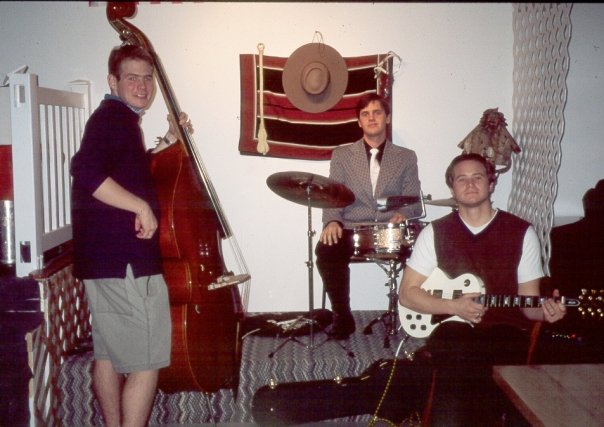
Maybe it was a simple recognition of the impulse to dress up when playing the drums.  I have done my share of theatrical self-presentation as a drummer:


And as I wrote not too long ago, I have been feeling this desire for more personal adornment lately.  I wonder how much of it comes from my approaching middle age.  I've been wearing jeans and t-shirts for over 20 years, and as I see more grey hairs in the mirror, not only do I feel a wish to present myself to the world with a dignity and a distinction, but I still have enough of my youthful idealism and turn-of-the-century experience that I want my distinction and dignity to be something more universal, more human, more psychologically whole than the dominant image of the businessman of the 20th century industrialized world.

Sporting my rainforest jasper pendant, brass cuff and a homemade bead bracelet.
  So seeing Orri in that garb was an affirmation, but I could say it was a reminder of our collective mortality also.  However I might explain it, something clicked as I watched, spoke a kind of resigned peace to my mind: these guys will grow old too, as I will.  Watching this with the benefit of my limited experience in a drum chair on the stage, and with the amplification of my own imaginings, I felt I was arriving at a better understanding of what it looks like "from both sides now" to be a creator who reaches a large audience - a goal I still aspire to.

It helps to sweep away even more of the hero-worship that held sway over me in my youth.

I'm going to write in later posts about some of the things their music means to me.  After all, they have encouraged this, with the wordless liner notes and title-less tracks of their third album, and their experimental video projects.  So this is the introduction and there will be more to come in this series.

Wednesday, February 3, 2016

"It's hard to be humble . . . when you're Danish"

I'm still working on my grandmother's research notes.  Today I'm in the local library, with a carrel by the window and Dietrich Fischer-Dieskau singing Schubert on my headphones.  It's nice.

I just found some notes she took from William James - I like William James.  I had started to read The Varieties of Religious Experience a couple of years ago, and this reminds me I ought to try to finish it.  (You can get it for free on Project Gutenberg.)

These notes were bundled with some drafts she had written about Danish history.  My great-grandmother was born in Utah to parents who had recently immigrated from Denmark - Scandinavia supplied a huge number of Mormon immigrants in the early days.  My great-great-grandfather, in fact, was called as a missionary to southern Minnesota (where I also lived for 12 years) and met many fellow Danes there.

So my father has one Danish grandparent, and my mother does too.  And I can feel a certain pride in that heritage when my grandmother wrote: "Denmark came to appreciate and give worth to peace.  She developed ways by which peace could be maintained without aggressiveness in conquest and control of other nations."

I have felt a lot of pride in my Danish heritage and hope to go visit Denmark some day.  I continue to be curious about what Grandma thought and wrote concerning the history of Salina.  Many times I've reflected on what a shock it must have been for inhabitants of a prosperous green low land bordering the sea, to find themselves in a dry landlocked country with red cliffs towering over their new homes.  I think that's one of the distinguishing oddities of American history in general: how many groups of people have tried to adapt ways of life that evolved in certain environments, to new environments that are radically different. 

Wednesday, December 16, 2015

I'm starting to wear more jewelry. What does that mean?

I guess I've always liked jewelry.  I still have a Navajo silver-turquoise ring from Arizona that I got when I was maybe 10.  It doesn't fit anymore, so I bequeathed it to my daughter.  And I've had a few rings and bracelets that I've worn over the years, but never for very long.  The longest I've worn any item of jewelry has been my wedding ring: a nice plain gold band that a brother-in-law described as a "Ben-Hur ring" when he saw it.

This summer I started buying hematite rings at Dancing Cranes Imports in Salt Lake City and wearing them until they break - usually a month or two.  They cost about a buck, and they're fun.  I also bought a green stone pendant there that is apparently made of rainforest jasper.  I like to wear it.  My baby daughter likes to play with it when I do.  So I don't wear it as much as I might.

And I've always liked the idea of bracelets too: I mean, Ben-Hur, right?  So recently I ordered a brass bracelet from Gifts with Humanity and am looking forward to wearing it.  I used to wear a wristwatch and sometimes I miss having metal around my wrist.

It's not the sensation I miss, it's the adornment.  I'm starting this personal socio-psychological experiment, to claim more of a stake in the masculine tradition of adornment.  This tradition isn't nearly as strong in my culture as it is in some others, but I'm a citizen of the world.  I'm also interested in depth psychology.  I've never been a typical guy, but I've learned enough that I don't have to conform to a narrow cultural and historical definition of masculinity to be a man, and to feel like a man.

So this is my little way of expanding my personal sense of masculinity: searching for pendants and bracelets on ebay, finding adornments to put on my person.  That and (far more typical) collecting sticks and stones - but that's another story.

Wednesday, December 2, 2015

My grandmother's unfinished work (including a scanned typewritten page)

Lately I've been going through some old family papers.  There was a time, not so long ago, where I worked full-time as a professional archivist.  Since then I've kept my hand in with some side projects, and this is the latest one.  As with any project involving personal or family papers, there are easier parts (like sorting letters) and then there are the perplexities - in this case, my grandmother's writing.

My paternal grandmother was born in Salina, Utah (how many of you reading this have heard of it?) and had an expansive and curious mind.  She wrote poetry, drew and painted, as her time allowed while raising children and keeping house, and when her children were grown she went back to school, where she planned on writing a Master's thesis on the history of her hometown.  She never finished it, but she left a quantity of handwritten notes and drafts, including many typewritten pages with corrections and revisions.  Working with all this has reminded me forcefully of a collection I worked with in my former archives job: the manuscripts and research notes of another woman who had attempted to write a history of her hometown and left it unfinished at her death.

I wrote about it on another blog I maintained at the time, commenting on the tendencies I saw in her methods and the affinities I saw with my own.  My grandmother left behind much fewer notes and drafts - at least, much less material has come to me - but working with them is of course much more interesting to me.  I recognize in myself a wish that she showed to address a wide range of questions within the scope of what might seem a discreetly-defined subject.  Her research into her hometown's history seems to have swung wide to accommodate various reflections on sociology, economy and theology - not surprising, really, when you consider Salina's history as a Mormon Pioneer town.


I think that the work my grandmother left undone was motivated by either the same spirit or a similar one to what has been working in me for several years.  In my case, I'm attempting to express my ideas in fiction, and while I don't know how early on my grandmother began her work, I think of my age and my life responsibilities, and I don't want to let the rest of my life go by without finishing.  Maybe this can be one more motivator for me: to finish this for her sake as well as everything else.

Wednesday, December 3, 2014

Some thoughts about race

Some of my best friends were black – and some of my worst enemies too. And it took me a long time to wake up to my complicity in racism. I went to school in affluent middle class suburban environments in Minnesota. I don't remember any black students in my elementary school, but I do remember learning about slavery and racism while I was still young, and being horrified. I also remember before going on a family trip to Chicago to visit my brother in school, a friend told me “be careful if you go to south Chicago. There are a lot of black people there.” -Well, so what? I asked, incensed at his insinuation. Though the only black people I met personally in my childhood were those in Chicago – or in Columbia, Missouri, where my other brother was in school – I did watch movies with black characters, like Ghostbusters, and I watched the Cosby Show, and I thought that black people were cool. How could anyone hate them, I wondered, when they were so cool?

[Someone needs to make a meme with Danny Glover's character in Silverado saying "Son, you've got a lot to learn about people."]

In eighth grade I became friends with the only black student in my junior high school except for a girl from Africa. He was an amateur rapper with the stage name “MC Carpet,” adopted in reference to his flat-topped hairdo in the style of the time (this was in 1990). Being one of two black kids in a white school where the cool kids listened to gangster rap and everyone listened to MC Hammer, I think he felt like he had to emphasize his racial traits to make him stand out from his white classmates who idolized Eazy-E. My friend wasn't into gangster rap, but he had a bombastic persona and some of his lyrics were quite sexual. All this shielded an awkward and sensitive character that made him as much a social outcast as me. To make matters worse, he wore some kind of orthopedic brace, which in junior high never helps. I still remember him in the locker room after those humiliating gym classes, in his metal and plastic frame, cold and white against his bare brown buttocks – fragile flesh in that concrete cave. “Watch out for the black moon, y'all!” he would shout before disrobing.

Being the only black guy in school, you'd think all the white kids who listened to rap would look up to him as the real deal, but I repeat: he was one of the outcasts like me. His posturing was dismissed by those of the higher strata. He was not strong: I once saw him get beat up by our lunch table (none of the rest of us dared to intervene). Once he shaved “WORD UP” into the hair on the back of his head and it backfired about as spectacularly as my covering my jean jacket with buttons, i.e. it drew nothing but gleeful derision. But I wasn't aware of that derision having a racial aspect: I thought he was picked on for being a nerd and a wimp, not for being black. Maybe his loud flaunting of his blackness helped shield him from overt racial malice? At the time, Steve Urkel was making us all laugh on TV and getting white audiences used to the idea of black nerds. Or maybe I just failed to see a powerful racial undercurrent. Maybe everybody had to pick on the only black kid in the school, to prove that they wouldn't discriminate in their cruelty. There was plenty of cruelty to spare, so maybe they felt that it would be reverse discrimination (which as every good white person knows is twice as bad, right?) to spare a target because of his color.

I lost touch with my junior high friends when we moved to the Cities, and I started 9th grade in a huge but affluent school with many more black students. Many more in absolute numbers, but relatively they were still a small number. It's true that a lot of them sat together at lunch, and of course some of us white students sometimes commented on that, but the classrooms were inescapably integrated. The black guys in choir made me laugh and left me alone. I got along pretty well with the studious and religious guys who put Bible quotes in their lockers: with one of them by my side I actually had the nerve to debate theology with an agnostic in one of my classes. But there was also a big bully in Social Studies, who provoked me to one of my immature attempts at violence and then had the nerve to ask me if I was racist. “I'm not!” I sobbed. “The last thing I am is racist!” In American Government I got along just fine with one black girl, but another one teamed up with her blonde friend to make my life miserable.

It didn't help that I was one of those adolescent boys that teachers like to complain about: I mean I was still lax in my personal hygiene. I figured that since I wasn't growing yet, I still hadn't hit puberty yet, so why should I waste time on deodorant? Especially since I was already missing too much sleep by having to get up early for the weekday religious instruction that we Mormons get as teenagers.
My classmate and her friend were not shy about expressing their disgust at my smell, or how long I went between washing my clothes. Once she grabbed a ball-point pen and wrote on my knee with it: “there! I'm writing 'Friday' on your jeans, so you can wash them over the weekend, and if you don't I'll know it the next time you wear them because this will still be here.”

It may have occurred to me to protest this invasion of my personal space, but I didn't stop her. It could have been resignation to the fact that I just didn't have what it took to resist what everybody dished out without making a big scene, or it could have been some kind of masochistic pleasure at getting this kind of intimate attention from a girl. I think it was more the latter.

I didn't like these girls. Besides being mean to me, they were raunchy and obnoxious. But I wanted to like them and for them to like me, and if I couldn't have that, then at least I was getting attention from them. I wasn't aware enough of my feelings or feelings in general to recognize that sadomasochistic attachment lurking under the surface of our interactions, and there was no encouragement or time to develop a conscious understanding of it, what with classes, homework and report card angst demanding so much of my time and attention. Role-playing scenarios in Social Studies only scratched the surface, and an awkward boy who got a C in the class didn't look likely to have interest or aptitude for psychology. Even our kind-hearted teacher could not have taken the kind of time and attention with me that might have called out my interest and native empathy to develop beyond the immature behavior that marked me as a prime target for harassment. Teachers in a school of 2000 students simply cannot afford to give that much attention, even if it is a “school of excellence.” In fact, the school's excellence accentuated my poor performance, casting it all the clearer as sinful rebellion against a benevolent authority that “really wants to see you succeed.”

I was better served by Neil Peart, who deserves some kind of honorary education degree for all the learning he has fostered in nerdy Anglophone teenagers fed up with school over the last 38 years. As I sat glued to the radio one night in 1993 for a special program in honor of the release of Counterparts, I heard him mention Carl Jung and Camille Paglia. While it took me almost 20 years to follow up with my own investigation into these visionary voices, the song they inspired, “Animate,” became one of my all-time Rush favorites and remains for me one of the best songs in an album that suffers at times from a heavy-handed didactic tone.

One of those socially virtuous songs, “Alien Shore,” resonated with my experiences at the time: “You and me, we are thrust into these solitudes: color and culture, language and Race. Just variations on a theme, islands in a much larger stream . . . for you and me race is not a definition.” Race was not a definition for my black classmates in high school from my viewpoint, and I didn't think it should be. Our shared social class was a commonality that made comfortable inter-racial mingling the order of the day – at least that was how I saw it. So when the students at my school put on a cultural awareness program my sophomore year I saw it as divisive, making a big deal out of differences I felt that I had accepted and learned to ignore. It happened during my sophomore year, when I was at my most reactionary. That was also the year that I had a black study hall supervisor. He professed a reverence for Truman Capote, but I don't think he would have known what to do with a student like him. Catherine Woods he was not. Confronting me once about something I didn't do, he refused to allow me a word in edgewise and seemed compelled to remind me who was boss: “if you give me any more nonsense, I'll come down on you like a ton of bricks.” In a silent bout of l'esprit d'escalier which I would never have dared to voice, I imagined asking him “Is this because I'm white?” I remain grateful that in that case my fear saved me from saying something so stupid.

Of course I not only had something to prove, but a limited frame of reference to work with. I could have benefited from some sustained, well-informed and calm discussion of not only race but economic class, and their interrelationship. What if the cultural awareness presentation had dealt squarely with economic class as well as race and ethnicity?

I keep wondering: what might have my experience been in a mostly working-class, or inner-city high school? I had some working-class friends, thank God, even in my privileged upbringing; but they were all white. There may have been apartment complexes in my school's area, maybe even trailer parks, but no black ghetto. Students of all colors wore skewed baseball caps and saggy baggy pants as well as neat sweaters. “Cross colors” was a hot new clothing brand that did just that.
Some of the things I remember from that cultural awareness presentation: “why do black people change songs so much when they sing them?” A blonde cheerleader dancing enthusiastically to hip-hop and then saying “I'm glad they brought over your ancestors as slaves!” A monologue portraying the life of one of the first successful black women entrepreneurs.

Aha! Being a dutifully aspiring young Republican I worshiped entrepreneurs, and so I came out of my defensive conservative shell to rejoice at this shining light of good example (I remember also admiring how the presenter kept her poise when confronted by mild heckling). See, I wanted to say, this is what I'm talking about!

Looking back, I don't recall any discussion of systemic racism in relation to politics and economics: the students' grievances centered around “the way they are treated because of their differences.” Because I felt that I didn't treat them any differently (I, who didn't have many friends anyway), I didn't think anyone else did either, and so these provocateurs weren't acknowledging my generosity. How dare they be so ungrateful!

Year later, in Pittsburgh, I worked with a black woman, an attorney who had two sons named Thurgood and Langston. It taxed her patience to talk to people on the phone who “can't speak the king's English,” and she often disparagingly talked about the attitude that “The Man is keeping you down” as “complete bullshit.” I have wondered what she would have thought of that presentation if she could have gone back in time and visited my school. Would she have told them to quit whining about The Man keeping them down and just get on with it? Would she have thought they had a better deal in the suburbs of Minneapolis than in Pittsburgh? I really have no idea. I don't know what her experiences were like living in Pittsburgh, which, though it has its problems with racism, also has a much, much higher black population than Minneapolis. It may be full of bigots, but the objects of their bigotry aren't as exotic as they were where I grew up. Still problems, but different kinds.
The part of the presentation that got me the most steamed was where the white students were saying how grateful they felt thinking about all the settlers who came over on the Mayflower and so on, and then the black students started bursting their bubbles: “People! Open your eyes! Not everyone came over on the Mayflower! Our ancestors were packed into the hull like sardines!” And the white students covered their ears, so the black students had to come closer and speak louder.

On a human level of course I couldn't help but recoil at the horror of the slave trade, so why did it get me so angry that the descendents of slaves were expressing their own horror at it? The guilty take the truth to be hard, and that reminder of the historical injustice underpinning my privileges cut me to the quick. You see it every day: people try to excuse themselves by taking offense. So few have learned how to debate responsibly that it works too often: the moment someone takes offense at what you say, you have to give up the moral high ground? (Seems to me a dark-skinned prophet had something to say on that subject on a city wall a few hundred years ago.) I thought there must be some malice in their bringing this up to manipulate our emotions and make us uncomfortable. I had been taught to believe that whenever black people brought up the past in that way that there was some Hidden Agenda at work, or at least rudeness: couldn't they see that it wasn't nice to make us polite white folks uncomfortable? Didn't they want to put the past behind them and be friends?

There must have been some mention of Columbus in the presentation too, because I wrote in my yearbook, and I quote: “if 1 more fyag bashes Columbus I will drop out of school & egg their house!”


I can't pinpoint the exact moment when I woke up about this, but it was really always there, the human recognition of injustice. I didn't want to admit it because it went against the doctrine I had submitted my mind to at the time. Despite learning of the evils of mass conformity in my Great Wars class and reading A Raisin in the Sun in English, I didn't yet have the nerve or the strength to apply the lesson with consistency. The anger with which I smothered my conscience speaks to the same stunted psychic growth that locked me in sadomasochistic relationships – and which does the same for too many people. After all, that's what school really teaches.

It also has taught the descendants of 19th-century Scandinavian, German, Italian, Irish, Slavic, etc. immigrants to ignore their own family histories in favor of Mayflower mythology, which is another problem. Some southeast Asian immigrants took part in that awareness presentation 20 years ago, and I imagine that if they're still doing them, that recent ones will include Latin American immigrants as well. Those two groups come of their own free will, but aren't able to blend in just by learning the language either, as most Europeans could.  An education which truly encouraged, or at least allowed each young person to own and explore their individual ancestry and its culture (partly by not crowding their time with schedules, assignments and tests) would give a better environment for the kind of empathy; or patient, respectful admission of its limits; that these students were right to wish for in their peers – that every citizen is right to demand in a society with any kind of pretensions or aspirations to freedom.

Saturday, November 22, 2014

Typecast: Spiritual struggle


If you know any teenagers I highly recommend The Teenage Liberation Handbook by Grace Llewellyn.  There used to be an easily accessible PDF online, but I think it got taken down.

Tuesday, February 18, 2014

In which I quote obscure songs and philosophize (also not a typecast, sorry)

You run to the gate but you'll be marked late.
It's for your own good. It's for your own good.

You're likely to make the grandest mistakes.
You suffer alone in the skin and the bone.

Let's sharpen those new sets of arrows
for the next generation of playground martyrs,

and join in the game of intolerable shame,
'cos everyone shares in the sins of their fathers.

School bell rings. Single file in.
Trade you my unhappily everafters.
So bring out those things to hammer out the wings
of the next generation of playground martyrs.
-David Sylvian, “Playground Martyrs” (Steve Jansen, Slope)

I'm an art-school witness, witness this device.
I always feel so helpless lost in this episode twice.
-Justin McBride, “The West in Despair” (Finngerhutt, The Secret Life of Bookworms)

We are all of us, who have been wounded by the device of school, witness to it, though some of us have suffered more for our testimony than others. Some of us might not even be aware that we are martyrs: what we went through doesn't mean anything now that we're “grown up.” Or whatever it might mean is just that we went through an unavoidable part of life, an institution, a part of the set-up taken for granted.

In the aggregate we are an archive, a fonds, a record group, a body of evidence witness to the device that has shaped life in the US and in the industrialized world for so long that nobody remembers a time when it did not.

I always did feel so helpless, in those classrooms, on those playgrounds, lost in the episode countless times. I remember playing some sport in the gym, in fifth or sixth grade, and imagining I was in a TV show. My life went on in my mind and body as independently as was possible from the world around me and the experiences of those in it, but they had to coexist to some extent. I had to do dramatic poses and facial expressions in a freeze-frame every time the ball went by me: it was the only way I could make my life into something meaningful, the only way I could redeem it. By acting in my own private little TV show in gym class, I was the star of something. I drew a magic circle around myself, and for a time the derision of the others was an acceptable price to pay for the little bit of mastery that I owned in pulling off those poses. At first I paid the price but I did not count the cost (Neil Peart), but then after a while as it became more clear to me how ridiculous the others found my actions, and how completely they failed to understand why I did them, I think the pain of that overrode the benefit of doing it.

Magic circle, but in some way I had expected my peers to understand what I was doing, because I often assumed that the contents of my private fantasies were openly apparent to others. For a time this made it very difficult to bathe or use the toilet, because I was convinced that acquaintances could magically see through my eyes and would therefore see my private parts if I looked at them. I still have not come to any sort of workable hypothesis of how this kind of thing could have been treated. But what I am satisfied in hypothesizing is that this kind of fantasizing is rampant among children, especially introverted ones, and most especially among introverts who feel insecure packed in a classroom with other children their age and kept there by force, feeling the effects of the authority-imposed pecking order, all the more terrifying and rigid for being imposed by an authority unconscious of its actions, or whose spokespersons sometimes vocally deny the authority's unconscious unspoken actions, try so hard to go against them. Teachers often try so hard to protect children from the effects of the system they serve that it is tragic to see.

Benevolent mothers smother the child, the benefactors are in denial.
-David Sylvian, “The Banality of Evil” (Nine Horses, Snow Borne Sorrow)

Their words and wishes show themselves as powerless.

Powerless I stand before the ocean.
-Craig Bench (Pilot – Provo, 1998-2000, unfinished LP)

I want to get some students together in a safe place, sit down with them and tell them: I know of this. I understand that some of you carry within yourselves these fantasies, these private worlds, things that you cannot share with anyone, that if your parents see a hint of it they immediately judge, they may panic. If your peers see them they attack. If your teachers see they “intervene” and generally make it worse. Let me offer sanctuary. I won't even ask that you share secrets with me. Let me offer a way that you can face them, own them, manage them. I hope that in doing so you can give a space and a time for what drives them to let off steam, to vent, to find an expression that will ease the pressure on your soul and allow you to live a more purposeful, directed, awake and confident conscious life.

Writing in journals? That would be one way. Sitting still with eyes closed, daydreaming, maybe even Active Imagination? Is that appropriate for adolescents?

Dear old Mrs. Harmer in my 7th grade art class had all of us sit in a group and put our palms over our eyes to meditate – even the inveterate offender who muttered “bitch” at her back. You just can't make that kind of thing work if any of the children feel unsafe, and they will as long as there is that dynamic of unequal power relations in a room. And you can't expect to find out those dynamics with clumsy adult attempts to get children to talk as if there were nothing under the surface, however good your intentions.

Maybe that was why I was so interested in the Loch Ness Monster and Bigfoot as a 7th-grader, because I knew for absolute truth that we stand powerless before the dark water which holds mysterious beings, monsters that don't heed our wishes and which we cannot measure, no matter how many times we look, no matter how sophisticated our equipment is. That monster is there but the deadened eyes of a materialist-minded man cannot hope to see or discover it. It refuses to reveal itself to his arrogant probes.

So what is the kind of humble probe that can reveal it? School personnel just want to know how they can diagnose and treat. That's part of the problem, because the reason they want to do that is in order to get things going efficiently again, move in the direction of a program that would keep everyone safely and neatly on the road to a “success” that they can't really define. Their blind pursuit of progress and uniform success is dumping all sorts of mutogenic ooze into the water to create even more monsters.

What is the monster? I thought of Nessie as benevolent, a sort of guardian. Like Napoleon Dynamite, I thought of her as an underwater ally against the monstrous depredations of my classmates whose souls had been driven into an animal unconsciousness by the larger leviathan of the school.

Let's not insist on a coherently logical structure of metaphor here. I don't know how much I thought of Nessie as benevolent, but being so far away she couldn't get at me even if she had a mind to chomp people. Maybe it was that I felt I could hold onto something mysterious: that there were these mysterious things: monsters, aliens that I felt I could know or at least know something about. And by reading those books about monsters and aliens I felt that I had a way of managing them. At the least it was empowering to feel that I had a knowledge of things that were mysterious, maybe. Or it was a way of affirming the truth of how much that shapes life is unconscious.

Mystic rhythms, under northern lights or the African sun.
Primitive things stir the hearts of everyone. . . .
Mystic rhythms under city lights or a canopy of stars.
We feel the powers and we wonder what they are. . . .
We feel the push and pull of restless rhythms from afar.
-Neil Peart, “Mystic Rhythms” (Rush, Power Windows)

Few of my peers accepted the stories of literal monsters below the surface of factual lakes. Looking back, does it just show how little they thought of the reality of things shaping our lives that went on unspoken, impossible to challenge because they were impossible to articulate, unless in ways that could be dismissed as childish? Were my peers more interested in finding a place in the order where they could have comfort, find a place at the table, gain the favor of the king, a seat on the bench in the mead hall? Some of them were obviously going somewhere with their lives in a way that I wasn't. Some seem to have set themselves up pretty comfortably after having passed all the requirements set by that unconscious beast.

Ich bin das letzte Biest am Himmel.
-Blixa Bargeld, “Letztes Biest (am Himmel)” (Einstürzende Neubauten, Halber Mensch)

The school leviathan swirls over us like the clouds – not out of a death-eater skull, because that would show too plainly what it was up to. Some sort of imperial Chinese dragon. A superior force hovering over like a facile god: above=greater, superior in every literal sense, self-evidently our ruler. The heavens where the invisible being dwells in a place no scientific probing can ever hope to discover (another reason why I was susceptible to cryptozoology? And the shame at seeing the extents of credulity to which faith might lead was keener for my friends than for me?), and whose dictates are to be obeyed without question.

The waters above the firmament as well as those below: those unconscious processes, the mystic rhythms or the sinister forces that drove us, were not just subterranean. Subterranean were the forces that set my peers against me, that drove our conflicts with each other, that tried to find expression in what the ready guide in the celestial voice (Peart) made permissible and possible. There were unconscious forces above us that ruled over those below, and made the vessel in which the lower forces cycled and fermented.

Ancient idolatries born of natural psyche are wholesome and benevolent compared to the modern ones born of the machine which made bold to exist in the spirit instead of obeying (Rainer Maria Rilke). And it is one of the saddest ironies to me that those who shave their faces and straighten their ties should ally themselves so fully with the modern idolatries in denouncing the ancient ones as wicked, should assert that the God who brought the human psyche into being is identical with that leviathan which swirls invisibly in the skies above the school building and the skyscraper, the one that cooks children in its vessel that I don't want to call hermetic. A celestial dragon that wears smiling masks but puts the lid on us in the pot, fires below, heating the waters of our psyche in an industrial recipe. Some of the dragon's acolytes have written cookbooks and now their heirs are following those recipes, without question, because this dragon is a god to be obeyed without question. We leave the judgment to the experts, we defer to something above us, also unknowable.

This is hard, because certainly the true God is also unknowable at the core, but I hold to a segment of Rod that Nephi wrote: he doeth not anything save it be for the benefit of the world. I also think of Alma's seed metaphor: something is true because it is light, is discernible. It leads you along but in a way that you see plainly, even if it is only one step at a time. A kindly light leading through a dark night, instead of a prideful, garish day (John Henry Newman) – I have always found that image of the garish day to be very interesting in light of our habitual symbolism of day and light. Spiritual metaphors are like language: if one talks about above=good, below=bad, light=good, dark=bad, that's a discreet system. Within its own boundaries, those signs are valid, but it's not a universal truth, like a map might show Minnesota as purple and it works within the map, but the land isn't really that color.

The Earth's core is a second sun underground, the cthonic sun? The invisible sun?

There has to be an invisible sun. It gives its heat to everyone.
There has to be an invisible sun that gives us hope when the whole day's done.
-Sting, “Invisible Sun” (The Police, Ghost in the Machine)

Like Robert Ingersoll I want to stand on a rock of surety in this: there is a plainness like Nephi says, a basic benevolence or rightness that is discernible to everyone, the capacity to spot a naked emperor; and that this doesn't ever truly die even if we ignore it. I want to believe that no matter how deep we might try to bury this, it will keep speaking to us, and I accept that its voice speaking like familiar spirits out of the dust (Isaiah), coming out of those deep layers might sound so spooky that we will be even more likely to fear it, shun it. We could trivialize it (like using Tibetan monks' chants for Hallowe'en sound effects), or we could condemn it as evil in the same hasty judgment that one of my youth leaders showed in saying Queensrÿche's Batman-like logo looked Satanic. Or my fear that King Crimson's “Thrak” and “VROOM VROOM: Coda” were Satanic when I first heard them – and my roommate said as much: “this is Satan music!”

It certainly was eye-opening music that King Crimson gave me: they beguiled me, and I did eat. (And then learned about Thrace, which has Turkish-influenced folk music in asymmetrical meters. Robert Fripp referenced Bulgarian music as part of his European musical heritage. Like I wrote before: orcs-Turks.) Here was something that gave eloquent voice to those immeasurable monsters in the deep. And over time, I have learned that some of them indeed are our allies.

Wednesday, February 5, 2014

White Boy Fantasy with Potatoes (no typecast this time, sorry)

An adolescent's concept of the middle ages, or an adolescent boy's concept: how many are like mine? A lot of my imagination has always centered around food, and my fantasies of Medieval meals owed their bulk to the pot roast dinners we often had in my family while I was growing up. There seemed something anachronistic and archaic about a huge hunk of meat on a platter; I think this is universal, judging by the portrayals I've seen in popular media and the wide appeal of turkey drumsticks at Renfaires. Eating large quantities of meat is typically understood as a manly taste, and there is something nearly exclusively masculine about the appeal of a mythical Dark Ages that goes hand in hand with an enjoyment of fantasy role-playing games and their derivative fiction, as well as the accompanying art that teeters on the edge of the pornographic. It's more cave man than anything, and that adolescent male attraction to the Dark Ages has little to do with chronology and almost everything to do with the shagginess that Umberto Eco astutely pointed out in “Dreaming of the Middle Ages.” Cave men with castles for caves and iron swords instead of flint axes. Yet somehow their women achieve modern nutrition and hygiene.

(A Dungeons & Dragons manual I once had, Creative Campaigning, suggested setting a campaign in a stone age and included a reduced magic system to go along with the primitive conditions. I now think that's totally backward: the more primitive the technology and economy, the more pervasive the magic. That game designers should fail to see that speaks to the psychological, historical and mythological ignorance of their society.)

Since in my childhood home we generally had mashed potatoes and gravy with pot roast, I took for granted the Medieval character and even provenance that I projected on them. Not just mashed potatoes but those soggy ones that have been cooked with beef and onions in a slow cooker, absorbing the juice. The whole package of meat, onions and potatoes, whether the meat stays in a chunk or gets cut up for stew, is unconsciously imported into masculine fantasies. In the past few years I've done NaNoWriMo there's been a running joke about stew on the fantasy forum, stemming probably from a question in David J. Parker's Fantasy Novelist's Exam: “Do you not realize it takes hours to make a good stew, making it a poor choice for an 'on the road' meal?”

Even to this day, when I hear or read the word “Lombard” I have to fight to keep the taste and feeling of mashed potatoes and Tabasco sauce out of my mouth. That particular association comes from history books I read when I was 17: the fall of the Roman Empire, the barbarian invasions, the desert fathers. But they said nothing about food, so all throughout I held in my mind a picture of barbarians newly established in appropriated Roman castelli, eating mashed potatoes. This was also shortly after I had taken a great liking to Tabasco sauce and often put it on my mashed potatoes, mixing it in until they turned pink. So for me the Dark Ages came to taste like two American things that were unknown in Europe at that time. I didn't know that; I had only the vaguest idea of the history of food and didn't realize how enormously important staple food crops are in economy, technology and politics, what a difference potatoes really made in Europe in the modern era. My interest in history was a means to an end of fertilizing fantasy; it still is to a great extent, as I think it should be for everyone if the world is to change for the better. But my fantasies then were more narcissistic than the utopian dreams that my spiritual conversions have since engendered, and I had less factual knowledge to help me emerge from the ethnocentric Anglo-American adolescent dreams that I swam in.

So I didn't know the difference between old world and new world crops. I don't want to pin the whole rap for that on Tolkien: as a mythical world, Middle Earth has no reason to pretend to any historical accuracy, being a mythical creation (and Sam cooking rabbit stew in Ithilien makes sense in its context).

But the way the fantasy genre has evolved since then has led to the irresponsible behavior lampooned so well in the Fantasy Novelist's Exam: trying to copy your inspirations without doing your research. Over the past few years there's been a lot of debate online about the race or color of characters in fantasy fiction vis-a-vis “historical accuracy.” I haven't dug deeply into that or followed very closely, mostly because it has always seemed self-evident to me that if you're writing or playing fantasy then you don't need to be “historically accurate.” But if you are writing a fantasy actually set in medieval Europe, then you're obligated to take into account the relations of trade, religion and scholarship that brought people of different races in contact with each other then and there. As a teenager I got an education about Saracens from Judith Tarr's Ars Magica. That novel was published in 1989, and of course Ursula LeGuin's Earthsea novels with their multiracial cast are even older, and not beholden to any concerns for historical accuracy, whatever shallow resemblance their props might have to medieval stuff.

Is the stereotype of a medieval European fantasy landscape – full of castles, monsters, knights errant and damsels in distress all white – more of a notion in the minds of amateur male authors than a reflection of how the genre really goes? It might go back to Ariosto after all, as I mentioned in a previous post: Orlando Furioso is a classic adolescent male fantasy and its European point of view recoils in disgust from black characters and even paints the Princess of Cathay as blond. But I'm not well-read in modern fantasy; I hardly touched it for years until I started on Robert Jordan's Wheel of Time series about 11 years ago. It was a welcome re-entry for me because of all that it does right: a multi-racial cast, world-wide trade networks over millennia of history (so potatoes, tobacco etc. make sense, though he keeps maize and tomatoes isolated in the desert to add color in winking asides), and only the most superficial resemblance to “medieval Europe.” It's such a popular series I guess I figured it was typical of how the genre developed while I wasn't looking (I wonder if he was inspired at all by Delany's subversive Return to Neverÿon series with its blond barbarians and child empress).

I fear I'm wrong, based on what I have read from people about what is considered “typical” fantasy – people who I assume have read much more of it than I have. I might like to call it something like White Boy Fantasy with Potatoes: adopting medieval trappings like long swords, armor and castles, and even trying to make these as “accurate” as you can, while blithely including in your misty “northern European” setting blatant anachronisms like potatoes (or pumpkins, like I saw in the Gargoyles TV cartoon series), sewers, cheap soap, or the grosser absurdities like chicks in chainmail . . . but keeping everyone white (with the possible exception of black-skinned evil underground elves) because, forsooth, there were no black people in northern Europe “back then!” This does deserve criticism as narrow-minded: there's not much excuse for it in this century, and I think it's the real butt of Parker's jokes in his exam, much more than Robert Jordan's feminist heroines. White Boy Fantasy with Potatoes might draw from Tolkien, but it leaves off from the mythic resonance that gave his work its sense, settling its roots more in modern American experience. WBFwP is a product of 20th century industrialized middle-class teenage life, along with drive-through fast food, high school romance movies and prog rock. It's gratifying to think that I might extrapolate from my own psychic experience to understand the appeal of a typical and popular genre, but it's sad to think that it should be so typical.

 I have to state that my experience with fantasy as a teenager was more with gaming than fiction, and I wonder how many others have experienced similar. The “Fantasy Novelist's Exam” takes obvious aim at the practice of importing game mechanics into novels, as in the series built on the D&D franchise: Dragonlance, Forgotten Realms and probably others that I don't know about. I read Dragonlance books as a teenager and I bristled when others dissed them. At the time I found a lot of value in them (I liked them much more than Forgotten Realms which I abandoned halfway through the first volume). I don't know what I would think of them if I were to re-read them now; my intent here isn't to judge their literary value. I believe that, whatever literary value they may achieve, they still ought to be considered as belonging to the gaming world, separate from “the fantasy genre” as a whole, inasmuch as authors working in the wider genre, though they may be building from common tropes, have more leeway than those who are bound to a set of game mechanics. Some things are more appropriate for games than for novels, and I've become convinced that what makes for good gaming and good fiction are usually opposites.

How many of the authors writing in the freedom of the wider fantasy genre have really taken that leeway though? Again, my ignorance. I turned my back on the genre because I judged it as I have seen it judged by others: overrun by white boys who want to rove through northern European or North American-looking settings, slaying monsters (including orcs who sound like Turks, or is it the other way around?), eating meat and potatoes, and making love to centerfold models in fur or chainmail bikinis – all without encountering inconveniently different people who would challenge the comfortable demography of their actual suburban lives. I might have judged unfairly; I would like to think so – again, I'd like to think that those white boys (whom I can totally empathize with, alas) are mostly the fans and amateur writers rather than the published authors.

But whatever the genre's past might have been, I'm discovering exciting new work by authors like N.K. Jemisin, whose Hundred Thousand Kingdoms I recently read. There's some fantasy for you! - drawn from an obviously wide foundation in psychology, politics, economics; and a rich life experience of living, working and studying in many places. I've recently read others whose settings are modeled on earthly history and geography away from the misty wilds: the eastern Mediterranean for Megan Whalen Turner, and the urban Renaissance for Rachel Hartman. They show evidence of conscientious historical research and that is gratifying, even if they come across more as fenced gardens than as worlds (how much more do I have a right to expect? The pioneers of the novel form itself didn't do years of exhaustive world-building: they focused on a few people in one time and place). There seems to be a growing appreciation for historically-modeled fantasy, which is what I started trying to write over 10 years ago. I'd better finish it soon; I'd hate to miss the right moment to get it published.