(I took the header picture of a Common Loon resting on a pond in Utah on its way north in June of 2015. It was in transition from winter to summer plumage.)

Translate - I dare you. Then make a comment on the funny errors the translator made.

Showing posts with label SF/F. Show all posts

Monday, April 19, 2021

Writing groups and classics

  In 2015 Buzzfeed published "If Jane Austen Got Feedback From Some Guy In A Writing Workshop" by Shannon Reed.  "Tim," a caricature of a young man with a goatee and fedora (not quite a neckbeard, I don't know if that stereotype had emerged yet), pompously lays out what Pride and Prejudice needs to make it a better book.  It was meant as a denunciation of mansplaining but really that's hardly relevant: this is a brilliant satire of the problems with writing groups in general, regardless of the sex of either the writer or critique partner.

I've been in three writers' groups in the past decade, so I don't feel qualified to make general statements about what they're like from my own experience.  But I will point out that two of these have been organized under the auspices of statewide writing organizations, the kind that host conferences and publish anthologies.  I have heard from other writers I know about their experiences in groups.  This Buzzfeed piece reinforces my hunch: my experiences - my frustrations - in writers' groups are typical of the whole institution.

My writers' groups have helped me: mostly they've helped me get over the fear of sharing my work that had me paralyzed for far too long.  Fresh perceptions and perspectives of words I had come to take for granted from long brooding helped me see my tendency toward laziness and guard against it.

Maybe the most valuable lesson I have learned from writers' groups is how subjective judgments of quality can be.  Sifting through critique, I've learned to tell between diagnoses of faults in grammar and clarity, and confessions of wide divergences in taste between the reader and me.  This all has been indispensable exercise in critical thinking.

I thought of all this as I read Anne of Green Gables last year.  It was my first time.  After a lifetime of loving the Canadian TV adaptation from the 1980s with Megan Follows et al, and being moved by the purity of the story and the characters under the surface glamour of the cinematic medium, I decided to go to the source.

I loved it.  And I wondered: could it get published now?  The style has become dated, almost archaic, and I expect that those who have their fingers on the pulse of the book market hold today's writers to standards far removed from any of Montgomery's concern.  But it wasn't any extraordinary refinement of the craft of her writing that held me, though as a writer of that era her craft was of course solid.  What held me was my identification with Anne and other characters.  Montgomery drew me into the setting effectively, agreeably; I was able to make myself quite at home in there through my own skill as a reader and my own life experience.  I would not ask more of her.

What about a typical writers' group today: how would critique or beta readers respond to the first pages of Anne of Green Gables?  I can imagine: "This is a really slow start.  I don't know what's going on.  Look: if you want to grab the reader's attention you have to let them know who the characters are, what they want, what the stakes are.  This just takes too long to get there.  Who has time to stick with your story through all this meandering?"  "Why is this important?"  And so on.

My last writing group felt firmly oriented toward writing stories that would have the widest calculable market appeal.  Tastes have changed greatly in the past century.

    Taking part in the group was an exercise not only in my critical thinking but my morals as well: what are my motivations for writing?  Whom do I serve?  Market?  Self?  Muse or Divine gift?  What is my purpose?  What hardship am I willing to bear with in pursuit of it: rejection, misunderstanding, going without the validation that I crave?  What to make of this advice I'm getting: do I follow it out of a conscious decision to improve my craft or from people-pleasing?  I have long known that to be one of the reigning weaknesses of my character.

In one group meeting, another member mentioned Angle of Repose by Wallace Stegner: a Pulitzer winner, "but I hated it."

As for me, of Stegner I've only read Mormon Country so far but I loved it, and if I could put out something like that I would call myself a writer.  I knew when I heard that dismissal that that writers' group was not the best place for me.

People have called me a good writer.  One of Ursula K. Le Guin's many rejection letters told her "You write well."  Two reviewers of my fiction have compared it to Le Guin, and I have to work hard not to cling to that, since it's about the sweetest praise I've ever received.  One of these readers also called my story "bucolic," and that put me on Cloud Nine.

I wonder what that writing group would have done with Le Guin.  If I join another writing group I think I'll bring a piece by Le Guin or Samuel R. Delany for my first session and try to pass it off as mine, see what they do with it.  See if anybody even catches the deception.

For that matter, I wonder what the average Utah writers' group would do with the first five chapters of The Fellowship of the Ring if it weren't already a classic.  I think they'd rip it to shreds.

Maybe that's unfair.  But one thing I have noticed over the past 25 years in my involvement with the formidable LDS SF/F subculture is an impatience to the point of dismissiveness with writing that is too difficult.

"Literary Fiction" is that pretentious stuff that nobody reads.  They look down on our genres as substandard but we thumb our noses back, because our stuff is better, because it's actually fun to read.  So if you want to write good fantasy, you'd better make it exciting!

Well I don't want to write exciting stories.  I want to write bucolic stories.  I would rather not call my fiction fantasy, but I don't know where else it could come close to fitting.

I fear that the advice an aspiring writer most often finds is nothing more than a weathervane of current trends, in taste, in genre convention, in social norms.  I hope I'm wrong, but...

Back to that Buzzfeed article: it didn't just imagine Austen in some local homebrew writers' group, it imagined her in a graduate program.  You know, the kind you pay tuition for (that you probably have to spend years paying back).

I went to graduate school - in something even more arcane than Creative Writing, but much more practical.  I'm annoyed enough as it with the debt I had to take on; I'm glad I didn't go tens of thousands of dollars in debt for the risk of a Master's Degree in Creative Writing.  I can imagine my younger self doing it though, if I had been in a place where I "believed in my dreams" more strongly.  Maybe I would have been fortunate enough to get in a program that aimed (let alone knew how) to draw forth my vision and gift, gave me the space and support to develop them to their best expression with training of technique (maybe through a classical Trivium model?), and struck the right balance of rigor and inspiration, neither flattering me for work below my ability nor stifling my creativity by forcing me into a mold.  Maybe the more expensive the program I enrolled in, the greater chance I would have had of receiving such quality.  Those who get paid by such teaching have every reason to try to convince us of that.

Maybe I'm being unfair.  Maybe I should take on a regimen of, say, a year of reading the best fiction to come out of MFA Writing programs.  Surely there's a list somewhere of good books produced by these programs that merit such ruinous expense: surely their graduates, trained with such consummate skill, must boast a high rate of success in drawing respectable, comfortable incomes through their writing.  They must produce most of the bestsellers and the Pullitzer Prize winners, right?

Friday, March 11, 2016

Typecast: a musical fantasy, Baroque this time

I wrote this while looking after a toddler, so if it's disjointed and ends hastily, you'll know why.

Wednesday, February 5, 2014

White Boy Fantasy with Potatoes (no typecast this time, sorry)

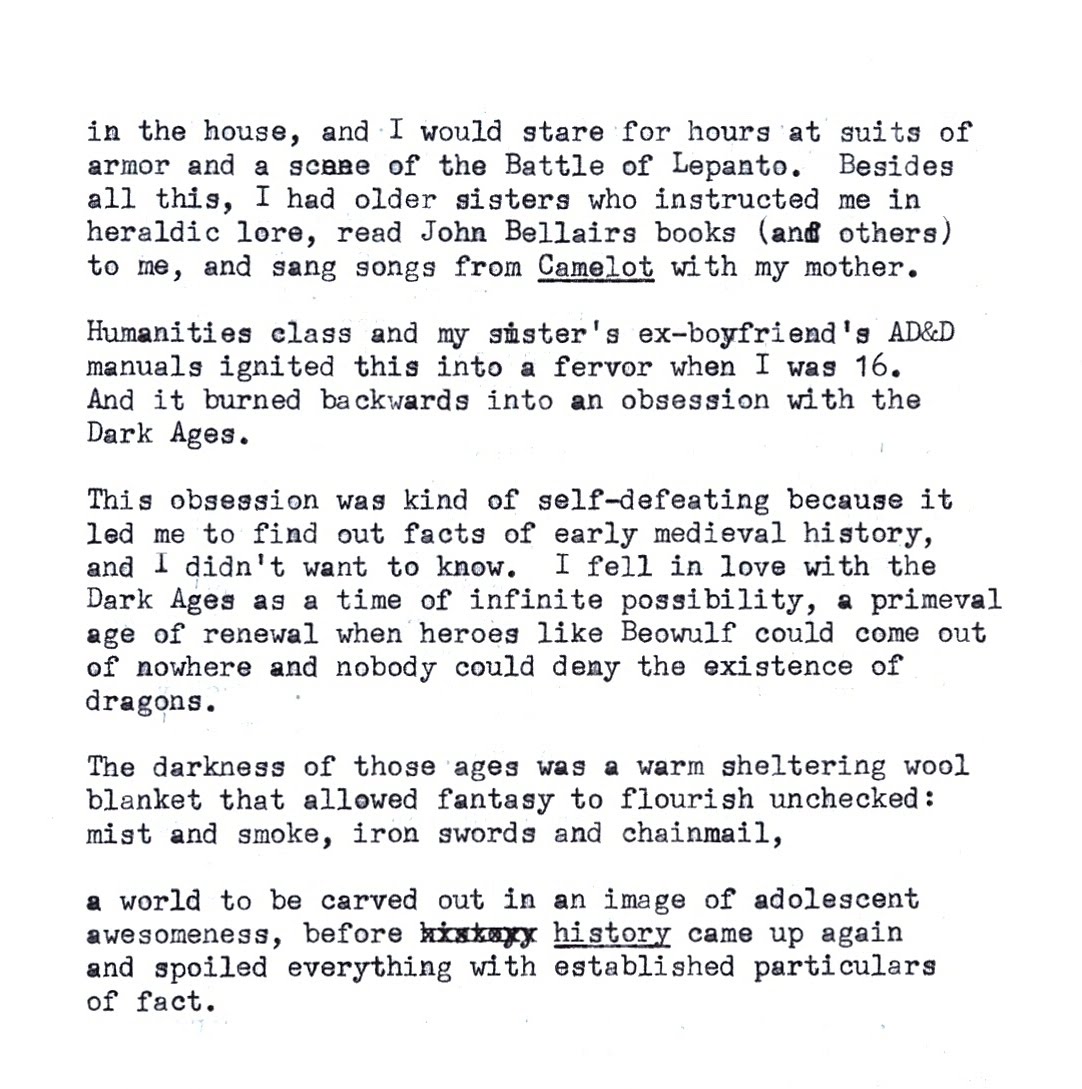
An adolescent's concept of the middle ages, or an adolescent boy's concept: how many are like mine? A lot of my imagination has always centered around food, and my fantasies of Medieval meals owed their bulk to the pot roast dinners we often had in my family while I was growing up. There seemed something anachronistic and archaic about a huge hunk of meat on a platter; I think this is universal, judging by the portrayals I've seen in popular media and the wide appeal of turkey drumsticks at Renfaires. Eating large quantities of meat is typically understood as a manly taste, and there is something nearly exclusively masculine about the appeal of a mythical Dark Ages that goes hand in hand with an enjoyment of fantasy role-playing games and their derivative fiction, as well as the accompanying art that teeters on the edge of the pornographic. It's more cave man than anything, and that adolescent male attraction to the Dark Ages has little to do with chronology and almost everything to do with the shagginess that Umberto Eco astutely pointed out in “Dreaming of the Middle Ages.” Cave men with castles for caves and iron swords instead of flint axes. Yet somehow their women achieve modern nutrition and hygiene.

(A Dungeons & Dragons manual I once had, Creative Campaigning, suggested setting a campaign in a stone age and included a reduced magic system to go along with the primitive conditions. I now think that's totally backward: the more primitive the technology and economy, the more pervasive the magic. That game designers should fail to see that speaks to the psychological, historical and mythological ignorance of their society.)

Since in my childhood home we generally had mashed potatoes and gravy with pot roast, I took for granted the Medieval character and even provenance that I projected on them. Not just mashed potatoes but those soggy ones that have been cooked with beef and onions in a slow cooker, absorbing the juice. The whole package of meat, onions and potatoes, whether the meat stays in a chunk or gets cut up for stew, is unconsciously imported into masculine fantasies. In the past few years I've done NaNoWriMo there's been a running joke about stew on the fantasy forum, stemming probably from a question in David J. Parker's Fantasy Novelist's Exam: “Do you not realize it takes hours to make a good stew, making it a poor choice for an 'on the road' meal?”

Even to this day, when I hear or read the word “Lombard” I have to fight to keep the taste and feeling of mashed potatoes and Tabasco sauce out of my mouth. That particular association comes from history books I read when I was 17: the fall of the Roman Empire, the barbarian invasions, the desert fathers. But they said nothing about food, so all throughout I held in my mind a picture of barbarians newly established in appropriated Roman castelli, eating mashed potatoes. This was also shortly after I had taken a great liking to Tabasco sauce and often put it on my mashed potatoes, mixing it in until they turned pink. So for me the Dark Ages came to taste like two American things that were unknown in Europe at that time. I didn't know that; I had only the vaguest idea of the history of food and didn't realize how enormously important staple food crops are in economy, technology and politics, what a difference potatoes really made in Europe in the modern era. My interest in history was a means to an end of fertilizing fantasy; it still is to a great extent, as I think it should be for everyone if the world is to change for the better. But my fantasies then were more narcissistic than the utopian dreams that my spiritual conversions have since engendered, and I had less factual knowledge to help me emerge from the ethnocentric Anglo-American adolescent dreams that I swam in.

So I didn't know the difference between old world and new world crops. I don't want to pin the whole rap for that on Tolkien: as a mythical world, Middle Earth has no reason to pretend to any historical accuracy, being a mythical creation (and Sam cooking rabbit stew in Ithilien makes sense in its context).

But the way the fantasy genre has evolved since then has led to the irresponsible behavior lampooned so well in the Fantasy Novelist's Exam: trying to copy your inspirations without doing your research. Over the past few years there's been a lot of debate online about the race or color of characters in fantasy fiction vis-a-vis “historical accuracy.” I haven't dug deeply into that or followed very closely, mostly because it has always seemed self-evident to me that if you're writing or playing fantasy then you don't need to be “historically accurate.” But if you are writing a fantasy actually set in medieval Europe, then you're obligated to take into account the relations of trade, religion and scholarship that brought people of different races in contact with each other then and there. As a teenager I got an education about Saracens from Judith Tarr's Ars Magica. That novel was published in 1989, and of course Ursula LeGuin's Earthsea novels with their multiracial cast are even older, and not beholden to any concerns for historical accuracy, whatever shallow resemblance their props might have to medieval stuff.

Is the stereotype of a medieval European fantasy landscape – full of castles, monsters, knights errant and damsels in distress all white – more of a notion in the minds of amateur male authors than a reflection of how the genre really goes? It might go back to Ariosto after all, as I mentioned in a previous post: Orlando Furioso is a classic adolescent male fantasy and its European point of view recoils in disgust from black characters and even paints the Princess of Cathay as blond. But I'm not well-read in modern fantasy; I hardly touched it for years until I started on Robert Jordan's Wheel of Time series about 11 years ago. It was a welcome re-entry for me because of all that it does right: a multi-racial cast, world-wide trade networks over millennia of history (so potatoes, tobacco etc. make sense, though he keeps maize and tomatoes isolated in the desert to add color in winking asides), and only the most superficial resemblance to “medieval Europe.” It's such a popular series I guess I figured it was typical of how the genre developed while I wasn't looking (I wonder if he was inspired at all by Delany's subversive Return to NeverΓΏon series with its blond barbarians and child empress).

I fear I'm wrong, based on what I have read from people about what is considered “typical” fantasy – people who I assume have read much more of it than I have. I might like to call it something like White Boy Fantasy with Potatoes: adopting medieval trappings like long swords, armor and castles, and even trying to make these as “accurate” as you can, while blithely including in your misty “northern European” setting blatant anachronisms like potatoes (or pumpkins, like I saw in the Gargoyles TV cartoon series), sewers, cheap soap, or the grosser absurdities like chicks in chainmail . . . but keeping everyone white (with the possible exception of black-skinned evil underground elves) because, forsooth, there were no black people in northern Europe “back then!” This does deserve criticism as narrow-minded: there's not much excuse for it in this century, and I think it's the real butt of Parker's jokes in his exam, much more than Robert Jordan's feminist heroines. White Boy Fantasy with Potatoes might draw from Tolkien, but it leaves off from the mythic resonance that gave his work its sense, settling its roots more in modern American experience. WBFwP is a product of 20th century industrialized middle-class teenage life, along with drive-through fast food, high school romance movies and prog rock. It's gratifying to think that I might extrapolate from my own psychic experience to understand the appeal of a typical and popular genre, but it's sad to think that it should be so typical.

 I have to state that my experience with fantasy as a teenager was more with gaming than fiction, and I wonder how many others have experienced similar. The “Fantasy Novelist's Exam” takes obvious aim at the practice of importing game mechanics into novels, as in the series built on the D&D franchise: Dragonlance, Forgotten Realms and probably others that I don't know about. I read Dragonlance books as a teenager and I bristled when others dissed them. At the time I found a lot of value in them (I liked them much more than Forgotten Realms which I abandoned halfway through the first volume). I don't know what I would think of them if I were to re-read them now; my intent here isn't to judge their literary value. I believe that, whatever literary value they may achieve, they still ought to be considered as belonging to the gaming world, separate from “the fantasy genre” as a whole, inasmuch as authors working in the wider genre, though they may be building from common tropes, have more leeway than those who are bound to a set of game mechanics. Some things are more appropriate for games than for novels, and I've become convinced that what makes for good gaming and good fiction are usually opposites.

How many of the authors writing in the freedom of the wider fantasy genre have really taken that leeway though? Again, my ignorance. I turned my back on the genre because I judged it as I have seen it judged by others: overrun by white boys who want to rove through northern European or North American-looking settings, slaying monsters (including orcs who sound like Turks, or is it the other way around?), eating meat and potatoes, and making love to centerfold models in fur or chainmail bikinis – all without encountering inconveniently different people who would challenge the comfortable demography of their actual suburban lives. I might have judged unfairly; I would like to think so – again, I'd like to think that those white boys (whom I can totally empathize with, alas) are mostly the fans and amateur writers rather than the published authors.

But whatever the genre's past might have been, I'm discovering exciting new work by authors like N.K. Jemisin, whose Hundred Thousand Kingdoms I recently read. There's some fantasy for you! - drawn from an obviously wide foundation in psychology, politics, economics; and a rich life experience of living, working and studying in many places. I've recently read others whose settings are modeled on earthly history and geography away from the misty wilds: the eastern Mediterranean for Megan Whalen Turner, and the urban Renaissance for Rachel Hartman. They show evidence of conscientious historical research and that is gratifying, even if they come across more as fenced gardens than as worlds (how much more do I have a right to expect? The pioneers of the novel form itself didn't do years of exhaustive world-building: they focused on a few people in one time and place). There seems to be a growing appreciation for historically-modeled fantasy, which is what I started trying to write over 10 years ago. I'd better finish it soon; I'd hate to miss the right moment to get it published.

Wednesday, August 19, 2009

Pencast: Dungeon Days Revisited

As I wrote in a previous post, I used to be heavily into fantasy role-playing games, or I used to want to be heavily into them. I spent a lot of time making up characters who never saw any action and wishing I could stay away from home -- or awake -- longer on the occasions that I actually did get to play with others.

Recently I've been thinking more about this pastime from my youth. I rediscovered this brilliant 1990s comedy sketch the other day, and I've been looking through some of the few old rule books that I've kept. Recently my wife and I were shopping at the local used bookstore and picked up Wizards of the Coast's Wheel of Time RPG. Maybe I just don't like to face the fact that I'm twice as old as I was when I started playing this stuff, but I've found myself wishing again for a group of like-minded nerds to trot out my new character ideas with.

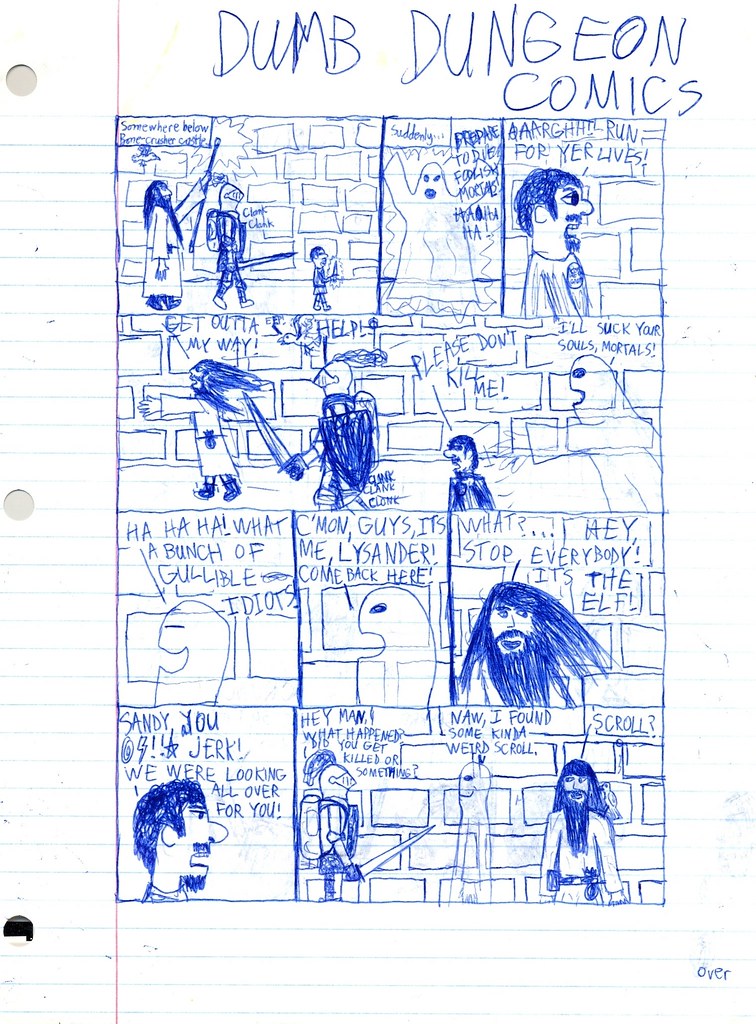
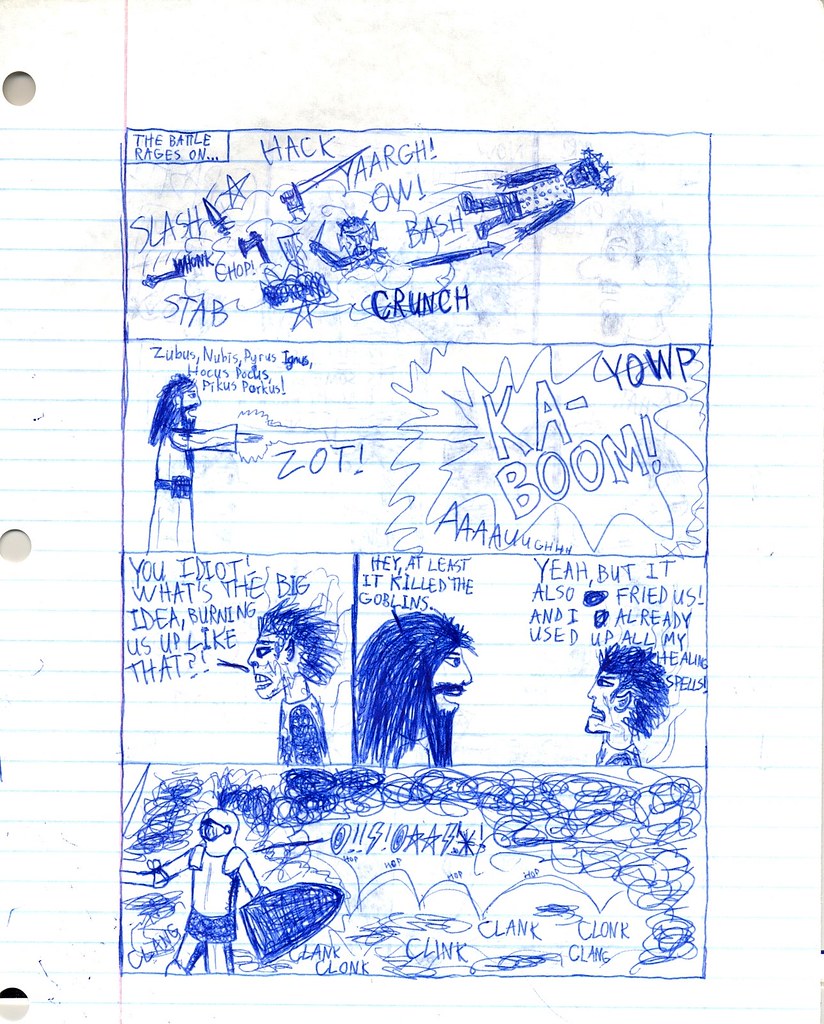
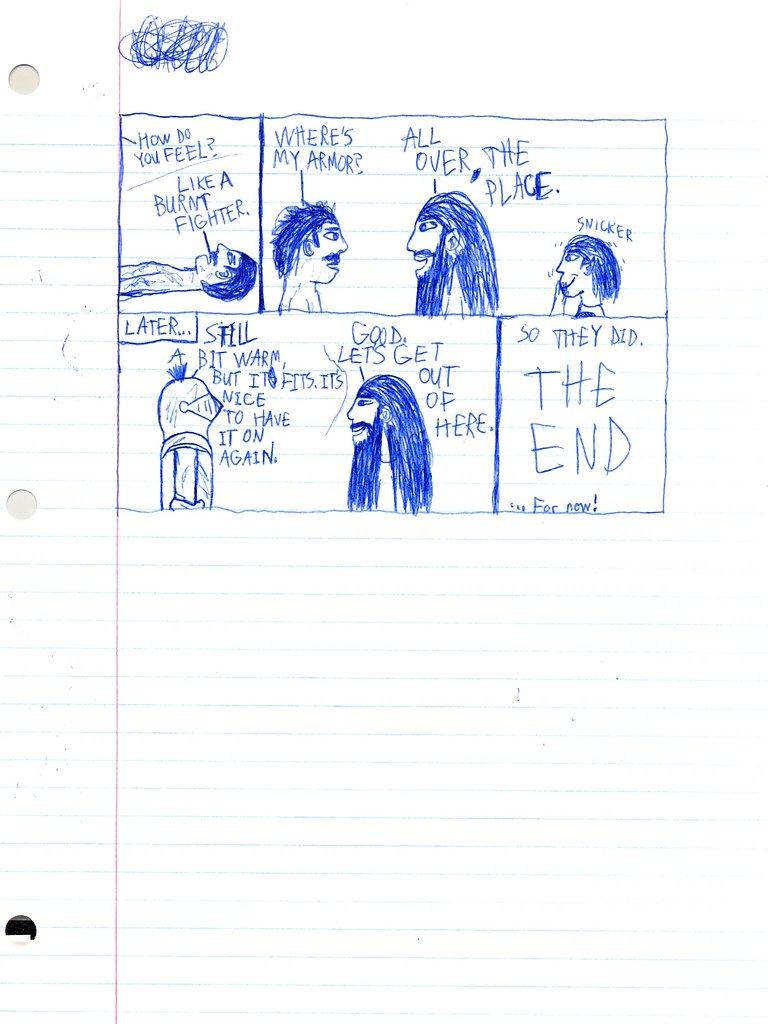
Amongst all of my old gaming stuff I found a comic strip I drew on notebook paper while I was in high school. I think I must have been 16, maybe 17 when I drew it. I meant to draw more but never got around to it. (There were other comic strips that I started and then abandoned as well. Some of them had potential but my drawing technique, such as it was, has decayed over time.)

So without further ado, here it is.