(I took the header picture of a Common Loon resting on a pond in Utah on its way north in June of 2015. It was in transition from winter to summer plumage.)

Translate - I dare you. Then make a comment on the funny errors the translator made.

Showing posts with label Sentimental nostalgia. Show all posts

Sunday, July 30, 2017

My hiking sling

In 2002 I went on several hikes in the mountains of Utah, including a four-day backpacking trip to the Uintas with an ascent to the summit of King's Peak.  On that hike I came up with an idea: what if I used one of my Mexican blankets for a sling to carry my stuff, instead of a backpack?  On that particular excursion I had carried my tent and other gear to our camp site in a large framed pack, and I didn't want to have to haul that to the peak, so something stripped down and minimal like a blanket sling made sense.

It must have been in one of my custodial jobs that I worked in college that I acquired a very large safety pin, which I had used at times to fasten a wool blanket around me like a cloak.  If you're interested in doing this yourself, I recommend doing a search on ebay for "laundry horse blanket safety pin," and you should be able to find one.  (I could have put a link here, could even have made it a commission link, but I've stopped doing that stuff.)  I'm going to share with you the basic method for rigging one of these up:

First, take your blanket and fold it lengthwise into thirds.
Photos by my sweetie.

 I might have tried folding in half twice, but thirds seems to work the best, giving a close-able pocket effect.

Next, drape the ends of the blanket over your shoulder (whichever you choose: during a hike I switch from one to the other every so often).  Holding one end on the front, bring the other up from behind . . . 


. . . and pin it.


 Here I want to point out that it has worked better to leave it as seen here: on a recent hike I tried gathering the ends into more of a taper.  It didn't work very well: the bunched cloth actually cut into my shoulder more than the simple pinning did, and somehow it messed up the neat pocket effect I had enjoyed on my previous hikes.

Although I got my inspiration for this from old depictions of people carrying bedrolls to camp with, I've never attempted to carry camping gear in this, always keeping it strictly to day hike use.  I carry food, water, extra clothes and first aid supplies, and it does pretty well I'd say up to maybe 15 pounds - I'm not very good at guessing weight.  On my most recent hike up to Timpanogos Basin I included a small stainless steel cook kit (1 lb) with an alcohol stove and fuel bottle.  If memory serves aright, I've used this rig to get to the summits of King's Peak, Squaw Peak and Mount Timpanogos, as well as several shorter hikes.  Here are some views of it in action:

King's Peak, July 2002, in the clouds.  Man, I was in such good shape back then.  Photo by one of my hiking buddies.
 
Organ Mountains, New Mexico, 2007.  The blanket can get hot in hot weather, but I've never found it unbearable.  Photo by my brother.


Timp, 2007 - the last time I made it to the top.  Photo by my other brother.

I like the advantage this device affords of having my trail snacks and sundries within easy reach.  By shifting sides regularly I avoid getting my shoulders sore.  Besides, it has that anachronistic simplicity that I love.

Recently I read about Emma Gatewood, the first woman to hike the entire Appalachian Trail alone - and carrying her gear in a sling bag held over one shoulder.  Not exactly the same thing, but even so I feel like I'm in good company.  I've long felt that people set too much store by fancy modern hiking and camping equipment, and I feel vindicated by examples like hers - or the Timp hikers of the early 20th century.

Here's to many years of hiking yet to come!

Monday, May 16, 2016

Sticks!

Another of my articles has appeared on the Jung Society of Utah blog today.  Since I always have limited space on the blog there, I decided I'd write a little bit more about my sticks here.

I've finished two sticks in the past year: a sort of baton or wand of apricot for myself, and a walking stick of plum for my sweetie.
 
Part of the apricot baton . . .

. . . and part of the plum walking stick.

I'm particularly pleased with the plum: it came out looking like a walking stick I might see at a gift shop in a park (except that I finished it with oil and beeswax instead of polyurethane or something like that).  It wasn't complicated to make at all: just took some time and care.  That's the best thing about working with sticks, I think: you don't have to be a master craftsman, you just have to take time and care, and I think it especially helps to be in tune with your inner child.
 
The wide tip of the baton, showing the piece of sodalite that I mounted in it.
When I was a boy, I loved whittling sticks.  That was part of their appeal: with a pocket knife I could not only shave away outer layers of bark and grime to let the beauty of the wood shine through, I could also sharpen a stick to a crude spear point, and I had a weapon that has cost me nothing. When you're a child on a camping trip, in woods that might be full of cougars, bears or (especially) monsters, this gives a tremendous sense of security.

I think it would be a cheap and nasty dismissal to assign some kind of crude phallic meaning to this fascination with sticks (although I'm open to the idea of symbolic resonance of that sort in wands and scepters). I don't want to get into a rationalistic picking apart of this fascination with sticks in an attempt to explain it. There are some things that it is well to explain, but others it does your soul more good to just do.

Thursday, February 18, 2016

My Sigur Rós fantasies, part 2 (or, brass buttons)

Brass buttons!  I have a navy peacoat that has brass buttons.  My sister gave it to me over 20 years ago and it used to fit me very nicely.  The thick wool is like armor.  It's shapewear, really: can you tell in this picture that I was overweight?

In Boston, at the birthplace of a great-great grandfather, 1998
Trench coats or dusters are a standard nerd uniform, but they don't have anywhere near the panache of thick wool and brass buttons.  I've decided that if I'm going to be odd, I'd rather do it in a way that aspired to an absolute elegance.

When Sigur Rós released Kveikur in 2012, I held off from getting it for a while, because I was sad that Kjartan had left.  But it's become one of my favorites - especially "Stormur" and "Bláþráður" which share a very similar sound.

In the video for "Glosoli" from their 2006 release Takk, a drummer boy in an old military-style coat leads a group of children.


And the band members have sported costumes reminiscent of military uniforms (or marching band - anyway, with lots of buttons):


Maybe that's why, when I listen to "Stormur" and "Bláþráður," I feel like some kind of fabulous cosmic dragoon, decked out in a splendid coat of sober color, with the thick wool covering a body formed in appropriately manly proportions.  Somewhat like that drummer boy, I imagine myself soaring above the landscape, taking in the vastness of it, or marching along on some purposeful errand - or maybe just on one of my hikes (I'll write more about that later).

I mentioned that my coat feels like armor.  In fact, I credit part of the impetus for my novel in progress to that coat: the refinement and elegance of industrialized aesthetics that produced the clean lines of such a coat (instead of the sweeping curves of 18th-century military dress) attract me greatly, but I wanted to visualize a society that could achieve this sort of thing - and early industrial technology - but without the dehumanizing weapons of modern warfare.  I imagined trains, wool coats, brass buttons and sabers - without firearms.

This was in my head long before I ever heard of steampunk - and my vision was of a cleaner look than the clutter I often see in steampunk illustration and cosplay.  It's been interesting to observe emanations of my teenage visions appearing in contemporary fantasy - from the Mistborn Trilogy to Frozen.

Frozen: Scandinavian aesthetics.  Is this my Danish background coming through?  I saw Babette's Feast for the first time in college, and those snappy military uniforms made quite an impression.  (One of my favorite scenes also is where the storekeeper puts on his postal hat to deliver a letter.)  I grew up in a household with Danish furniture and utensils and so maybe I imbibed an appreciation for Nordic design that way.

I also grew up in a family where we were expected to dress up for many occasions.  This meant that I quite often wore a blazer - and hated it.  I think back on this as something like the way I hated math, even though I was good at it, and for a time even was a member of a competitive "Math League" in junior high.  It turned out that wearing a navy blue wool jacket - with brass buttons - was ideal for playing soldiers after church.  Perhaps I would have been mollified more often in my father's dress code requirements had he appealed to that sense of fantasy - you don't have to dress up, you get to do cosplay.  After all, I did find his old military gear and regalia irresistible, and I have enjoyed dressing in olive and khaki, despite my pacifism.
 
Minneopa State Park, Mankato, Minnesota, 1999

But that's another story. 
 (This post contains affiliate links, which I put in whenever and however I like.  Click or don't, as you wish.)

Thursday, February 4, 2016

My Sigur Rós fantasies, part 1

(Part 1: Introduction)

I discovered Sigur Rós in 2001, right as they were starting to make big waves across the Atlantic.  Like countless other 20-somethings, I swooned to "Svefn-g-englar" in my candlelit bachelor apartment.  I saw them perform in DC that year, and after the show I stuck around to bug them.  I remember talking to Orri as he smoked and looked around as if he couldn't wait to finish talking with me and get on with the rest of his evening.  As I was leaving the venue I spotted Kjartan and called out "Thanks for the show!"  "No problem," he replied.

Afterwards I felt foolish.  I already knew about fame and how it puts sensible musicians on their guard (I listen to Rush, for heaven's sake).  Watching the interview sections in Heima I was reminded of that.  When people make music that reaches a large audience, their music comes to mean many things for all those different people, and that means there has to be a boundary set up, to prevent the listeners from imposing their projections on their fellow human beings who make the music, who have their own separate lives.

I recognize this, and despite my seven-year-old daughter's wish to fly to Iceland and visit Jónsi (yes, she's a fan too, like many children, as I understand) I know that most likely I'll never be in the same room with those guys again and that I have no right to expect that just because I like their music they'd want to be my friends.

But in my own personal take on their music, and my own interaction with the copy of the version of their persona that reaches me, Sigur Rós is my band in a way that few others are.  For one thing, those guys are my age (I'm not quite two months older than Orri).  Right now the only other band I can think of that I listen to, with members my age, is Aloha.  Since I discovered them I've followed them through the phases of the twenties and thirties, and I've had moments of deep empathetic resonance (which again I recognize can only go so far).  For example, when I saw a clip of their second film Inni, especially with Orri wearing that crown of his.  I can't quite explain, but something in that sight struck me with a deep familiarity.  What was it?  I don't know if I can explain.


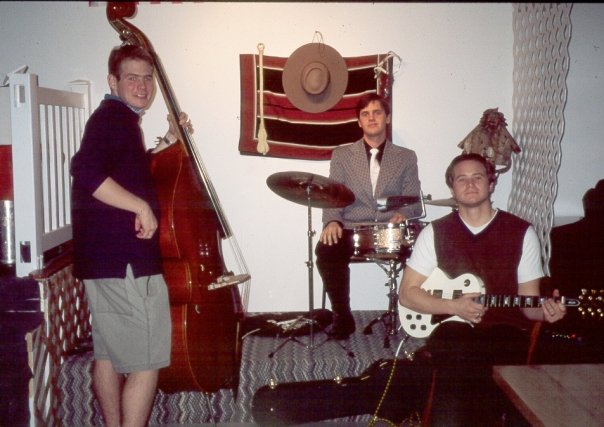
Maybe it was a simple recognition of the impulse to dress up when playing the drums.  I have done my share of theatrical self-presentation as a drummer:


And as I wrote not too long ago, I have been feeling this desire for more personal adornment lately.  I wonder how much of it comes from my approaching middle age.  I've been wearing jeans and t-shirts for over 20 years, and as I see more grey hairs in the mirror, not only do I feel a wish to present myself to the world with a dignity and a distinction, but I still have enough of my youthful idealism and turn-of-the-century experience that I want my distinction and dignity to be something more universal, more human, more psychologically whole than the dominant image of the businessman of the 20th century industrialized world.

Sporting my rainforest jasper pendant, brass cuff and a homemade bead bracelet.
  So seeing Orri in that garb was an affirmation, but I could say it was a reminder of our collective mortality also.  However I might explain it, something clicked as I watched, spoke a kind of resigned peace to my mind: these guys will grow old too, as I will.  Watching this with the benefit of my limited experience in a drum chair on the stage, and with the amplification of my own imaginings, I felt I was arriving at a better understanding of what it looks like "from both sides now" to be a creator who reaches a large audience - a goal I still aspire to.

It helps to sweep away even more of the hero-worship that held sway over me in my youth.

I'm going to write in later posts about some of the things their music means to me.  After all, they have encouraged this, with the wordless liner notes and title-less tracks of their third album, and their experimental video projects.  So this is the introduction and there will be more to come in this series.

Sunday, January 17, 2016

Nearly nine years

This blog has been around for nearly nine years under its current name.  Before March 2007 if I recall aright, it was mostly a political blog, emanating fervent heat from the idealism that my experiences of recent years have managed to temper and disappoint, but not to purge.

I'm glad I made the change to the name and focus almost nine years ago.  I might put up some of the earlier stuff I posted again, on a separate page, as part of the remodeling I'm doing in this new year.

In looking through some old posts I found this one written when I was still living two days' journey away from the Wasatch Front.  It helps me to reflect on how grateful I am to be living back in my homeland again, even though there are many people and things I miss about New Mexico.

As this year progresses, I'll continue to change and grow this blog.  A while ago I noticed that somehow the old blogroll I used to have on the sideline is no longer there, and I want to work to build that back up.  Also, long-time readers will notice that I've started adding affiliate links.  This is an experiment and I'm interested to see what happens with it.

Wednesday, December 2, 2015

My grandmother's unfinished work (including a scanned typewritten page)

Lately I've been going through some old family papers.  There was a time, not so long ago, where I worked full-time as a professional archivist.  Since then I've kept my hand in with some side projects, and this is the latest one.  As with any project involving personal or family papers, there are easier parts (like sorting letters) and then there are the perplexities - in this case, my grandmother's writing.

My paternal grandmother was born in Salina, Utah (how many of you reading this have heard of it?) and had an expansive and curious mind.  She wrote poetry, drew and painted, as her time allowed while raising children and keeping house, and when her children were grown she went back to school, where she planned on writing a Master's thesis on the history of her hometown.  She never finished it, but she left a quantity of handwritten notes and drafts, including many typewritten pages with corrections and revisions.  Working with all this has reminded me forcefully of a collection I worked with in my former archives job: the manuscripts and research notes of another woman who had attempted to write a history of her hometown and left it unfinished at her death.

I wrote about it on another blog I maintained at the time, commenting on the tendencies I saw in her methods and the affinities I saw with my own.  My grandmother left behind much fewer notes and drafts - at least, much less material has come to me - but working with them is of course much more interesting to me.  I recognize in myself a wish that she showed to address a wide range of questions within the scope of what might seem a discreetly-defined subject.  Her research into her hometown's history seems to have swung wide to accommodate various reflections on sociology, economy and theology - not surprising, really, when you consider Salina's history as a Mormon Pioneer town.


I think that the work my grandmother left undone was motivated by either the same spirit or a similar one to what has been working in me for several years.  In my case, I'm attempting to express my ideas in fiction, and while I don't know how early on my grandmother began her work, I think of my age and my life responsibilities, and I don't want to let the rest of my life go by without finishing.  Maybe this can be one more motivator for me: to finish this for her sake as well as everything else.

Thursday, November 5, 2015

More about music: alternative skating rink mix

This evening we took our seven-year-old to a roller rink for a school party.  I could write a book about this.  I went to skating parties when I was in elementary school - in fact I saw one boy who looked just like me at 10.  Not just in the color of his hair and the shape of his face, it was also the way he wobbled unsteadily on the skates as he tried to keep his balance and figure out how to push himself along.  I wanted to go give him a big hug and tell him "it's all right, everything will be all right."

Maybe it was the nostalgia, but I found myself enjoying this evening's outing immensely, even the dance-beat pop music that played loudly over the speakers.  But I still thought of other music that might be interesting to roller skate to - or to watch people roller skate to.  What would some of the teens and preteens who were so amazingly agile (so glad to see that youth are still skating!) make of something like "ZNS" that I posted a few days ago?  Or . . . well, let's come up with a few more possibilities.


I would pay money to watch choreographed roller skate performances to these.


Friday, October 30, 2015

Some music offerings for Halloween

What's Halloween without some suitable music?

Today we went to our first-grader's school costume party (some of you longtime readers may recall, with me, when this girl was first born.  In particular, I believe it was Michael Clemens who warned me that before I knew it, she would be telling me about her boyfriends in Kindergarten.  Alas, 'twas all too true.

I digress.  At the school they played The Monster Mash.  not just the well-known song, but the entire Bobby Pickett album.  I hadn't known there was a whole album.  I hadn't known that the guy who did the voice was named Bobby Pickett.(1)

In our family we usually listen to Midnight Syndicate around Halloween.  They're great fun as long as you don't take them seriously.  We have several of their spooky Halloween albums, bought over the years from trips to Halloween stores.  Our seven-year-old loves them - she's constructed mythologies around them involving characters of her own device.(2)

Then there are our Type O Negative CDs, kept in the Halloween box.  Heavy metal and Halloween: a match made in . . . don't say it.

I saw Type O Negative in 1994 when they opened for Queensrÿche, whose Rage for Order stands for me as the definitive statement of vampire-themed heavy metal.  I'll be forever grateful to my sister for buying it on vinyl and letting me inherit it.

But check this out:


I've been a fan of Einstürzende Neubauten for about 14 years now.  The song for the video above, "ZNS" comes from their 1985 masterpiece Halber Mensch.  So does this:


Trick or treat!


-----
(1)  I hadn't known there was a deluxe re-release of the thing on purple vinyl:

I love the internet.

(2)  Born of the Night was the first one we bought and probably still my favorite.  They now have a Halloween Music Collection on Amazon as an mp3 download.

Thursday, May 15, 2014

Dream, Dare, Do

The morning of September 9, 2013 I saw a stream of sixth graders walking in front of the building in the lovely cool morning – first hint of autumn, magic magic magic. Even walking past the school building later that afternoon and not forgetting the terror and captivity, I felt magic from the red bricks, from the cool air, from the memory of pencils. Shouldn't there be a place for the honor of that, as part of autumn's enchantment in childhood?


But I was thinking about the morning first. Those sixth-graders filed past the door in tune with the morning's loveliness. Then I heard an adult voice bark “single file straight line!” as if they were a bunch of jailbirds – reminding me that, in fact, they are.


When I called the sixth-grade school they said that these students had attended an assembly at the middle school, some anti-bullying thing. Very much on everyone's mind these days. I called the middle school and found out they contract with some outfit to come and give them this presentation every year.


Apparently it's a big deal: they set up three big screens in the gym and have a powerful sound system. They're very proud of it, saying it “will encourage students to clarify dreams, look clearly at obstacles, and through hard work and determination, turn their dreams into a reality. Students will learn positive methods for dealing with the pressure, stress and fear they feel inside, and they'll understand the importance of setting short-term goals for their lives.” And of course there's the personal responsibility that adults never tire of invoking when it comes to making younger people do things: this show “will help students realize that it's time to stop passing the blame to someone else and start taking responsibility for their futures.”


Their website offers a shrunk-down version of the presentation, which I watched. They certainly do try to make an overwhelming show of sight and sound. The shrunken preview can't match the experience of the real thing, they say, and I believe them.


A powerful, high-impact character lesson, they say. What it is is loud and vapid, the art of saying nothing over forty minutes refined near to perfection. I can imagine sitting in the bleachers in the gym with those sights spread out over huge screens and the sound blasted into your head – no escape. I imagine all the adults, having their ears pressed flat to their skulls by the angry-sounding pop metal music in the thing, maybe not enjoying it at all but thinking that these guys who made it sure must be legit cuz they've got all this badass-sounding music that the teenagers like.


I sat through plenty of clumsy agitprop while I was in school, and of course we saw through the grown-ups' feeble attempts to appropriate our vernacular and poured derision thereon when they were safely out of earshot. I'm 36 and have only the vaguest idea what kids are listening to these days, but watching this it looks like (alas) the propaganda engineers have gotten much better at what they do over the past quarter century. The music in this presentation sure didn't sound like the cheesy stuff that tried to inspire my generation to love school. This stuff was like a hammer to your brain, along with the rapid editing of shots (including plenty from action movies) smashing away at any attempt by a viewer to formulate and consider any thoughts of substance or consequence.


-Which served its purpose, since what would happen if too many people really started asking questions like: what if my hopes and dreams are in fact blocked by having to go to school every day? Just how exactly do my good grades in each subject prepare me to reach my dream? How do the standardized programs of learning even help me to find what my true dream is? Are the grotesquely-amplified examples of athletes and singers really relevant to my life? How would the authorities over me react if I dreamed of a life outside of this system and dared to do what I had to in order to bring that about?


How much can the school environment even bear the concept of an individual life's calling?

And on and on. I haven't the energy to write much more about it; I don't know if it even deserves the dignity of a detailed consideration or rebuttal – there's not really much to argue against, because it's damn near impossible to argue against emotion.


 Of course this thing doesn't show any sex or tantalizing views of certain body parts, but it's as pornographic as anything, stroking the feelings of your lower chakras in a calculated move to make a flood of feelings that will drown ideas. People pay for this kind of opiate in theaters or in their own homes to escape the meaninglessness of their over-regimented lives, or in the case of music, the powerless band together in communities around angry protest songs: punk, heavy metal, rap. I don't know if this production company really pulls off a convincing appropriation of that protest in the perception of its young captives. Despite the in-your-face, no-escape presentation method, I hope that the young people saw through it.


Maybe it's vain to hope too much: we constantly hear complaints about today's youth: about their apathy, their addiction to screens, their susceptibility to the persuasion of violent and titillating images on those screens – this presentation was tailored exactly to such, and depends on non-thinking recipients for its success. But I still hope. I hope there were a lot of closed eyes, and mouths in cupped hands pressed to ears, during the onslaught: respectful human touch is the best antidote to pornography.

Tuesday, February 18, 2014

In which I quote obscure songs and philosophize (also not a typecast, sorry)

You run to the gate but you'll be marked late.
It's for your own good. It's for your own good.

You're likely to make the grandest mistakes.
You suffer alone in the skin and the bone.

Let's sharpen those new sets of arrows
for the next generation of playground martyrs,

and join in the game of intolerable shame,
'cos everyone shares in the sins of their fathers.

School bell rings. Single file in.
Trade you my unhappily everafters.
So bring out those things to hammer out the wings
of the next generation of playground martyrs.
-David Sylvian, “Playground Martyrs” (Steve Jansen, Slope)

I'm an art-school witness, witness this device.
I always feel so helpless lost in this episode twice.
-Justin McBride, “The West in Despair” (Finngerhutt, The Secret Life of Bookworms)

We are all of us, who have been wounded by the device of school, witness to it, though some of us have suffered more for our testimony than others. Some of us might not even be aware that we are martyrs: what we went through doesn't mean anything now that we're “grown up.” Or whatever it might mean is just that we went through an unavoidable part of life, an institution, a part of the set-up taken for granted.

In the aggregate we are an archive, a fonds, a record group, a body of evidence witness to the device that has shaped life in the US and in the industrialized world for so long that nobody remembers a time when it did not.

I always did feel so helpless, in those classrooms, on those playgrounds, lost in the episode countless times. I remember playing some sport in the gym, in fifth or sixth grade, and imagining I was in a TV show. My life went on in my mind and body as independently as was possible from the world around me and the experiences of those in it, but they had to coexist to some extent. I had to do dramatic poses and facial expressions in a freeze-frame every time the ball went by me: it was the only way I could make my life into something meaningful, the only way I could redeem it. By acting in my own private little TV show in gym class, I was the star of something. I drew a magic circle around myself, and for a time the derision of the others was an acceptable price to pay for the little bit of mastery that I owned in pulling off those poses. At first I paid the price but I did not count the cost (Neil Peart), but then after a while as it became more clear to me how ridiculous the others found my actions, and how completely they failed to understand why I did them, I think the pain of that overrode the benefit of doing it.

Magic circle, but in some way I had expected my peers to understand what I was doing, because I often assumed that the contents of my private fantasies were openly apparent to others. For a time this made it very difficult to bathe or use the toilet, because I was convinced that acquaintances could magically see through my eyes and would therefore see my private parts if I looked at them. I still have not come to any sort of workable hypothesis of how this kind of thing could have been treated. But what I am satisfied in hypothesizing is that this kind of fantasizing is rampant among children, especially introverted ones, and most especially among introverts who feel insecure packed in a classroom with other children their age and kept there by force, feeling the effects of the authority-imposed pecking order, all the more terrifying and rigid for being imposed by an authority unconscious of its actions, or whose spokespersons sometimes vocally deny the authority's unconscious unspoken actions, try so hard to go against them. Teachers often try so hard to protect children from the effects of the system they serve that it is tragic to see.

Benevolent mothers smother the child, the benefactors are in denial.
-David Sylvian, “The Banality of Evil” (Nine Horses, Snow Borne Sorrow)

Their words and wishes show themselves as powerless.

Powerless I stand before the ocean.
-Craig Bench (Pilot – Provo, 1998-2000, unfinished LP)

I want to get some students together in a safe place, sit down with them and tell them: I know of this. I understand that some of you carry within yourselves these fantasies, these private worlds, things that you cannot share with anyone, that if your parents see a hint of it they immediately judge, they may panic. If your peers see them they attack. If your teachers see they “intervene” and generally make it worse. Let me offer sanctuary. I won't even ask that you share secrets with me. Let me offer a way that you can face them, own them, manage them. I hope that in doing so you can give a space and a time for what drives them to let off steam, to vent, to find an expression that will ease the pressure on your soul and allow you to live a more purposeful, directed, awake and confident conscious life.

Writing in journals? That would be one way. Sitting still with eyes closed, daydreaming, maybe even Active Imagination? Is that appropriate for adolescents?

Dear old Mrs. Harmer in my 7th grade art class had all of us sit in a group and put our palms over our eyes to meditate – even the inveterate offender who muttered “bitch” at her back. You just can't make that kind of thing work if any of the children feel unsafe, and they will as long as there is that dynamic of unequal power relations in a room. And you can't expect to find out those dynamics with clumsy adult attempts to get children to talk as if there were nothing under the surface, however good your intentions.

Maybe that was why I was so interested in the Loch Ness Monster and Bigfoot as a 7th-grader, because I knew for absolute truth that we stand powerless before the dark water which holds mysterious beings, monsters that don't heed our wishes and which we cannot measure, no matter how many times we look, no matter how sophisticated our equipment is. That monster is there but the deadened eyes of a materialist-minded man cannot hope to see or discover it. It refuses to reveal itself to his arrogant probes.

So what is the kind of humble probe that can reveal it? School personnel just want to know how they can diagnose and treat. That's part of the problem, because the reason they want to do that is in order to get things going efficiently again, move in the direction of a program that would keep everyone safely and neatly on the road to a “success” that they can't really define. Their blind pursuit of progress and uniform success is dumping all sorts of mutogenic ooze into the water to create even more monsters.

What is the monster? I thought of Nessie as benevolent, a sort of guardian. Like Napoleon Dynamite, I thought of her as an underwater ally against the monstrous depredations of my classmates whose souls had been driven into an animal unconsciousness by the larger leviathan of the school.

Let's not insist on a coherently logical structure of metaphor here. I don't know how much I thought of Nessie as benevolent, but being so far away she couldn't get at me even if she had a mind to chomp people. Maybe it was that I felt I could hold onto something mysterious: that there were these mysterious things: monsters, aliens that I felt I could know or at least know something about. And by reading those books about monsters and aliens I felt that I had a way of managing them. At the least it was empowering to feel that I had a knowledge of things that were mysterious, maybe. Or it was a way of affirming the truth of how much that shapes life is unconscious.

Mystic rhythms, under northern lights or the African sun.
Primitive things stir the hearts of everyone. . . .
Mystic rhythms under city lights or a canopy of stars.
We feel the powers and we wonder what they are. . . .
We feel the push and pull of restless rhythms from afar.
-Neil Peart, “Mystic Rhythms” (Rush, Power Windows)

Few of my peers accepted the stories of literal monsters below the surface of factual lakes. Looking back, does it just show how little they thought of the reality of things shaping our lives that went on unspoken, impossible to challenge because they were impossible to articulate, unless in ways that could be dismissed as childish? Were my peers more interested in finding a place in the order where they could have comfort, find a place at the table, gain the favor of the king, a seat on the bench in the mead hall? Some of them were obviously going somewhere with their lives in a way that I wasn't. Some seem to have set themselves up pretty comfortably after having passed all the requirements set by that unconscious beast.

Ich bin das letzte Biest am Himmel.
-Blixa Bargeld, “Letztes Biest (am Himmel)” (Einstürzende Neubauten, Halber Mensch)

The school leviathan swirls over us like the clouds – not out of a death-eater skull, because that would show too plainly what it was up to. Some sort of imperial Chinese dragon. A superior force hovering over like a facile god: above=greater, superior in every literal sense, self-evidently our ruler. The heavens where the invisible being dwells in a place no scientific probing can ever hope to discover (another reason why I was susceptible to cryptozoology? And the shame at seeing the extents of credulity to which faith might lead was keener for my friends than for me?), and whose dictates are to be obeyed without question.

The waters above the firmament as well as those below: those unconscious processes, the mystic rhythms or the sinister forces that drove us, were not just subterranean. Subterranean were the forces that set my peers against me, that drove our conflicts with each other, that tried to find expression in what the ready guide in the celestial voice (Peart) made permissible and possible. There were unconscious forces above us that ruled over those below, and made the vessel in which the lower forces cycled and fermented.

Ancient idolatries born of natural psyche are wholesome and benevolent compared to the modern ones born of the machine which made bold to exist in the spirit instead of obeying (Rainer Maria Rilke). And it is one of the saddest ironies to me that those who shave their faces and straighten their ties should ally themselves so fully with the modern idolatries in denouncing the ancient ones as wicked, should assert that the God who brought the human psyche into being is identical with that leviathan which swirls invisibly in the skies above the school building and the skyscraper, the one that cooks children in its vessel that I don't want to call hermetic. A celestial dragon that wears smiling masks but puts the lid on us in the pot, fires below, heating the waters of our psyche in an industrial recipe. Some of the dragon's acolytes have written cookbooks and now their heirs are following those recipes, without question, because this dragon is a god to be obeyed without question. We leave the judgment to the experts, we defer to something above us, also unknowable.

This is hard, because certainly the true God is also unknowable at the core, but I hold to a segment of Rod that Nephi wrote: he doeth not anything save it be for the benefit of the world. I also think of Alma's seed metaphor: something is true because it is light, is discernible. It leads you along but in a way that you see plainly, even if it is only one step at a time. A kindly light leading through a dark night, instead of a prideful, garish day (John Henry Newman) – I have always found that image of the garish day to be very interesting in light of our habitual symbolism of day and light. Spiritual metaphors are like language: if one talks about above=good, below=bad, light=good, dark=bad, that's a discreet system. Within its own boundaries, those signs are valid, but it's not a universal truth, like a map might show Minnesota as purple and it works within the map, but the land isn't really that color.

The Earth's core is a second sun underground, the cthonic sun? The invisible sun?

There has to be an invisible sun. It gives its heat to everyone.
There has to be an invisible sun that gives us hope when the whole day's done.
-Sting, “Invisible Sun” (The Police, Ghost in the Machine)

Like Robert Ingersoll I want to stand on a rock of surety in this: there is a plainness like Nephi says, a basic benevolence or rightness that is discernible to everyone, the capacity to spot a naked emperor; and that this doesn't ever truly die even if we ignore it. I want to believe that no matter how deep we might try to bury this, it will keep speaking to us, and I accept that its voice speaking like familiar spirits out of the dust (Isaiah), coming out of those deep layers might sound so spooky that we will be even more likely to fear it, shun it. We could trivialize it (like using Tibetan monks' chants for Hallowe'en sound effects), or we could condemn it as evil in the same hasty judgment that one of my youth leaders showed in saying Queensrÿche's Batman-like logo looked Satanic. Or my fear that King Crimson's “Thrak” and “VROOM VROOM: Coda” were Satanic when I first heard them – and my roommate said as much: “this is Satan music!”

It certainly was eye-opening music that King Crimson gave me: they beguiled me, and I did eat. (And then learned about Thrace, which has Turkish-influenced folk music in asymmetrical meters. Robert Fripp referenced Bulgarian music as part of his European musical heritage. Like I wrote before: orcs-Turks.) Here was something that gave eloquent voice to those immeasurable monsters in the deep. And over time, I have learned that some of them indeed are our allies.

Wednesday, February 5, 2014

White Boy Fantasy with Potatoes (no typecast this time, sorry)

An adolescent's concept of the middle ages, or an adolescent boy's concept: how many are like mine? A lot of my imagination has always centered around food, and my fantasies of Medieval meals owed their bulk to the pot roast dinners we often had in my family while I was growing up. There seemed something anachronistic and archaic about a huge hunk of meat on a platter; I think this is universal, judging by the portrayals I've seen in popular media and the wide appeal of turkey drumsticks at Renfaires. Eating large quantities of meat is typically understood as a manly taste, and there is something nearly exclusively masculine about the appeal of a mythical Dark Ages that goes hand in hand with an enjoyment of fantasy role-playing games and their derivative fiction, as well as the accompanying art that teeters on the edge of the pornographic. It's more cave man than anything, and that adolescent male attraction to the Dark Ages has little to do with chronology and almost everything to do with the shagginess that Umberto Eco astutely pointed out in “Dreaming of the Middle Ages.” Cave men with castles for caves and iron swords instead of flint axes. Yet somehow their women achieve modern nutrition and hygiene.

(A Dungeons & Dragons manual I once had, Creative Campaigning, suggested setting a campaign in a stone age and included a reduced magic system to go along with the primitive conditions. I now think that's totally backward: the more primitive the technology and economy, the more pervasive the magic. That game designers should fail to see that speaks to the psychological, historical and mythological ignorance of their society.)

Since in my childhood home we generally had mashed potatoes and gravy with pot roast, I took for granted the Medieval character and even provenance that I projected on them. Not just mashed potatoes but those soggy ones that have been cooked with beef and onions in a slow cooker, absorbing the juice. The whole package of meat, onions and potatoes, whether the meat stays in a chunk or gets cut up for stew, is unconsciously imported into masculine fantasies. In the past few years I've done NaNoWriMo there's been a running joke about stew on the fantasy forum, stemming probably from a question in David J. Parker's Fantasy Novelist's Exam: “Do you not realize it takes hours to make a good stew, making it a poor choice for an 'on the road' meal?”

Even to this day, when I hear or read the word “Lombard” I have to fight to keep the taste and feeling of mashed potatoes and Tabasco sauce out of my mouth. That particular association comes from history books I read when I was 17: the fall of the Roman Empire, the barbarian invasions, the desert fathers. But they said nothing about food, so all throughout I held in my mind a picture of barbarians newly established in appropriated Roman castelli, eating mashed potatoes. This was also shortly after I had taken a great liking to Tabasco sauce and often put it on my mashed potatoes, mixing it in until they turned pink. So for me the Dark Ages came to taste like two American things that were unknown in Europe at that time. I didn't know that; I had only the vaguest idea of the history of food and didn't realize how enormously important staple food crops are in economy, technology and politics, what a difference potatoes really made in Europe in the modern era. My interest in history was a means to an end of fertilizing fantasy; it still is to a great extent, as I think it should be for everyone if the world is to change for the better. But my fantasies then were more narcissistic than the utopian dreams that my spiritual conversions have since engendered, and I had less factual knowledge to help me emerge from the ethnocentric Anglo-American adolescent dreams that I swam in.

So I didn't know the difference between old world and new world crops. I don't want to pin the whole rap for that on Tolkien: as a mythical world, Middle Earth has no reason to pretend to any historical accuracy, being a mythical creation (and Sam cooking rabbit stew in Ithilien makes sense in its context).

But the way the fantasy genre has evolved since then has led to the irresponsible behavior lampooned so well in the Fantasy Novelist's Exam: trying to copy your inspirations without doing your research. Over the past few years there's been a lot of debate online about the race or color of characters in fantasy fiction vis-a-vis “historical accuracy.” I haven't dug deeply into that or followed very closely, mostly because it has always seemed self-evident to me that if you're writing or playing fantasy then you don't need to be “historically accurate.” But if you are writing a fantasy actually set in medieval Europe, then you're obligated to take into account the relations of trade, religion and scholarship that brought people of different races in contact with each other then and there. As a teenager I got an education about Saracens from Judith Tarr's Ars Magica. That novel was published in 1989, and of course Ursula LeGuin's Earthsea novels with their multiracial cast are even older, and not beholden to any concerns for historical accuracy, whatever shallow resemblance their props might have to medieval stuff.

Is the stereotype of a medieval European fantasy landscape – full of castles, monsters, knights errant and damsels in distress all white – more of a notion in the minds of amateur male authors than a reflection of how the genre really goes? It might go back to Ariosto after all, as I mentioned in a previous post: Orlando Furioso is a classic adolescent male fantasy and its European point of view recoils in disgust from black characters and even paints the Princess of Cathay as blond. But I'm not well-read in modern fantasy; I hardly touched it for years until I started on Robert Jordan's Wheel of Time series about 11 years ago. It was a welcome re-entry for me because of all that it does right: a multi-racial cast, world-wide trade networks over millennia of history (so potatoes, tobacco etc. make sense, though he keeps maize and tomatoes isolated in the desert to add color in winking asides), and only the most superficial resemblance to “medieval Europe.” It's such a popular series I guess I figured it was typical of how the genre developed while I wasn't looking (I wonder if he was inspired at all by Delany's subversive Return to Neverÿon series with its blond barbarians and child empress).

I fear I'm wrong, based on what I have read from people about what is considered “typical” fantasy – people who I assume have read much more of it than I have. I might like to call it something like White Boy Fantasy with Potatoes: adopting medieval trappings like long swords, armor and castles, and even trying to make these as “accurate” as you can, while blithely including in your misty “northern European” setting blatant anachronisms like potatoes (or pumpkins, like I saw in the Gargoyles TV cartoon series), sewers, cheap soap, or the grosser absurdities like chicks in chainmail . . . but keeping everyone white (with the possible exception of black-skinned evil underground elves) because, forsooth, there were no black people in northern Europe “back then!” This does deserve criticism as narrow-minded: there's not much excuse for it in this century, and I think it's the real butt of Parker's jokes in his exam, much more than Robert Jordan's feminist heroines. White Boy Fantasy with Potatoes might draw from Tolkien, but it leaves off from the mythic resonance that gave his work its sense, settling its roots more in modern American experience. WBFwP is a product of 20th century industrialized middle-class teenage life, along with drive-through fast food, high school romance movies and prog rock. It's gratifying to think that I might extrapolate from my own psychic experience to understand the appeal of a typical and popular genre, but it's sad to think that it should be so typical.

 I have to state that my experience with fantasy as a teenager was more with gaming than fiction, and I wonder how many others have experienced similar. The “Fantasy Novelist's Exam” takes obvious aim at the practice of importing game mechanics into novels, as in the series built on the D&D franchise: Dragonlance, Forgotten Realms and probably others that I don't know about. I read Dragonlance books as a teenager and I bristled when others dissed them. At the time I found a lot of value in them (I liked them much more than Forgotten Realms which I abandoned halfway through the first volume). I don't know what I would think of them if I were to re-read them now; my intent here isn't to judge their literary value. I believe that, whatever literary value they may achieve, they still ought to be considered as belonging to the gaming world, separate from “the fantasy genre” as a whole, inasmuch as authors working in the wider genre, though they may be building from common tropes, have more leeway than those who are bound to a set of game mechanics. Some things are more appropriate for games than for novels, and I've become convinced that what makes for good gaming and good fiction are usually opposites.

How many of the authors writing in the freedom of the wider fantasy genre have really taken that leeway though? Again, my ignorance. I turned my back on the genre because I judged it as I have seen it judged by others: overrun by white boys who want to rove through northern European or North American-looking settings, slaying monsters (including orcs who sound like Turks, or is it the other way around?), eating meat and potatoes, and making love to centerfold models in fur or chainmail bikinis – all without encountering inconveniently different people who would challenge the comfortable demography of their actual suburban lives. I might have judged unfairly; I would like to think so – again, I'd like to think that those white boys (whom I can totally empathize with, alas) are mostly the fans and amateur writers rather than the published authors.

But whatever the genre's past might have been, I'm discovering exciting new work by authors like N.K. Jemisin, whose Hundred Thousand Kingdoms I recently read. There's some fantasy for you! - drawn from an obviously wide foundation in psychology, politics, economics; and a rich life experience of living, working and studying in many places. I've recently read others whose settings are modeled on earthly history and geography away from the misty wilds: the eastern Mediterranean for Megan Whalen Turner, and the urban Renaissance for Rachel Hartman. They show evidence of conscientious historical research and that is gratifying, even if they come across more as fenced gardens than as worlds (how much more do I have a right to expect? The pioneers of the novel form itself didn't do years of exhaustive world-building: they focused on a few people in one time and place). There seems to be a growing appreciation for historically-modeled fantasy, which is what I started trying to write over 10 years ago. I'd better finish it soon; I'd hate to miss the right moment to get it published.