(I took the header picture of a Common Loon resting on a pond in Utah on its way north in June of 2015. It was in transition from winter to summer plumage.)

Translate - I dare you. Then make a comment on the funny errors the translator made.

Showing posts with label Chocolate Project. Show all posts

Tuesday, February 23, 2016

The Chocolate Project, episode 3: Baker's unsweetened, part 1

(This picture is a link: you can buy this chocolate on Amazon.)

I wasn't going to do this at first, but then I figured, why not?  After all, this is what I used when I first started making hot chocolate the old-fashioned way.  For a long time, this was practically the only chocolate I used.  And despite what I wrote about not knowing better, this chocolate is not bad.  It's a decent, nice everyday chocolate, if you're into drinking this kind of stuff frequently -

like 17th-century Spaniards.  In A New Voyage Round the World (that link will take you to a free ebook) William Dampier wrote:

The nuts of this coast of Caracas, though less than those of Costa Rica, which are large flat nuts, yet are better and fatter, in my opinion, being so very oily that we are forced to use water in rubbing them up; and the Spaniards that live here, instead of parching them to get off the shell before they pound or rub them to make chocolate, do in a manner burn them to dry up the oil; for else, they say, it would fill them too full of blood, drinking chocolate as they do five or six times a day.

I'm not to the point of drinking chocolate that often - not yet.  And I'm sure that Baker's, as cheap as it is, isn't made from high-quality Venezuelan beans.  (I'm guessing that it's made from forastero beans grown in West Africa.)  This chocolate strikes me as a good one to use for backpacking trips or something of the sort.  I say this because I'm thinking of the Dominguez-Escalante expedition, which carried chocolate as part of its provisions.  I don't know for sure what kind of chocolate they had in Santa Fe to outfit overland expeditions like that, but I imagine it might have been relatively cheap, rugged stuff like this.

So, to establish a baseline, I whipped up some of this stuff for the family the other night.  Here's the recipe:
  • 4 ounces chocolate
  • 4 Tablespoons raw cane sugar
  • a little splash of fine vanilla (my sister taught us how to make it by soaking vanilla beans in brandy)
  • 1 cup boiling water
I'll try other sweeteners later; I think the raw cane sugar works very nicely with the flavor of the chocolate.  Baker's doesn't taste as "dark" as others, with what I consider more mid-tones than low or high.  Even the color is paler.  So the more caramel-ish character of the raw sugar fits it nicely.

My sweetie described the flavor as milder and subtler, and that for some reason it reminded her of trees.  Our seven-year-old found it rather bitter, while I found the sweetness level just about right.  The baby thought it was grand, as always.
Detail from Le Dejeuner by François Boucher; the full image is at the bottom of this post.
In conclusion, Baker's unsweetened chocolate makes a good drinking chocolate for common use.  And since it's usually very affordable (right now you can get a box on Amazon for a little over $2, which is as good a deal as you usually find in grocery stores), it's a good one to start with if you're interested in learning how to make it this way.  It's sad that they don't sell it in eight ounce boxes anymore: they're only four ounces now.


Image courtesy of Wikimedia commons.

Wednesday, February 10, 2016

The Chocolate Project, episode 2: Winco buttons


I discovered these around 2009, if I remember right.  I'm not sure who makes them, but they're in the bulk section of Winco, an employee-owned chain of grocery stores spreading through the inter-mountain west.  They're 64% cacao solids, and they have extra cocoa butter added, which gives them a smooth velvety feeling when beaten up into a drink.  They melt fairly quickly and are obviously made from pretty good beans.

I've been drinking these for a long time, usually with spices added, but of course for this first phase of the experiment, I did them plain, as before, using a third cup of water for two ounces of chocolate.

Our girls thought it was perfect.

My sweetie describes it as quite sweet, with a nice round flavor and a nice aftertaste.  Kind of a fruity note.

I thought so too: to my taste it seems to have more mid-high notes than the Guittard chips, and a reasonably clean finish.  Again, the added cocoa butter gives the drink an extra smoothness, which helps lubricate the thick consistency.

I will continue to use these for as long as I can foresee.  Although a little sweeter than I sometimes prefer, they're nice and luxurious and a good mainstay.  They're particularly good with some flavors that I'll write about later.

Tuesday, February 2, 2016

The Chocolate Project, episode 1: Guittard Extra Dark chips

It has begun!  The Chocolate Project is officially underway with the first family tasting.  For the first few rounds, we will try a variety of chocolate, plain, without spices (other than vanilla).  Then we'll start adding different spices and flavorings and making notes of what works well with what.  Oh yes, this is going to be fun!

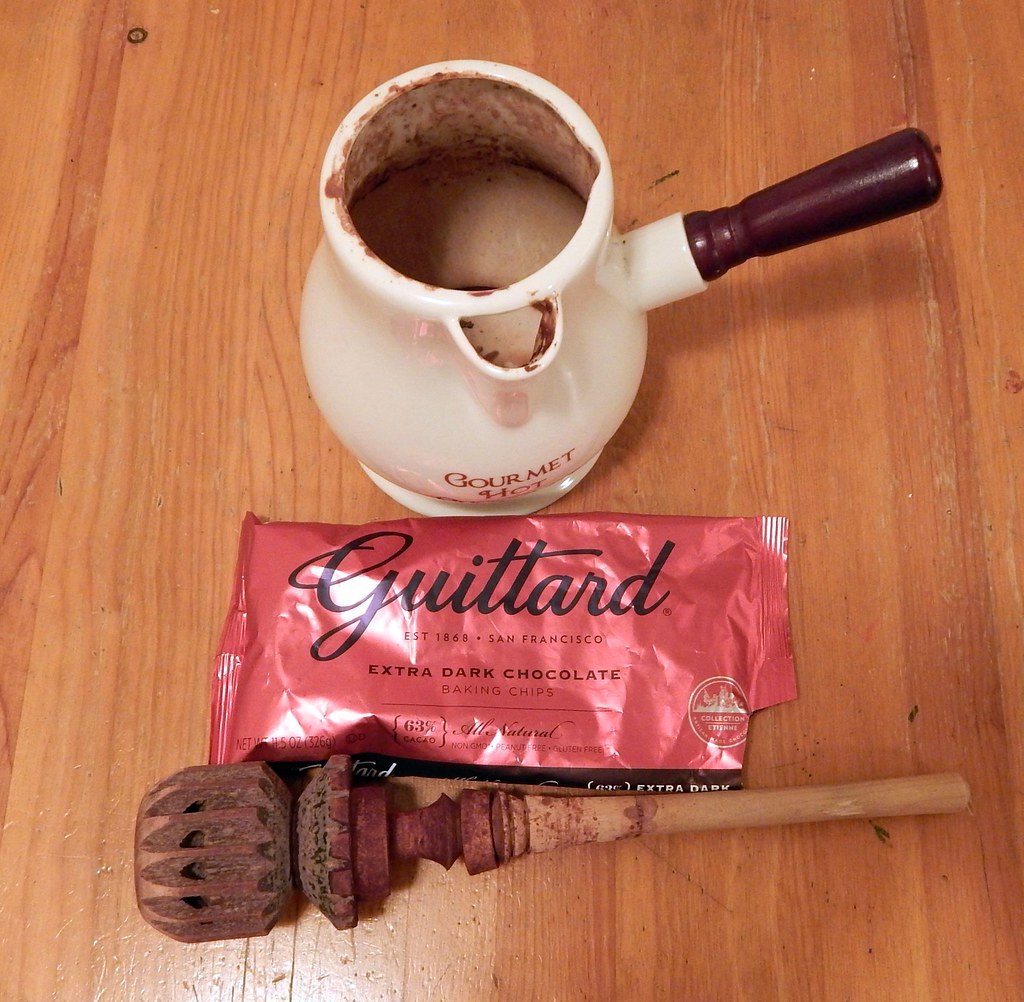
I discovered Guittard Extra Dark chocolate chips a few years ago, after having used Winco's chocolate buttons for a while.  These things are 63% cacao, which is a bit sweeter than I generally prefer, but they're convenient to use (they melt quickly into the hot water) and they're made with pretty good beans.  They don't quite have the complex richness that some of the finer brands have, but they're a lot closer that Baker's (which I used for a long time before I knew better).  Their ingredient list: Cacao beans, sugar, sunflower lecithin and real vanilla.


Ready to begin.  (I'm not very happy about the color here - I'll try to do better in following pictures.)
The method is the same for each one we try: heat the water to boiling, pour into the pitcher and beat it with the molinillo.  I got my main molinillo (pictured above) in a Mexican import store in Pittsburgh, and as for the pitcher, I don't know where you can get one.  My sweetie found it for me it at the local DI (Deseret Industries, a chain of thrift stores managed by the LDS Church).  But it's similar to one I found at Bed, Bath and Beyond.  Sorry not to have a link to buy one of those yet.

I used 2 oz of chocolate chips and 1/3 cup of water per serving, and made three servings total (I shared mine with the baby).  Here's what we thought:

The baby said: "Nomnomnomnom!"

My sweetie and our seven-year-old both thought it was quite sweet, grabbing at the back of the mouth, with an earthy kind of flavor.  I found it slightly caustic on the roof of my mouth, with a reasonably clean finish and a rich dark flavor.  Not as elegant or delicate in its bouquet of aromas as some varieties, but good and dark.  There's something in its flavor that to me suggests beets, in a good way.  Thick and maybe I would say somewhat fuzzy.

All in all, an excellent chocolate for common drinking.  I've used these for demonstrations in schools due to their ease of preparation and relative cheapness, and I expect I will continue to use them often.  If you want to buy some online, Amazon sells them in packs of four:

Thursday, January 21, 2016

Introducing the Chocolate Project

Some of you may remember my post of a few years ago where I wrote, in bad Early Modern English and worse Caroline minuscule, a recipe for the drinking chocolate that I like to make.  Ever since before that time - ever since reading The True History of Chocolate by Sophie and Michael Coe (affiliate link) - I've dreamed of starting a Chocolate House like they used to have in 16th and 17th century Europe.  Last summer I even went to some business planning workshops and tried to draw up a business plan for the idea.

I came away from it rather discouraged: even in Utah, where a Mormon-friendly alternative to coffeehouses would theoretically have the highest chance of success, I came to believe that the culture that would be needed to support the kind of establishment I have in mind simply does not exist.  Building a culture is no small matter.  If my novel, when it gets published, gains any appreciable popularity, then that might do it.

Meanwhile, I thought: what if I developed a product to sell?  Gourmet hot chocolate and drinking chocolate has been rising in the collective conscious like an underground lava dome, and I still see plenty of inexcusable ineptitude: people selling cocoa powder concoctions as if they were "drinking chocolate" or passing off coarsely-ground beans as gourmet because all that grit must mean it's legit . . .

Not that I have anything against cocoa, mind you, as long as it's done honestly.  Cocoa/hot cocoa and hot chocolate/drinking chocolate are two distinct things, and I'm on a mission to educate people about this.

So here's my latest project: the Chocolate Project.  I'm going to make a scientific, or at least a systematic, series of experiments in chocolate beverage-making, to work toward my product development goals.  Along the way I'll share my recipes for kitchen tinkerers and fellow chocolate lovers to share in my discoveries.  And I'll blog about it on this site, as well as post about it on social media.

I'm also dragging my family along on this.  They don't seem to mind being subjected to regular fancy chocolate, for some weird reason.