(I took the header picture of a Common Loon resting on a pond in Utah on its way north in June of 2015. It was in transition from winter to summer plumage.)

Translate - I dare you. Then make a comment on the funny errors the translator made.

Showing posts with label Economics. Show all posts

Monday, July 23, 2018

First corn

This is the second year in a row that we have planted a garden in the yard of our new house - for which we are and will ever be grateful.  Last year we had some tomato plants and herbs.  This year we have tomatoes, peppers, melons, cucumbers, corn, beans, squash, herbs . . . and a cabbage.  I'm constantly making plans for improving, and since I'm doing a no-till approach for most of it, I've got cardboard boxes laid down over more land to expand.

We have two kinds of corn growing: Painted Mountain and Hopi Blue.  I timed their planting so they wouldn't cross-pollinate, and it worked: the Painted Mountain, which I planted in April, came up in the beginning of May, and its ears are ripening as the Hopi Blue is just starting to pollinate.

This evening I picked the first two ears of the Painted Mountain corn, and here are some pictures.

Thanks to my sweetie for taking this picture.


These were the early birds.  The rest of the ears will probably be ready in a week or so.  We'll hang them up to dry, use some as decorations in the fall (along with the blue), and then . . . 

We will eat it!

If you want to see a little tour of our garden as it looked about three weeks ago, you can watch the video below.  The tomatoes and blue corn have grown a lot since then.


Sunday, September 10, 2017

Quest cooking: Rice pilaf

Yesterday I decided that too much time had passed since I'd used my rocket stove, so I cooked a simple meatless pilaf on it.  It had been a while since I'd done rice on this stove.

Here's what I put in:
About a tablespoon of ghee
Half a yellow onion, sliced
A carrot, sort of julienned
Salt
Cumin (about a half teaspoon?)
Two cardamom pods, shelled and ground
Red chile (a teaspoon or two, my hand slipped) - in honor of a departed sister of mine who used to live in New Mexico, may she rest in peace
1 cup basmati rice
1 2/3 cups water

Here are some pictures, taken by my sweetie.


Tending the flame while sauteeing the onions.  For the initial hotter flame I used twigs cut from our quince bush earlier this year.

Carrots and spices waiting to go in

After frying the dry rice with the vegetables and spices for a bit, add water . . .

. . . stir, and simmer over a lower flame for about 15 minutes.  For the lower flame I used dead branches cut from our plum tree, about half an inch thick, two at a time.
By moving the pot around the stove every so often I hoped to avoid getting a burned spot in the middle.  I still got a darkened spot, but despite what it looks like here it wasn't really burned, and didn't adversely affect the flavor of the dish.
At church we've been attending a meeting dedicated to emergency preparedness (something that Mormon culture can sometimes take to extremes).  With recent events reminding us both of the necessity to be prepared for disruptions of all kinds and the appropriateness and limitations of different strategies for this, I want to keep my skills up in strategies not only for preparedness where we live, but also self-reliance and voluntary simplicity.  I'm glad we have neighbors on our street who are also interested in this kind of thing.

Friday, August 4, 2017

Preserved lemons

I haven't got apricots this summer, and I might have missed my chance, which is too bad.  I wanted to eat some fresh, dry some, and pickle some like I did last year.  I still have some of the ersatz umeboshi that I blogged about, and they're still good and salty and potent.  I've used them to flavor beans, grits and sauces, only rarely eating them straight because they're so salty.  It looks like I'll run out of them and not have any to replenish, unless I can quickly get some apricots.  The harvest has been meager around here this year, so I might have to settle for store-bought trucked-in - bleah.  But for the sake of the brine, it might be worth it.

I wanted to report on another food project I did this spring: preserved lemons.  These are a tradition in Morocco and other places (my Lebanese cookbook has a recipe).  I've been wanting to try them and when we visited Mesa, AZ this April I had my chance: the last of the citrus was on and some neighbors of in-laws had a tree that was burgeoning with more fruit than they could use.  So my older daughter and I went and picked huge lemons and grapefruits.  I'm really getting spoiled for fruit: I don't want to buy lemons or grapefruits from stores any more either.

Anyway, I took some pictures.  Here are some of the lemons:

Some of the smallest ones - barely fit four in this jar
 I did two jars: the smaller one you see here, and a larger one.  The smaller jar had more salt - I thought it might be too much - but it kept fine at room temperature after the first month curing.  The larger jar developed a skin of mold on top but I scraped it off and the lemons are fine.  I keep the larger jar in the fridge, and the smaller jar has been used up by now, from sharing with others and using in recipes.

The juice - lovely salty sourness - is excellent for hummus and guacamole.  The peel gets really soft and is easy to mince, crush and grind, and I like to put it in dressings and sauces, though I'm still getting used to the flavor.

Also in Arizona I picked a bunch of little ornamental oranges from my in-laws' tree.  They're sour and not very juicy, but while we were staying there I found that their juice made a wonderful pasta sauce with olive oil and garlic.  So I decided to preserve some of them in salt too.

The mini oranges - on the table you can see bits of cloves from some pomander balls I also made that day (I must not have done them right because they went bad - the pomander balls I mean).


Packing them in salt

Trying to squish them down so they'd be covered in juice

The two fruits in their jars ready to cure, with more lemons in the background

The preserved mini-oranges combine the tangy complexity of orange peel flavor with intense saltiness, bringing a surprising bright taste to savory dishes.  It's not something I'm used to but it''s delicious.  I particularly like to use them in peanut sauces.

I don't know if we'll go to AZ again next spring, so in case we don't I might have to pay for family to pick and send more fruit.

Tuesday, August 30, 2016

Fictional foods: apricot experiment update

So last month I posted about salting a bunch of apricots.  I've done some more work on them.  A few days after I started, I saw that the brine was slowly leaking out from the bags, and so I combined both batches into one and put them in a pickle jar.  So much for trying out different kinds of salt.

This is what they looked like after sitting for a month.
 The umeboshi recipe I was working with said to sterilize the vessel with vodka before putting them in it, but we don't keep vodka in the house, and besides, I kind of thought the whole point of people discovering how to preserve food in salt was so that you could, you know, put it in things like jars and barrels without it spoiling?  I've made sauerkraut before in glass jars after just washing them in hot water, and my dad grew up making sauerkraut by packing the cabbage and salt into the barrel with the end of a baseball bat.  So I took a risk: as long as my jar, cup and rocks (to weigh the fruit down and keep it in the brine) were clean, I'd see what happened.  As you can see, they looked fine, and as you can't smell, they smelled just like vegetable matter fermenting in brine should smell.

The next step was to dry them in the sun.  Since I currently have Wednesdays off from work, I decided to let them sit out that day last week and see how dry they'd get.  After all, strictly speaking I'm not making umeboshi, just something very close.
Just out of the jar, drying on a cut-up old undershirt (washed, of course) and paper bag.
At first I kept moving them to stay in the sun while keeping them close to the house, and then when my sweetie had finished running errands, I put them on top of the car.  I thought they might dry out more at the end of the day, but after bringing them in, I decided to pack them into a clean dry glass jar and see what happened.


After a day in the sun.

After a few days in the jar, after drying.  You can see the thicker brine that's seeping out in the bottom.

So they've been sitting in their jar for a week, and so far they're doing fine.  I used one in a bowl of beans I took to work, and I have to say they work very nicely with pinto beans.  Their flavor is not quite like umeboshi: its almost metallic, and is taking some getting used to, but I'll keep experimenting to see what they go well with.

 I'm looking forward to tasting them in a few months and finding out how the flavor develops.

Sunday, August 14, 2016

More heart's blood

I mentioned in a previous post a regrettable decline in pioneer values that I perceive in the developing towns along the Wasatch Front.  Where I live you can see a curious mix of old houses in reasonably good shape, decrepit buildings where closed businesses once stood, and newer stores, office buildings and roads built to accommodate and encourage the post-industrialist consumer lifestyle of today.  It is always sad to me to see how often the older buildings with a cozier, more human, more convivial spirit to them get left to decay and then swept aside, or re-purposed: along one length of a principal street are several lovely old houses that now hold retail businesses (existing perhaps tenuously) or professional offices.

To me this is all a betrayal and defeat of the vision that settled this area, and to my view an honest assessment of the current social and economic order of the Mormon heartland must confess that we have a sad state of affairs.  Land that could be productive, used to house people in modesty, industry and communal self-reliance is regularly parceled out to build luxurious dwellings at obscene prices.  Small businesses feel they must curry favor with the trendy whims of indifferent consumers in order to survive: it is harder and harder to count on a robust spirit of 2 Nephi 26:30 to keep any enterprise afloat (and you can just forget about verse 31).

An unreflective enthusiasm for a gospel of growth and prosperity gives carte blanche to expressions of arrogance and greed that are embarrassing and insulting to an idealistic viewer.  I think it no coincidence that Hugh Nibley wasn't allowed to fulfill a career of scholarly inquiry and social criticism in peace without his persona and legacy being yanked into extremes of adulatory folklore and allegations of the most sordid private sins: our culture has little tolerance and less use for principled and consistent critiques.  And attempted critiques regularly veer into reactionary political stances, which I also find very sad and self-defeating.

But I realize too that self-reliance is hard, and not exciting or sexy.  I think a great deal of the consumer mindset that produces such callous effects worldwide in fact is rooted in the desire for miraculous deliverance: how wonderful it is, after all, to see something like a new restaurant arise from the ground, and to spread its large printed advertisements across the land for miles, with no effort from me!  Is it not something like an experience of grace, to be able to simply walk into a clean, climate-controlled, brightly-lit and fragrant space, with nothing required of me other than to be served, to make my selection, and then have the freedom to leave in search of another similar environment?  Granted, we have to pay for the things we get here, but beyond the money we part with for specific goods and services, the larger message is of this abundance from above and afar: these brands, these buildings, this infrastructure comes to us, lifts us up, and asks nothing more of the worthy among us other than an attentive duty to the specialized abstracted tasks laid out before us in yet another climate-controlled and brightly-lit space.

I think that all this truly fees like heaven to many, many people, in an unconscious or at least little-examined way.  My conscience, in exercise with my intellect, is still set against it, but I have a clearer understanding of it now.

Sunday, July 24, 2016

Fictional foods: experiments with apricots

I've spent a lot of time building my world, and part of the process of making it as rich and realistic as I can is thinking about what people eat there.  Over the years I've done quite a bit of experiments in the kitchen as I've concocted and invented recipes that I imagine might be on the tables of various lands and peoples.  Something that I'd like to do some day for LTUE would be to help organize a potluck meal with participants bringing dishes from stories they liked - or wrote, or are writing.  M.K. Hutchins, whom I met at the 2014 meeting, had that idea, and I need to talk to her about it again.

You should read her blog: she puts recipes up there, for fictional foods as well as for authentic Aztec chocolate.  And you should read her stories.

So it's apricot season here in Utah, and a nice neighbor let us go and pick from her tree.  This was last week, and the fruits were only just starting to ripen - everywhere I drive I see trees loaded with fruit and it makes me sad.  There's more than I can ever pick or use, and apparently more than most people want to pick or use - one more lamentable loss of pioneer values.  I'll make a quick plug here, to any readers in the Wasatch Front area, for the Glean Utah and Glean Provo Facebook groups.  They need a lot more attention, as do the fruit trees around here.

So, in my tiny attempt to do my part, and enlisting the help of a zealous seven-year-old, I ended up with a lot of apricots that are not quite ripe.  I ate as many as I could, and I still had all these others sitting here, and outside there are still more and more ripening.  I thought about what I could do with these, and I decided that with the ripest ones I would make freezer jam.

And with the unripe ones, I got this crazy idea: what would happen if I packed them with salt and let them sit?  My Japanese cousins had introduced me to umeboshi years before, and I remembered that those aren't really plums but a certain variety of apricot.  Would plain old apricots work?  I did a search and found exactly what I was looking for: yes!

I thought to myself: this is Japanese, but the ingredients - apricots and salt - are plentiful in Utah, and of course also in the environment where much of my work in progress takes place (one of the states there owes its wealth to the salt trade).  So why wouldn't the people in my world preserve some of their apricots in this way?  How they might use these pickled fruits in their cuisine?

So I got started: washed the fruits and picked out the unblemished ones,


packed them in bags with salt (and a bit of vinegar)

I used sea salt for the one on the left, and Himalayan pink salt on the right.  I didn't have enough Real Salt (from Redmond, UT) left to use on this.

and put the bags in a dark cupboard where they'll sit for the next month.

Meanwhile, I also found out that Mexico has a similar food tradition: saladitos and chamoy.  After all, why not?  If you have certain ingredients available, people are going to figure out different ways to combine them.  It just goes to show that while we might identify certain foods or ingredients with a certain culture or place, the world is wide and varied, and the human imagination even more so.

Happy Pioneer Day!

Sunday, March 20, 2016

The Provo City Center Temple

This afternoon my sweetie and I attended the dedication of the new Provo City Center Temple.  It was done in three sessions and we attended the third, broadcast into a meetinghouse in the town where we live that isn't Provo: I don't think there were regular church meetings anywhere in Utah today, at least not along the Wasatch Front.

They made such an effort to let as many take part in the dedication because this temple has a unique history.  It was built in the shell of an old building that used to be a tabernacle.

The old Mormon pioneer tabernacles are some of my favorite things.  I don't know how many survive now, but for years I've thought I'd like to take a tour of them.  They're essentially large meeting halls, with two levels of seats, and are often used for cultural events as well as church meetings.  The big dome-topped Tabernacle on Temple Square is probably the most famous, and the biggest (at least before the humongous conference center was built).  But the buildings I'm talking about are more like the smaller Assembly Hall on Temple Square.  Several of them were built with Gothic Revival architectural style or influence.

I loved the Provo Tabernacle, ever since moving back to Provo in 1994 and attending various concerts there.  When I heard the news of the fire that gutted it in 2010 I was devastated, as were countless others.  And I thought: the Church should restore it, but it probably won't.  So I was also glad with countless others when the plans were announced the following year to not only restore it, but to turn it into a Temple.

We went through it during the open house, and I have never been in another Temple that I have found as beautiful or moving.  The stained glass windows, the decorative motif of four-petaled flowers, quartered circles . . . dare we even say, crosses?  And all the wood!  There's wood everywhere, stained a rich warm homey brown.  We call Temples the House of the Lord, and this one really does feel like God's living room.  The pictures linked above don't really do it justice.

I can't deny feeling a certain sense of loss at this beauty - flawless and immaculate, but cozy - being reserved for a Temple instead of in a building kept open to public access.  I comfort myself with the thought of the other tabernacles still standing.  And it's also comforting to see a Temple displaying more hobbit-like charm than the cold white-on-white austerity that has been the norm for so long.  I like to think that it's a sign that the culture of the Church is changing for the better.

It's slow though.  There are complex meanings and signals I see in a place like this.  Mormons love luxury, even when they're indulging in pioneer fantasies, and I see a perfect example of that in the interior of this building.  I believe in comfort, in abundance, in wealth, even - but I believe in it as an ideal to be socially made and shared.  And as I see it, that was the ideology that drove those pioneers to make such improbable structures in their frontier settlements.  For a group of people in a place with no infrastructure to speak of to pool their resources and coordinate their labor to raise the most beautiful buildings they could, in brick or even granite, instead of slapping up cheap board facades . . . I understand and share the indignation that Mormons felt when the railroads brought the Gentile rabble from the east with their piddly, trashy saloons.

The tabernacles stand to me as a signal of hope in the promise of collective and cooperative enterprise, an ideal that our culture has for the most part turned away from with a multitude of blindly individualistic sneers, simultaneously gentrifying and uglifying what was supposed to be a Zion society.  To see those empty brick walls held up and filled with something that is so obviously a tribute to the spirit of those early days (even if the work of building was done by hirelings instead of by community effort), and offered up to God, is another sign of hope in my eyes.

Wednesday, January 20, 2016

Can I make a fortune as a writer? A rant.

I regularly get messages in my inbox from people offering to sell me the secrets of success.  Today one of them offered access to a free training session on how to become a published author in ninety days.

I see this kind of thing and I think: how strange it is that in a cultural environment resting on the foundations of Gutenberg and grammarians, we should see a situation prevail which reminds me of antiquity: in order to publish a book, why, all you have to do is hack out your ideas and release them to the world!  - Except now we don't have an environment of scarcity: modern societies aspire to universal literacy and publishing doesn't require a staff of slave scribes or even a contract with a printing press.

Let me tell you why I'm skeptical.  As someone who has been writing for 20 years, I know how much work it takes to write well.  I estimate that I'm about three-quarters of the way to the million words that it takes to gain mastery of the craft - and I have deliberately underestimated.  People tell me I write well.  Sometimes I let myself believe it.  Sometimes I say so myself on a cover letter, because I have to admit that compared with many other people, I do.

But that's because I have worked at it so much.  And I know that good writing entails rewriting.  This is especially true for creative writing, but anything that seeks to be of real use is going to have to go through a critical eye and get rearranged.  I've written my share of relatively dry and utilitarian stuff but even for that I didn't publish first drafts.

Thousands of people write 50,000 words in 30 days every November.  But that doesn't mean their drafts are ready to be published.  Reputable advice about NaNoWriMo will reassure you that when you're "finished," your book will suck.  And that's ok, because now you can take the time to edit, revise and rewrite, to get it ready to publish.  Some NaNo-ers like to try to get this done within the year following the completion of their first draft.  To do that in two months?

When I was a faculty member at a certain university, I took part in a semester-long writing workshop.  Right off the bat I was disappointed by the message that the presenter gave: don't worry about trying to say something original, she said, just join the conversation.  I thought: well, isn't that what the Internet is for - for people to just sound off and repeat the same conversations over and over until at some point hopefully they get off and graduate?

I've since come around to her way of thinking to a point: "ring the bells that still can ring, forget your perfect offering" and all that.  But here's the thing: even operating on such a premise, the article that I wrote - and published - through that program went through peer reviews.  It got rejected twice before I got it into shape fit for publishing.

I look at these people who say they've gotten rich publishing ebooks that they wrote in no time and I think, what on earth can they be writing?  If it's fiction or poetry or even personal essay I would rest easier: creative writing thrives on the endless permutation of themes, characters and questions.  For current events there's journalism.

But from what I see, I strongly suspect that what many of these people are writing is "content" that you could have from other books already published, if you simply took some time and care at the library.  That would mean that the fortunes of these few depend on the hurried laziness of the many who would rather pay a few bucks for convenience than do any serious investigation.

Blogging is to blame for this in great degree, I'm sure.  I might also be inclined to point a finger at NaNoWriMo, but I think it's more than bias born of affection that gives me pause there.  For although I have read the success stories about the people whose NaNo novels get published - and read - the emphasis I see in NaNoWriMo's promotions is far more weighted on the personal fulfillment of accomplishing the writing for yourself, and honoring your creativity.  I don't see the same mentality of "look how easy it is to make loads of money!"  Because - well, imagine this! - people who have a story to tell aren't always in it for the money.  And maybe the people who care about quality of prose and rigor of thought aren't out to get rich either.

Much of the blame for this I would also lay at the feet of the Prussian-derived public school systems, but I think that might be another story.  And I'm sure someone could lead an informative discussion about the nature of newspaper journalism in relation to all this.

I don't know if I should be disturbed at this or not: I'm charitable enough, I suppose, that I look at these cheerleaders for the drop-out-and-travel-the-world-by-publishing-ebooks (or an affiliate marketing blog) lifestyle and I think: is there a possibility this might not be just another variant of the Get Rich Quick Scheme?  To their credit, I do read from affiliate marketers who say that it took months to see results from their efforts.  There are even some like this guy who project a gruff persona to try to drive away the lazy people who just want to plug into the system and get paid without making an effort.

Again and again I find myself reflecting on the curious case of Nehor, as recorded in the Book of Alma: a guru of positive thinking and a gospel of prosperity, he got so angry when an old man argued against his ideas that he killed him.  And his followers perpetrated some of the most ruthless atrocities of their time.

So I see these smiling guys who can't seem to put together a sentence without using the word "awesome" or "amazing" and I think, what would they be like when cornered?  What claws and fangs would come out if they found that someone was putting their ebooks to their natural use and copying them for free?

There's more that I can and want to write about this, but it might take several more posts and/or a dissertation.

Wednesday, December 2, 2015

My grandmother's unfinished work (including a scanned typewritten page)

Lately I've been going through some old family papers.  There was a time, not so long ago, where I worked full-time as a professional archivist.  Since then I've kept my hand in with some side projects, and this is the latest one.  As with any project involving personal or family papers, there are easier parts (like sorting letters) and then there are the perplexities - in this case, my grandmother's writing.

My paternal grandmother was born in Salina, Utah (how many of you reading this have heard of it?) and had an expansive and curious mind.  She wrote poetry, drew and painted, as her time allowed while raising children and keeping house, and when her children were grown she went back to school, where she planned on writing a Master's thesis on the history of her hometown.  She never finished it, but she left a quantity of handwritten notes and drafts, including many typewritten pages with corrections and revisions.  Working with all this has reminded me forcefully of a collection I worked with in my former archives job: the manuscripts and research notes of another woman who had attempted to write a history of her hometown and left it unfinished at her death.

I wrote about it on another blog I maintained at the time, commenting on the tendencies I saw in her methods and the affinities I saw with my own.  My grandmother left behind much fewer notes and drafts - at least, much less material has come to me - but working with them is of course much more interesting to me.  I recognize in myself a wish that she showed to address a wide range of questions within the scope of what might seem a discreetly-defined subject.  Her research into her hometown's history seems to have swung wide to accommodate various reflections on sociology, economy and theology - not surprising, really, when you consider Salina's history as a Mormon Pioneer town.


I think that the work my grandmother left undone was motivated by either the same spirit or a similar one to what has been working in me for several years.  In my case, I'm attempting to express my ideas in fiction, and while I don't know how early on my grandmother began her work, I think of my age and my life responsibilities, and I don't want to let the rest of my life go by without finishing.  Maybe this can be one more motivator for me: to finish this for her sake as well as everything else.

Thursday, February 27, 2014

Some thoughts after reading The Fountainhead

(One of these days I'll get back to typecasting.)

So I finally read The Fountainhead. I stayed up past 1 in the morning to finish it, and in fact I even cried at several points throughout. I want to buy my own copy of it and underline passages and write all sorts of things in the margins.


This book has been staring at me for about 20 years from library shelves, mostly through the editions with Art Deco covers. Those were terrifying Apollonian arrows pointing to a destiny that I put off for too long (like Thomas Pynchon, but that's another story). So finally I checked out a copy from the local library and got sucked in. Today, a day after reading it, I wrote the following.


Producers and parasites. In the Fountainhead Ayn Rand shows (somewhat melodramatically, but that isn't a bad thing) model characters or characters as models of these principal types in their purity. I find myself unable to dispute the core of the principles in their purity, but what I think is the cause for worry about Rand isn't the truth in the “selfishness” that is essential to every individual soul (and I want to write more about that, also parse Lehi's “men are that they might have joy” in relation to this), nor is it the core principle of whether one produces or not. Of course in real life when one person produces something and the rest of us benefit. I think of Robert Fripp's words: “Music so wishes to be heard that it calls on some to give it a voice and some to give it ears.” Civilization has been around long enough to make the manifestations of these principles – in pure and perverted forms – so complex that applying them to real-life situations entails doing everything you can to trace each economic interaction and relation back to its roots. This is why mainstream partisan politics are so dissatisfying, and why TV news and talk radio are such dismal ways to try to be informed about what's going on in the world and what you can do about it. This is also why parlor politics rarely if ever gets beyond a ritualistic bashing of everyone's favorite imagined villains, backed up with appeals to everyone's favorite authorities.


I've certainly seen Ayn Rand cast as a villain, a Korihor-like prophetess of greed and callousness. In the purity of her concepts, I accept that she wasn't advocating racism nor greed for money and power (at least not in The Fountainhead). On the contrary, she exposed those as betrayals of self, mere variations of “second-handedness.” So why does she get such a bad reputation? I haven't studied her Objectivist philosophy, so I don't know what else she wrote that attracted such ire, but I intuit the following scenario repeating countless times: a man goes out and makes a load of money in some business, reads Rand, and then says: look, I have made stuff, employed people, ergo I'm a producer. How many people completely miss the lesson of Gail Wynand? How easy it is to assume that the producers in society are not just the entrepreneurs (which is already too narrow) but the ones who have become wealthy. And how easy it is to use the label “parasite” as a politically correct justification for dismissing any concern or basic human empathy or at least rational consideration of whole swaths of people. Are they the ones making the money, making the jobs? Are they among the few, the proud captains of industry? No? Are they in misfortune, are they (or do we see them as) dependent on any kind of assistance? Do they have the impudence to procreate without having steady means of their own self-sufficient heroic make to support them materially (according to our standard of living)? Yes? Why then they're parasites. Q.E.D. And we don't have to worry that we're being racist by going along with the wink-wink nudge-nudge because Rand (or whoever) Said, so we're absolved of any effect our actions have of perpetuating collectivist oppression. Of course we'll put ourselves in the camp of producers as we whine in our parlor talk or radio call-ins or at the voting booth, even if we're working at jobs we don't really want, even if our political involvement is really an attempt to prop up some sense of meaning in our desperate lives, because we think we Get It. It's so easy to slip into this.


If there are people living in poverty we don't have to cathect to our images of them in a show of pity and meddlesome “charity,” but neither do we have to dismiss them as feckless failures because they're not all independent workers (though what if we all could be?), with the gumption to stick with their work through the tough times without complaint, facing the world alone like Roark did until enough of us finally come around to reward their contributions (through fair media of exchange that might not be available, which we might not want to admit).


Everyone is born with their own gift to give to the world, and some are more prominent than others (after reading The Fountainhead I feel I now accept the parable of the talents better, and have a new appreciation for Alma's mission to the Zoramites too), but it has to be remembered and acknowledged that the forces that so stifled the gifts of the producers included entrenched money interests, impersonal boards of directors and other features of the capitalist system. How easy it still is for second-handers at the helms of powerful corporations to cravenly claim that they are the real producers, while continuing to suffocate the world under mediocrity. It's no longer drippy Progressive preaching of self-sacrifice, it's brazen praise for “self-interest,” meaning the appetites and dictates of false, non-individuating selves: blind egos, contemptuous introjects, unacknowledged complexes, possessive archetypes – but not the true soul of every Self. A lazy appropriation of the terms of “self-interest” and “selfishness” makes it so easy to fall back into the conventional semantics that Rand took so much trouble to take apart that I wonder if it was worth her trouble and she might as well have coined a new term.


For a similar reason I currently have no interest in Objectivism as a philosophical system, because it still stinks to me of Intellectual Property, which I don't believe in. Looking briefly at the character of Roark: there is no need to impose a fiction of “intellectual property” on the architectural designs of someone with such a unique vision. If someone were to copy one of his buildings it would be imitation as tribute, flattery or incompetent servility – but it would not be theft. It means much that Rand includes the dialogue about individual private ownerships of our experiences with the world: Roark owns his buildings irrevocably, but so do those who use them or even see them, each in their own inviolate way. For Roark to act like too many so-called libertarians do, he would have to post guards outside all of his buildings to charge fees for walking in or even looking at them.


This has to do also with the struggle I've long had with reading or talking about philosophy. I like reading about it, and about psychology, and I don't dispute giving credit where due. But I return often to the words of Montaigne (in translation): “Truth and reason are common to every one, and are no more his who spake them first, than his who speaks them after: 'tis no more according to Plato, than according to me, since both he and I equally see and understand them.” (Essays Chapter XXV “Of the Education of Children” trans. Charles Cotton)


Even Howard Roark, who others see as cold and antisocial, takes for granted that if you saw a drowning man you would try to rescue him. It means a lot that in connection with this, when the young Gail Wynand is crawling along the sidewalk after being beaten nearly to death, the one person he asks for help dismisses him in “bovine indifference.” That adjective is important, because it is certainly an inhuman act to be so callous towards a fellow being. Rand showed this here and I'm glad to have read the book in order to have seen her acknowledgment of this truth.


Even so, the fact that she spent so much effort justifying her unorthodox use of phrases like “self-interest” and “selfishness” might not be enough to defeat this danger: the bare words stick in minds when their substance has ebbed, and then people are quick to attribute the conventional meanings to them and justify their inhumanity by the same kind of servility to a creed, this time a secular one: Rand – or whoever – Says. It is the exact same phenomenon as “the Scriptures say.” Any such vague appeals to authority should immediately put your internal radar on the alert. I can't help but think of the parable of the Samaritan when I read that episode in Wynand's youth, and I don't know if Rand had it in mind, but I'm glad she didn't have the scene take place at the door of a church, with a reverend wrinkling his nose at the human trash importuning him and slamming the door. Whether Rand meant to or not, she shows respect to Jesus' parable here, by letting it stand as a definitive statement of how religion so often leads people to do evil. She respected the parable by rounding it out, and showing how the betrayal of self which leads to such callousness can come from other sources besides religion.


The bar-keeper's refusal to help the young gangster is a betrayal of himself. It seems like selfishness and most of us would describe it as such, but it's the same kind of second-handedness that the young victim swallows and which sets him off on his meteoric rise to power. In refusing to help a young man nearly dead at his doorstep, the barkeeper is not listening to his human self in recognition of another human self, he is listening to the blindness of an ego that pits itself against others, that judges the worth of souls according to criteria inherited and accepted from others without question: gangsters, street trash, worthless. This is the turning point in Gail's life, when his refusal to accept incompetence fermented into his resolve to rule. Who knows what his career might have looked like if he hadn't started it out with such a foundation, and if whatever enterprise he began allowed room for other producers to work within it true to themselves? Do I mean something like Silicon Valley? Well, what would it take for such conditions to flourish and purify all over, not just in such pockets of privilege? I find answers to that question in E.F. Schumacher, Ivan Illich, Kevin Carson and others. For one thing, you can't get there with so much of human knowledge and invention locked up in copyrights and patents.


My working hypothesis is that most of the wealthy businessmen who are so adored by conservatives and so-called libertarians are more like Gail Wynand than Howard Roark. I wonder what kind of world we would have if half of them had the courage to make the kind of restitution that Wynand makes at the end of the book. Are Carnegie libraries enough?


One of the features in Roark's design that makes him so pure is that while those around him see him as a hero struggling against the world, he doesn't. He refuses to accept the charge of defiance that others try to pin on him, or even to feel the resentment that others feel in his behalf. He doesn't do his work out of defiance (as Wynand does), he does his work because he has to. When his first buildings go up, he faces accusations of faddishness, willful whimsy – the kind of thing that has put up monstrosities like the Information ScienceBuilding at the University of Pittsburgh. But through the book, it is evident that his love for buildings is inextricably linked with human empathy: he designs buildings with the consideration of what it will be like to inhabit them. The concern for others may be unconscious but is none the less powerful for that – in fact it may be its unconsciousness that makes it so effective. After Roark finishes the Heller house, his client says “You were very considerate of me.” Roark replies: “I haven't thought of you at all. I thought of the house. . . . Perhaps that's why I knew how to be considerate of you.”


One of the bits that brought tears to my eyes was where he sat with Dominique watching one of his buildings go up – a humble five-story store in an insignificant Midwestern town – and she expresses misguided sorrow at seeing such a brilliant architect stuck doing such insignificant buildings. He points out that it doesn't matter: he loves each building for its own sake. In fact, it bugged me, reading the book, that his Stoddard Temple of the Human Spirit is built so close to the earth, at such a human scale, as opposed to the intimidating grandeur of religious buildings throughout history which always tried to make people feel small and despicable (and there my straw man alert sounded the loudest of any point in the book), yet of course Rand has to have her characters gush about skyscrapers. And of course she also takes pains to qualify how skyscrapers don't make Wynand feel small but give him a sense of the “heroic in man.” What if the Stoddard Temple had been a tall skyscraper then?


When I read the part about the Stoddard Temple I thought of one of my Humanities teachers talking about Gothic cathedrals: their uplifting effect on the spirit as opposed to the intimidation of the older Romanesque buildings. Stepping into a Gothic cathedral, he said, is like getting on board a spaceship. (And it's interesting how Gothic architecture gets such scant mention in the novel.) I think I have come to respect skyscrapers in the way that Camille Paglia respects religion, but I'd still prefer a Gothic cathedral, or something like Simon and Jasmine Dale build – or Jung's Bollingen Tower. There's a temple of the human spirit for you!


The triumphant ending of The Fountainhead brought tears to my eyes, but it wasn't because the Wynand Building was the tallest on the earth. For me, Roark's greatest triumph is Monadnock Valley. That triumph flows from an explicit empathy for a human need, as Roark himself expresses in his presentation to the developers. By doing his work he has performed a true service to his fellow beings. So when later he lectures Peter Keating about how his design of Cortlandt Homes won't be motivated by concern for the poor slum-dwellers, I know what Rand means, and I accept that she felt the need to clear away the fog of Progressive sentimentality that surrounded her when she wrote. But it still reflects the truth that when you do find your own life's work and purpose, and are true to it, you inevitably benefit others – and I affirm the rightness of rejoicing in that and calling to that, even as I agree that boasting of it and taking it up as a sign of superiority over others corrupts it.

I choose to take as a sign of maturity that when I read the portrayals of sentimental praise for “the common man” in The Fountainhead, I didn't so much protest with the youthful idealism I might have once had – hey what's wrong with the common man? – but I reflected on the soul-sucking effects of state-imposed mass instruction, standardized testing and Common Core standards (which of course award lucrative contracts to a few winning business interests – are those people then Producers? Hell no!). I thought of an editorial by a retired teacher: “Please widen achievement gaps.” I thought of Sudbury Valley School and its dedication to democratic order which produces uncommon people, of Daniel Greenberg's statement that a right to vote is meaningless without mutual respect, of the self-fulfilling fear of mob rule by those who exercise their right to vote without exercising their brains.


“You are unique – just like everyone else.” “If everyone's special, no one is.” Such sarcasm is, to quote Jung, “the prerogative of habitual grumblers with bad digestions” (“Psychology and Religion” trans. R.F.C. Hull, Collected Works vol. 11, p. 105). Take time to reflect and to imagine what a world might look like where everyone really was equal in their right and opportunity to be unique. Let that dissolve the justifications you've accepted of everything that chokes such individuality – not only prevailing fashions in dress and so on, but the political and economic structures that support those who arrogate to themselves the undeserved title of Producers and betray themselves in imposing their mediocrity on the rest of us with state-backed protections of their so-called property.


 Ayn Rand might turn in her grave, but she is in agreement with Alma the younger in this: the outrage and impatience that come from seeing just how badly the world is run, how much individual human potential is wasted, should not be taken as an excuse to hate, but should strengthen the resolve of each of us to dedicate ourselves to the growth of our individual souls. Alma's tree metaphor (like that of the wise and foolish virgins) is self-centered in that way: you are the only one who can grow that tree, and you are the only one who can eat of its fruit.


So now I wonder if I'll go find out who John Galt is.


Also I have to wonder if Blixa Bargeld or any of his bandmates ever read the book.

Sunday, October 7, 2012

Quillcast: gleaning

Some calligraphy practice:
I'm not an orphan or widower, and not entirely a stranger here, but I'm still glad I got to go glean potatoes last week during harvest.
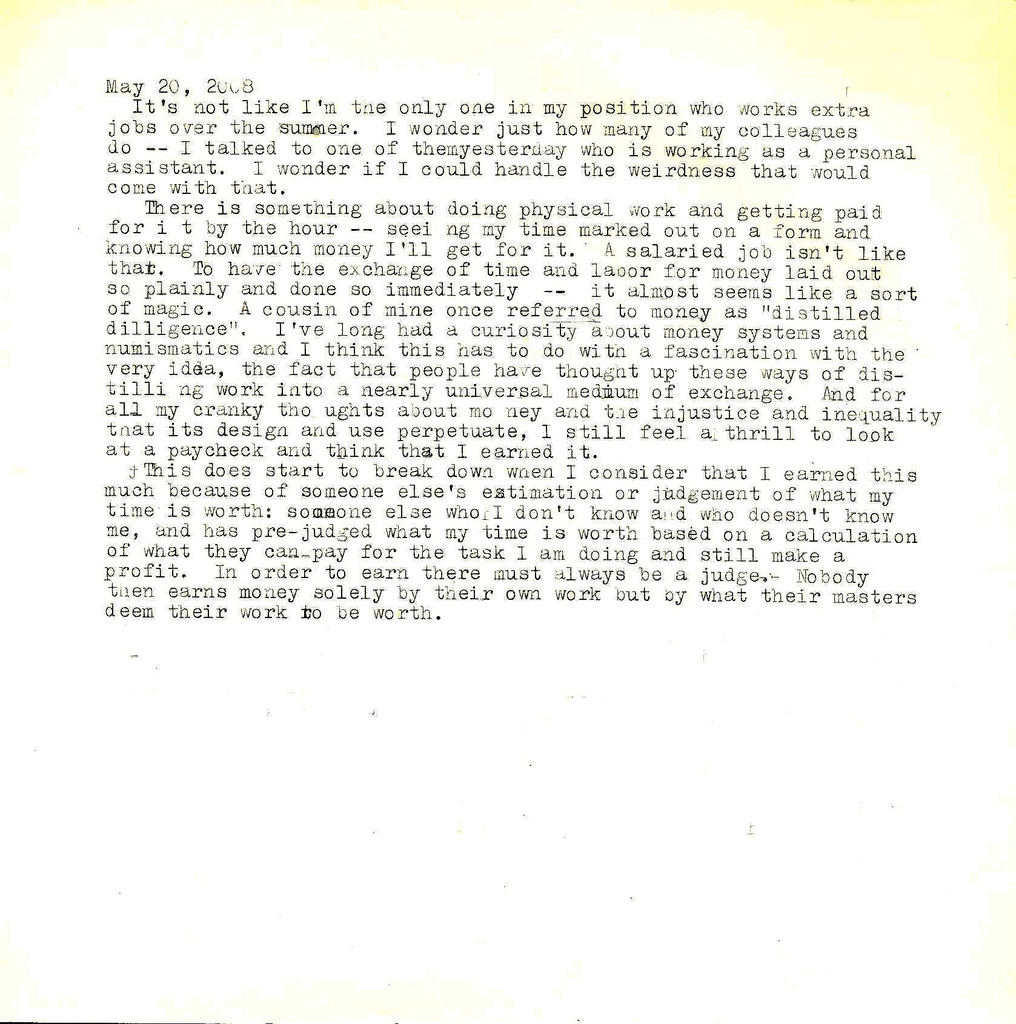
Wednesday, October 21, 2009

Typecast: by the rivers of Babylon

I have to post something because this is a blog. So here's what I typed today motivated by my chronic bleeding heart liberal Psalm 137 outrage.

Friday, February 13, 2009

Typecast: Wilfred Owen


SONNET

On Seeing a Piece of Our Heavy Artillery Brought into Action

Be slowly lifted up, thou long black arm,
Great Gun towering towards Heaven, about to curse;
Sway steep against them, and for years rehearse
Huge imprecations like a blasting charm!
Reach at that Arrogance which needs thy harm,
And beat it down before its sins grow worse.
Spend our resentment, cannon, -- yea, disburse
Our gold in shapes of flame, our breaths in storm.

Yet, for men's sakes whom thy vast malison
Must wither innocent of enmity,
Be not withdrawn, dark arm, thy spoilure done,
Safe to the bosom of our prosperity.
But when thy spell be cast complete and whole,
May God curse thee, and cut thee from our soul!


You can read more Wilfred Owen poetry here.

Friday, May 23, 2008

Temping

I got another typewriter. It needs a new ribbon. It also tends to cut through the heaviest paper I can find.

Monday, October 1, 2007

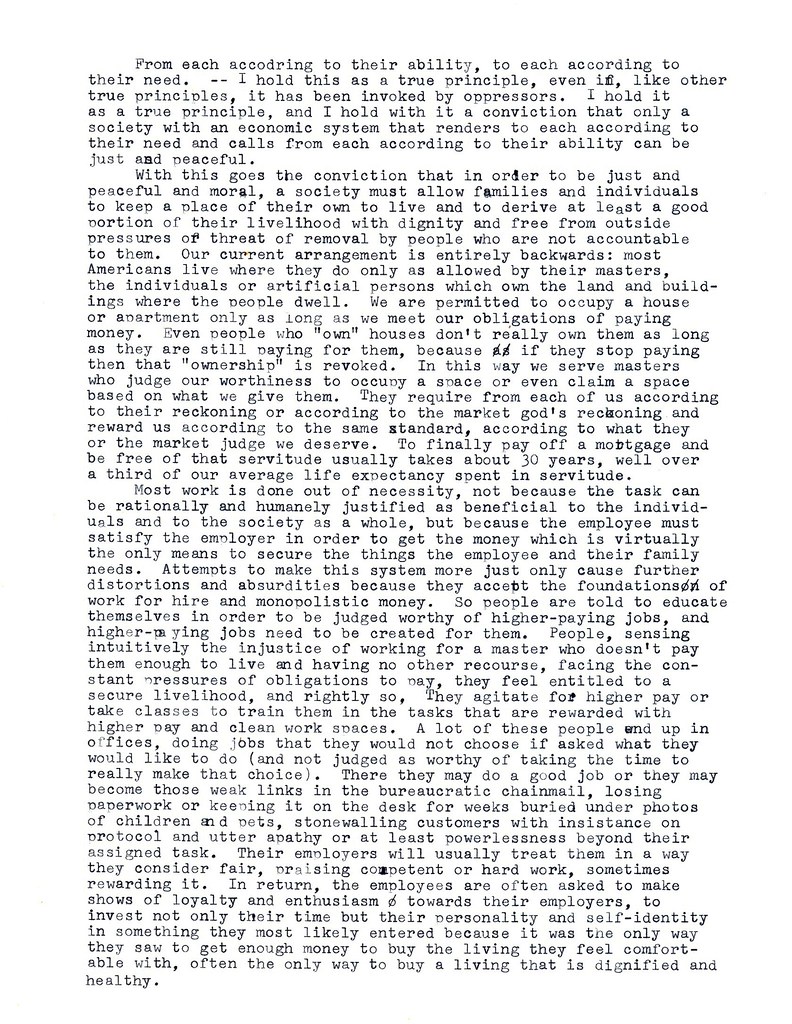
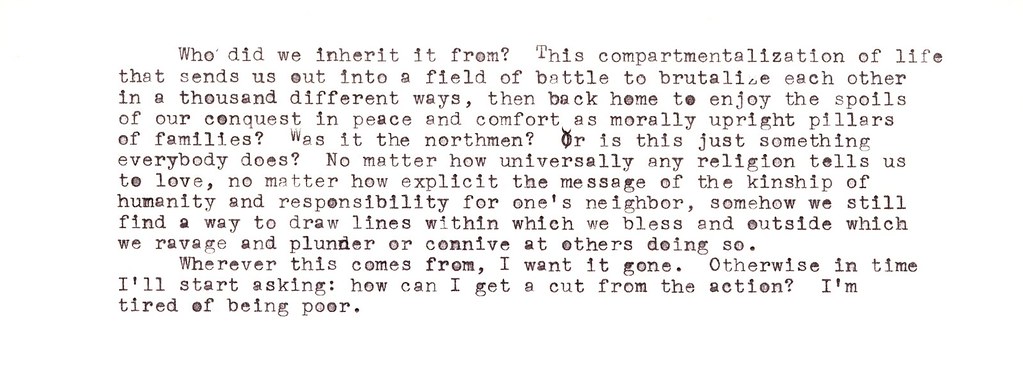
Some thoughts on work and the family

At a recent stake conference there was a lot of emphasis in the talks on the value of education and other things that got me reflecting again on the culture of privacy and sentimental domesticity that so many North American members of the Church adhere to.

Like anything, there are truths behind this ethos. Reading Stephanie Coontz’s The Way We Never Were and then Laurence Stone’s The Family, Sex and Marriage in England, 1500-1800 I still had nagging doubts: well, don’t people like to live in nuclear families when they can? This is what Ferdinand Mount argued in his book The Subversive Family: An Alternate History of Love and Marriage. I don’t remember seeing in any of these books any consideration of the scripture in Genesis that says a man will leave his parents – it seems to me that is probably the strongest scriptural support for the concept of the nuclear family unit.

I have become very dissatisfied and suspicious of any tendency to cast nuclear and extended families as opposing units. Talk of the nuclear family as a historical anomaly or artificial creation seems simplistic unless one makes clear that they are talking about an isolated or privatized ideal of the nuclear family, set up as a self-contained unit independent from its extensions, which I would agree is artificial and I believe carries the seeds of the disintegration of even that nuclear unit.

To say that the Industrial Revolution eroded or broke apart extended families strikes me as largely correct – and in fact I believe it began the breakdown of the nuclear family as well. To say that it created the nuclear family I think is a gross misunderstanding of how those who benefited from industry jealously guarded their nuclear families and began making a bigger fuss about them, in order to protect them from the family-destroying forces they were unleashing on the world.

Of course the losers in the new industrial system tried hard to keep their families together too, as Mount shows, and naturally the nuclear unit would have been easier to maintain in an era of footloose-ness than extended relations, especially among immigrants. But maybe the newly created industrial working classes remembered better than others that nuclear autonomy does not have to mean isolation, that nuclear and extended families do not have to be in opposition like so many have suggested.

In any case, many who wished to keep their families together and worked hard for that goal did not succeed, and were blamed. Or, families did stay together, but at the expense of accepting new ideas and standards (the cult of idle feminine domesticity, for example) that changed the family, made it less natural, or one might say, more natural in the King Benjamin sense: more selfish and insular than families had been in the context of cultures that retained more balancing wisdom?

I don’t want to be taken for a nostalgic believer in a pre-industrial golden age. But I do believe that when a culture changes suddenly – as the Anglo world did in the 18th and 19th centuries – then good things tend to be lost just as good things may be gained. And I believe that there were innovations in the middle-class concept of the family introduced in the Victorian period which led away from a healthy and true understanding of what families should be like. And since in the USA at least, the middle class ideal has been held up as the one all should aspire to, these perversions have taken deep root in our culture.

It is easy to interpret the Proclamation on the Family as reinforcing the Victorian middle-class ethos (maybe as easy as it is to interpret the Book of Mormon as vindicating the claims of the John Birch Society). But I have looked at the proclamation after rejecting that ethos, and found that the proclamation fits my dissident view just as well or better. I want people to be able to do that: to feel free to reject the Victorian model for the counterfeit that it is and still see the inspiration behind the proclamation. Otherwise, what is a thoughtful LDS to do but reject the proclamation in part or in whole? I don’t accept every word that comes from the General Authorities as binding doctrine (certain apostles’ opinions on politics for example), but when something is composed and presented like the proclamation was I’m inclined to give it the benefit of faith.

I think a lot of unnecessary heat is generated in many exchanges about women's "place" at work or in the home - in fact, being at home is work, and hard work at that – and I think that although much energy that went into women's liberation, etc. was misdirected (towards getting women to seek the same unjust power that a lucky few men had), it was/is vital that the Victorian middle class double-standard of womanhood be done away with and that work of all kinds be given the dignity it deserves.

What does it mean to say that the home is a refuge from the world, in a culture where common foundations to prosperity are hypocritically denied, where a myth of individualism has not only been exaggerated, but cynically manipulated to sell more stuff, to enrich powers that are not only unaccountable and authoritarian, but often unacknowledged as true powers?

What does self-reliance mean in a culture where personal convenience for individuals of one class of people is constantly pushed as the most worthy goal, and the costs of that personal convenience are pushed so far away as to be not only easy to ignore but difficult to actually find out? Industrialism has actively sought to make self-reliance impossible while at the same time creating a seductive illusion of it.

To what standard of living are men to be expected to provide for their families? Is a car a necessity? A dishwasher? A telephone? TV? Internet access? -Will dial-up do, or would a caring father insist on DSL? When a member of the First Presidency tells us not to regard yesterday’s luxuries as today’s necessities, how do we understand that? For if the purpose of getting as much education as we can is to be able to provide better, what “necessities” of the world can we really do without? How much of Thomas S. Monson’s counsel can we actually live up to, if our chosen course is to make ourselves competitive in the markets of the world? Does his advice apply only to “toys” – excesses such as boats and extra cars, or really huge houses – that are still beyond what has come to be expected?

I do not want to be impatient. But I do not see a way for me to fully live the gospel without giving up not only the “more” attitude and the world’s doctrine of progress, but also the attachment to the idea that we ought to seek to provide for our families by gaining advantages over others in a competitive, if not combative market. To accept the mindset of education = training in order to earn higher wages or salary than those poor souls who didn’t get my training: I don’t see how that can be easily separated from the ideology of progress that demands we keep up, not with some opulent Joneses across the street, but with the entire neighborhood, the entire society (or supposedly so)!

So who do I think I am, writing this as a salaried professional with a Master’s Degree? Can I diminish my hypocrisy and complicity by saying that I didn’t choose a lucrative profession, that I went into a field where nobody makes a lot of money?

Before making a labor-saving device, maybe one ought to ask the moral question of whether this is labor that should be saved, or that needs to be saved. At least we all ought to ask the practical questions: whose labor does this device save, and what is to be done in the time saved by it? Who will benefit? Will labor be saved to clear the way for more worthy pursuits for those who were overly burdened with odious drudgery, or will it be compressed to allow some to be idle while others have to perform the compressed and sped-up labor to support the idle ones?

We end up making work for ourselves – driving our cars to the gym – because maybe we’ve saved ourselves too much labor . . .

If work is a spiritual necessity and to be re-enthroned as a ruling principle in our lives, how are we to apply that in a culture that disdains manual labor and encourages us to be successful in order to support our families: in other words, to attain a comfortable height of command over others' despised but essential labor? It seems to me that as the economic system is currently set up, it is in fact very difficult for LDS families to truly live the deep gospel principles of work beyond small (symbolic?) strategies like having the kids do chores or encouraging teenagers to get jobs and do their own laundry.

Still, even such small gestures as assigning chores can help teach the reality of the economic activity that is needed to support a household, and it can teach the principle that the support of a household per se is not the province of only one family member or class of family members, but of all. To the extent that young people are given work responsibilities and expected to fulfill them – and even more, to the extent that they are persuaded that their work is needed by the family and by the household, the ideal of childhood or adolescence as holding a privilege of idleness is reduced. The ideal of idle womanhood does not seem to have survived as tenaciously: women are now expected not only to prove their virtue by earning wages – or better yet, salaries – but to keep houses clean, keep fit, and cook gourmet meals in 15 minutes while saving money.

The proclamation says: “mothers are primarily responsible for the nurture of their children.” It does not say that they are the only ones who can nurture their children, nor does it say that that is the only work they should do. One could debate semantics on both of these fronts, and I don’t feel like getting into an exposition of it longer than to point out that the statement gives minimal prescription and has a flexible application: it does not equate to a “barefoot, pregnant, and in the kitchen” model of motherhood. Compared with the full plate expected of modern women, might a simple responsibility for the nurture of children start to seem light?

Except that of course it isn’t. The bare physical nurturing that comes from the breast might not demand too much in the way of commitment beyond time and nutrition, but the other facets of nurturing are hard work, and if such hard work were more honestly acknowledged and sincerely honored, women might not need to feel that they had to prove their virtue by being so diligent in earning wages (or better yet, salaries) – and what would it take for men to be freed from feeling that they had to prove their worth the same way?

A rebellion against overly restrictive expectations of private nuclear family work (stay in the house all day with just you and the children) could go in different directions: a movement in favor of more communal forms of childcare and housework, for example. I suggest that unexamined selfishness did in fact play a large role in much of the rebellion against the older norms, and that much of the conservative fear of feminism, though often misdirected and exaggerated, was warranted by observing this selfishness. If the work of raising children were truly valued and understood on its own terms – and separated from the work of physically maintaining a house – might the feminism of the 1960s and 1970s have looked different? Might more women have been willing to call themselves feminists earlier?

Compared to the expectations of achievement put forth by the societies of power and privilege, might a simple orientation towards the provision and nurture of children as the primary goal for mothers and fathers be a focus of welcome simplicity after all?

The societies of power and privilege despise simplicity, and will likely tell us that simplicity of purpose leads to simplicity of mind and waste of potential. If we believe that, we will follow them, because we know in our souls that wasting our potential is an insult to God. Will we be persuaded by them, or will we listen to those who try to tell us that simplicity of purpose can actually enrich our minds and lead us to fulfill our true potential?