Tuesday, April 22, 2008


Friday, March 14, 2008
Some typewritten thoughts on being white and liberal
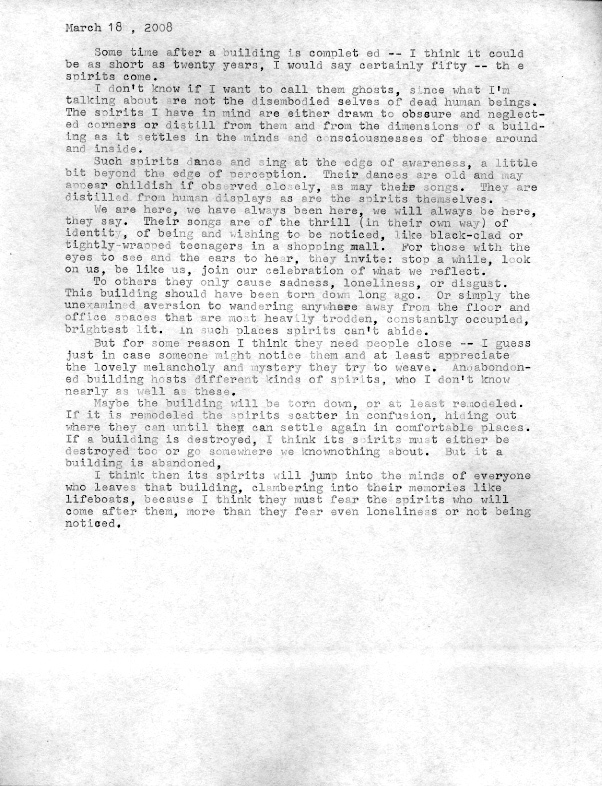
I've decided to try to type some of my blog posts on a manual typewriter. By doing this I'm diminishing the quality of my posts but I want to get better at thinking things through before I write them. I usually polish something quite a bit before posting it on here and I wonder how many other bloggers do the same, or how many just type and post without editing. I'd like to be able to express myself at least passably in a first draft, thus the typewriter.
Besides, it's fun. Although my ineptitude with putting images on this blog is sure to show.
In relation to the typed post below, here's an interesting poem.


Besides, it's fun. Although my ineptitude with putting images on this blog is sure to show.
In relation to the typed post below, here's an interesting poem.


Thursday, March 6, 2008
Thoughts on beauty
I have long wondered how many wonderful and beautiful young women there must be in the Church who are overlooked by young men because the young men are following the mainstream definition of beauty. If I have daughters, I will probably have to deal with the effects of this first-hand.
Even if young men in the Church scrupulously avoid staring at pictures of scantily-clad or suggestively-posed women, they may still be swayed by the ideology of only one possible ideal of perfection (most likely: as thin as possible, and then some) which requires countless women to torture themselves in attempts to conform.
I was seriously disturbed when I read a stammering attempt by the popular LDS author John Bytheway to answer a question of whether it was ok to make physical appearance an important factor in choosing a wife. I would like to have seen one in his position break through the assumptions behind such a question, as I assumed they must be. If it were a truly honest question of “are my tastes legitimate?” with certifiably no ties to any taste one way or the other, it would be enough to answer “sure” in an ideal situation, since with the variety of people in this world there ought to naturally be enough of a variety of tastes to find everyone an appreciative partner.
But this world is not in an ideal condition, particularly the industrialized part of it. And as things are, I suspected that behind the question lay an unspoken: “please justify me in insisting that my wife be skinny like I have been taught a woman must be to be beautiful, that she conform to the standard I have absorbed and accepted unquestioningly from the sources around me, and that she keep herself that way so that I don’t have to work on loving a woman who fails to please (or arouse) me by her appearance.” As I recall, John did at least address the second half of that question: be married long enough and you’ll eventually see your spouse looking disheveled or saggy - get over it. But the first part of the question is what I have, Alma-like, desired to shatter. Oh that I could shatter it with a voice to shake the earth.
I wish for kinder, less authoritarian understandings of beauty and sexuality, although I do have my own ideas of what is beautiful that could become potentially just as authoritarian if they had the backing that the current standard does. This is hard for me to admit, convinced as I am of the superiority of my ideas. But I wish for more gentleness towards and acknowledgment of the body, less shame and more honor, less rigor and more comfort.
Thursday, December 13, 2007
Blah blah blog
I haven't posted to this blog in 2 months.
I don't know how many people have read this blog, since I haven't taken the time to figure out how to install one of those counter things. But I doubt there's much traffic, since I don't have the time to post frequently. I wonder how people can find the time to post to blogs every day and comment on other people's blogs - is it because I don't have internet access at home?
Anyway, I'm just making it official that this blog is dormant. And furthermore I'm taking down the "Book of Mormon and Politics" posts because I want to compile them and publish them on paper. I can solicit comments and criticism of them over other channels than flinging them blindly out into cyberspace.
I don't know how many people have read this blog, since I haven't taken the time to figure out how to install one of those counter things. But I doubt there's much traffic, since I don't have the time to post frequently. I wonder how people can find the time to post to blogs every day and comment on other people's blogs - is it because I don't have internet access at home?
Anyway, I'm just making it official that this blog is dormant. And furthermore I'm taking down the "Book of Mormon and Politics" posts because I want to compile them and publish them on paper. I can solicit comments and criticism of them over other channels than flinging them blindly out into cyberspace.
Monday, October 8, 2007
More church-state madness
Recently there's been a flurry of public discussion centered around the bogus idea that the USA was supposed to be a "Christian nation". The secular humanists at Talk to Action have put up a number of stories about it which I'll link here:
Michael Medved Yearns for the Good Old Days of 1817 (or better yet, 1620)
Rush Limbaugh's Historical Ignorance
United States Treaties with the Barbary States pt.1 pt.2 pt.3
Is America a Christian Nation?
Oh, how I wish more people would make the distinction between the necessity of religion for a healthy society or the desirability of a religious or even Christian society; and an explicitly "Christian" government.
Michael Medved Yearns for the Good Old Days of 1817 (or better yet, 1620)
Rush Limbaugh's Historical Ignorance
United States Treaties with the Barbary States pt.1 pt.2 pt.3
Is America a Christian Nation?
Oh, how I wish more people would make the distinction between the necessity of religion for a healthy society or the desirability of a religious or even Christian society; and an explicitly "Christian" government.
Monday, October 1, 2007
Some thoughts on work and the family
At a recent stake conference there was a lot of emphasis in the talks on the value of education and other things that got me reflecting again on the culture of privacy and sentimental domesticity that so many North American members of the Church adhere to.
Like anything, there are truths behind this ethos. Reading Stephanie Coontz’s The Way We Never Were and then Laurence Stone’s The Family, Sex and Marriage in
I have become very dissatisfied and suspicious of any tendency to cast nuclear and extended families as opposing units. Talk of the nuclear family as a historical anomaly or artificial creation seems simplistic unless one makes clear that they are talking about an isolated or privatized ideal of the nuclear family, set up as a self-contained unit independent from its extensions, which I would agree is artificial and I believe carries the seeds of the disintegration of even that nuclear unit.
To say that the Industrial Revolution eroded or broke apart extended families strikes me as largely correct – and in fact I believe it began the breakdown of the nuclear family as well. To say that it created the nuclear family I think is a gross misunderstanding of how those who benefited from industry jealously guarded their nuclear families and began making a bigger fuss about them, in order to protect them from the family-destroying forces they were unleashing on the world.
Of course the losers in the new industrial system tried hard to keep their families together too, as Mount shows, and naturally the nuclear unit would have been easier to maintain in an era of footloose-ness than extended relations, especially among immigrants. But maybe the newly created industrial working classes remembered better than others that nuclear autonomy does not have to mean isolation, that nuclear and extended families do not have to be in opposition like so many have suggested.
In any case, many who wished to keep their families together and worked hard for that goal did not succeed, and were blamed. Or, families did stay together, but at the expense of accepting new ideas and standards (the cult of idle feminine domesticity, for example) that changed the family, made it less natural, or one might say, more natural in the King Benjamin sense: more selfish and insular than families had been in the context of cultures that retained more balancing wisdom?
I don’t want to be taken for a nostalgic believer in a pre-industrial golden age. But I do believe that when a culture changes suddenly – as the Anglo world did in the 18th and 19th centuries – then good things tend to be lost just as good things may be gained. And I believe that there were innovations in the middle-class concept of the family introduced in the Victorian period which led away from a healthy and true understanding of what families should be like. And since in the
It is easy to interpret the Proclamation on the Family as reinforcing the Victorian middle-class ethos (maybe as easy as it is to interpret the Book of Mormon as vindicating the claims of the John Birch Society). But I have looked at the proclamation after rejecting that ethos, and found that the proclamation fits my dissident view just as well or better. I want people to be able to do that: to feel free to reject the Victorian model for the counterfeit that it is and still see the inspiration behind the proclamation. Otherwise, what is a thoughtful LDS to do but reject the proclamation in part or in whole? I don’t accept every word that comes from the General Authorities as binding doctrine (certain apostles’ opinions on politics for example), but when something is composed and presented like the proclamation was I’m inclined to give it the benefit of faith.
I think a lot of unnecessary heat is generated in many exchanges about women's "place" at work or in the home - in fact, being at home is work, and hard work at that – and I think that although much energy that went into women's liberation, etc. was misdirected (towards getting women to seek the same unjust power that a lucky few men had), it was/is vital that the Victorian middle class double-standard of womanhood be done away with and that work of all kinds be given the dignity it deserves.
What does it mean to say that the home is a refuge from the world, in a culture where common foundations to prosperity are hypocritically denied, where a myth of individualism has not only been exaggerated, but cynically manipulated to sell more stuff, to enrich powers that are not only unaccountable and authoritarian, but often unacknowledged as true powers?
What does self-reliance mean in a culture where personal convenience for individuals of one class of people is constantly pushed as the most worthy goal, and the costs of that personal convenience are pushed so far away as to be not only easy to ignore but difficult to actually find out? Industrialism has actively sought to make self-reliance impossible while at the same time creating a seductive illusion of it.
To what standard of living are men to be expected to provide for their families? Is a car a necessity? A dishwasher? A telephone? TV? Internet access? -Will dial-up do, or would a caring father insist on DSL? When a member of the First Presidency tells us not to regard yesterday’s luxuries as today’s necessities, how do we understand that? For if the purpose of getting as much education as we can is to be able to provide better, what “necessities” of the world can we really do without? How much of Thomas S. Monson’s counsel can we actually live up to, if our chosen course is to make ourselves competitive in the markets of the world? Does his advice apply only to “toys” – excesses such as boats and extra cars, or really huge houses – that are still beyond what has come to be expected?
I do not want to be impatient. But I do not see a way for me to fully live the gospel without giving up not only the “more” attitude and the world’s doctrine of progress, but also the attachment to the idea that we ought to seek to provide for our families by gaining advantages over others in a competitive, if not combative market. To accept the mindset of education = training in order to earn higher wages or salary than those poor souls who didn’t get my training: I don’t see how that can be easily separated from the ideology of progress that demands we keep up, not with some opulent Joneses across the street, but with the entire neighborhood, the entire society (or supposedly so)!
So who do I think I am, writing this as a salaried professional with a Master’s Degree? Can I diminish my hypocrisy and complicity by saying that I didn’t choose a lucrative profession, that I went into a field where nobody makes a lot of money?
Before making a labor-saving device, maybe one ought to ask the moral question of whether this is labor that should be saved, or that needs to be saved. At least we all ought to ask the practical questions: whose labor does this device save, and what is to be done in the time saved by it? Who will benefit? Will labor be saved to clear the way for more worthy pursuits for those who were overly burdened with odious drudgery, or will it be compressed to allow some to be idle while others have to perform the compressed and sped-up labor to support the idle ones?
We end up making work for ourselves – driving our cars to the gym – because maybe we’ve saved ourselves too much labor . . .
If work is a spiritual necessity and to be re-enthroned as a ruling principle in our lives, how are we to apply that in a culture that disdains manual labor and encourages us to be successful in order to support our families: in other words, to attain a comfortable height of command over others' despised but essential labor? It seems to me that as the economic system is currently set up, it is in fact very difficult for LDS families to truly live the deep gospel principles of work beyond small (symbolic?) strategies like having the kids do chores or encouraging teenagers to get jobs and do their own laundry.
Still, even such small gestures as assigning chores can help teach the reality of the economic activity that is needed to support a household, and it can teach the principle that the support of a household per se is not the province of only one family member or class of family members, but of all. To the extent that young people are given work responsibilities and expected to fulfill them – and even more, to the extent that they are persuaded that their work is needed by the family and by the household, the ideal of childhood or adolescence as holding a privilege of idleness is reduced. The ideal of idle womanhood does not seem to have survived as tenaciously: women are now expected not only to prove their virtue by earning wages – or better yet, salaries – but to keep houses clean, keep fit, and cook gourmet meals in 15 minutes while saving money.
The proclamation says: “mothers are primarily responsible for the nurture of their children.” It does not say that they are the only ones who can nurture their children, nor does it say that that is the only work they should do. One could debate semantics on both of these fronts, and I don’t feel like getting into an exposition of it longer than to point out that the statement gives minimal prescription and has a flexible application: it does not equate to a “barefoot, pregnant, and in the kitchen” model of motherhood. Compared with the full plate expected of modern women, might a simple responsibility for the nurture of children start to seem light?
Except that of course it isn’t. The bare physical nurturing that comes from the breast might not demand too much in the way of commitment beyond time and nutrition, but the other facets of nurturing are hard work, and if such hard work were more honestly acknowledged and sincerely honored, women might not need to feel that they had to prove their virtue by being so diligent in earning wages (or better yet, salaries) – and what would it take for men to be freed from feeling that they had to prove their worth the same way?
A rebellion against overly restrictive expectations of private nuclear family work (stay in the house all day with just you and the children) could go in different directions: a movement in favor of more communal forms of childcare and housework, for example. I suggest that unexamined selfishness did in fact play a large role in much of the rebellion against the older norms, and that much of the conservative fear of feminism, though often misdirected and exaggerated, was warranted by observing this selfishness. If the work of raising children were truly valued and understood on its own terms – and separated from the work of physically maintaining a house – might the feminism of the 1960s and 1970s have looked different? Might more women have been willing to call themselves feminists earlier?
Compared to the expectations of achievement put forth by the societies of power and privilege, might a simple orientation towards the provision and nurture of children as the primary goal for mothers and fathers be a focus of welcome simplicity after all?
The societies of power and privilege despise simplicity, and will likely tell us that simplicity of purpose leads to simplicity of mind and waste of potential. If we believe that, we will follow them, because we know in our souls that wasting our potential is an insult to God. Will we be persuaded by them, or will we listen to those who try to tell us that simplicity of purpose can actually enrich our minds and lead us to fulfill our true potential?
Friday, April 27, 2007
Thoughts on the recent BYU commencement
Well, the BYU Commencement with Dick Cheney as speaker is over, and so is the Alternative Commencement which was put on by students who felt disenfranchised by the administration's invitation to VP Cheney. You can read an article about it here.
As a BYU alumn, it's been interesting to watch what little of this I could with the time I could spare. I have wondered what I would have done if I were still living within close range of Provo, and especially if I were a student (or working) at BYU now.
When I was a BYU student, I was beginning my leftward drift but only beginning. At my graduation in April 2001, Tom Lantos spoke, and I was surprised to learn that he was a Democrat. He received an honorary degree and gave a wonderful speech, and nobody seemed bothered in the slightest by his political affiliation - you might never have guessed it from his speech.
I have seen various reasons why people have protested Cheney's participation in this commencement. One thing I have read is that it seems to many people to compromise the Church's political neutrality by giving the appearance of an endorsement of the Republican Party. I have not found this to be a very satisfying argument mostly, partly because of my memories of my own commencement. The official statement ran to the effect that Cheney was invited because of his office and not his party. In principle, that's fair enough, but the fact that this particular VP was invited at this particular time does complicate the question. Still, given the Church leadership's general optimism towards the powers that be, it's not surprising that the BYU board of trustees rewarded Cheney's offer with an invitation.
It's hard to see sometimes through the fog of the political opinions of common members of the Church, and I can see how, again, this particular VP being invited at this particular time may look to some like flirting too closely with the appearance of political endorsement - I still haven't heard anyone try to explain how one member of BYU's board of trustees being a Democrat fits into this view though.
One might suggest that in order to avoid such troubles, no political officers should speak at commencements - would that be too austere? My sister got to hear Neil Postman at her commencement, the lucky duck. What if they did just keep the politicians to other functions? Would I have gone to hear Tom Lantos if he weren't speaking at my commencement? Certainly not, if the BYU Democrats had hosted it.
Another reason has been the controversy created by the current administration's policies, and going along with that, the outrage that many feel because of the policies and actions that Cheney has done, made, or been a part of - as one of the protesters' signs read: "it's not a partisan thing, it's an ethics and morals thing!" This to me was a much better reason to protest his speaking at the commencement, although again, the trend of optimistic and polite deference to those in power that has marked Church policy since the mid-20th century made it a pretty good guess that nothing would get the board of trustees to drop the invitation. Does that frustrate me? Yeah it does, somewhat, but I don't want to get too distracted by that frustration, because, look: there was a protest, and there was an alternative commencement. I could wish the protesters had an easier time of it, but the fact that there was a protest - and that BYU allowed it - gives me tremendous hope for the students, the school and the Church.
Some of the protesters put out a petition, which you can read here. I signed it, even though I knew it wouldn't stop Cheney from speaking at the commencement. I signed it mostly because of the second paragraph, and after I signed it I wondered if I ought to have just written a letter instead. Still, I was glad to hear that in fact VP Cheney did not "use the BYU commencement ceremony as a platform for his controversial political agenda" - apparently his speech was apolitical, so in that I choose to claim some success for "our side".
Come to think of it, when Margaret Thatcher spoke at a BYU forum while I was there, I don't recall her saying anything overtly political either . . .
So I'm glad that students and others protested. I'm glad that they got enough donations to hold their alternative commencement. I wish I could have been there. And I hope that this does help stir people at BYU and in Provo up from complacency.
Still, I see some danger:
The main danger I see is the anger and resentment that I detected in some of my associates at BYU even when there was no big controversy going on. Those of us who find much of "Mormon" culture - or even some unofficial (but still often rigid) practices within the Church to be silly, distracting, indefensible, wrong, or offensive, but still hold our faith and our covenants dear - we are always going to have the challenge of keeping ourselves from being poisoned by the anger that comes so easily whenever we get into conflicts with people who are attached to those things we object to.
Look at the outrage expressed in one call for donations for the alternative commencement, which was not written by a BYU student (and be aware: it uses harsh language). While I am glad that this post got the students the donations they needed, and I know that particular blog is highly thought of, in this instance the author goes too far: BYU as "a fringe example of blatant fascism"? I had my frustrations with the school's administrative style while I was there, but I didn't want to ally myself closely with people who had such contempt for it, and I still don't. I would hope that the student protesters would remember why they are protesting and not give in to such self-righteous anger - even if they see some in their opponents.
Another danger: the alternative commencement now has a website (in case you missed it, you can see it here). It isn't the same investment as a building or a newspaper might be, but still: it's an established presence, and there may be a temptation to keep it going: will someone get the bright idea to try to have an alternative commencement next year, and the next? I hope not: doing something like that for its own sake would quickly produce results very much like bad art and mediocre punk music.
All in all, though, it looks like the protesting students were true to their convictions and consciences and behaved in a way that citizens of a democracy should, and that makes me happy.
(One student made a short video about the protest, which is kind of amusing.)
As a BYU alumn, it's been interesting to watch what little of this I could with the time I could spare. I have wondered what I would have done if I were still living within close range of Provo, and especially if I were a student (or working) at BYU now.
When I was a BYU student, I was beginning my leftward drift but only beginning. At my graduation in April 2001, Tom Lantos spoke, and I was surprised to learn that he was a Democrat. He received an honorary degree and gave a wonderful speech, and nobody seemed bothered in the slightest by his political affiliation - you might never have guessed it from his speech.
I have seen various reasons why people have protested Cheney's participation in this commencement. One thing I have read is that it seems to many people to compromise the Church's political neutrality by giving the appearance of an endorsement of the Republican Party. I have not found this to be a very satisfying argument mostly, partly because of my memories of my own commencement. The official statement ran to the effect that Cheney was invited because of his office and not his party. In principle, that's fair enough, but the fact that this particular VP was invited at this particular time does complicate the question. Still, given the Church leadership's general optimism towards the powers that be, it's not surprising that the BYU board of trustees rewarded Cheney's offer with an invitation.
It's hard to see sometimes through the fog of the political opinions of common members of the Church, and I can see how, again, this particular VP being invited at this particular time may look to some like flirting too closely with the appearance of political endorsement - I still haven't heard anyone try to explain how one member of BYU's board of trustees being a Democrat fits into this view though.
One might suggest that in order to avoid such troubles, no political officers should speak at commencements - would that be too austere? My sister got to hear Neil Postman at her commencement, the lucky duck. What if they did just keep the politicians to other functions? Would I have gone to hear Tom Lantos if he weren't speaking at my commencement? Certainly not, if the BYU Democrats had hosted it.
Another reason has been the controversy created by the current administration's policies, and going along with that, the outrage that many feel because of the policies and actions that Cheney has done, made, or been a part of - as one of the protesters' signs read: "it's not a partisan thing, it's an ethics and morals thing!" This to me was a much better reason to protest his speaking at the commencement, although again, the trend of optimistic and polite deference to those in power that has marked Church policy since the mid-20th century made it a pretty good guess that nothing would get the board of trustees to drop the invitation. Does that frustrate me? Yeah it does, somewhat, but I don't want to get too distracted by that frustration, because, look: there was a protest, and there was an alternative commencement. I could wish the protesters had an easier time of it, but the fact that there was a protest - and that BYU allowed it - gives me tremendous hope for the students, the school and the Church.
Some of the protesters put out a petition, which you can read here. I signed it, even though I knew it wouldn't stop Cheney from speaking at the commencement. I signed it mostly because of the second paragraph, and after I signed it I wondered if I ought to have just written a letter instead. Still, I was glad to hear that in fact VP Cheney did not "use the BYU commencement ceremony as a platform for his controversial political agenda" - apparently his speech was apolitical, so in that I choose to claim some success for "our side".
Come to think of it, when Margaret Thatcher spoke at a BYU forum while I was there, I don't recall her saying anything overtly political either . . .
So I'm glad that students and others protested. I'm glad that they got enough donations to hold their alternative commencement. I wish I could have been there. And I hope that this does help stir people at BYU and in Provo up from complacency.
Still, I see some danger:
The main danger I see is the anger and resentment that I detected in some of my associates at BYU even when there was no big controversy going on. Those of us who find much of "Mormon" culture - or even some unofficial (but still often rigid) practices within the Church to be silly, distracting, indefensible, wrong, or offensive, but still hold our faith and our covenants dear - we are always going to have the challenge of keeping ourselves from being poisoned by the anger that comes so easily whenever we get into conflicts with people who are attached to those things we object to.
Look at the outrage expressed in one call for donations for the alternative commencement, which was not written by a BYU student (and be aware: it uses harsh language). While I am glad that this post got the students the donations they needed, and I know that particular blog is highly thought of, in this instance the author goes too far: BYU as "a fringe example of blatant fascism"? I had my frustrations with the school's administrative style while I was there, but I didn't want to ally myself closely with people who had such contempt for it, and I still don't. I would hope that the student protesters would remember why they are protesting and not give in to such self-righteous anger - even if they see some in their opponents.
Another danger: the alternative commencement now has a website (in case you missed it, you can see it here). It isn't the same investment as a building or a newspaper might be, but still: it's an established presence, and there may be a temptation to keep it going: will someone get the bright idea to try to have an alternative commencement next year, and the next? I hope not: doing something like that for its own sake would quickly produce results very much like bad art and mediocre punk music.
All in all, though, it looks like the protesting students were true to their convictions and consciences and behaved in a way that citizens of a democracy should, and that makes me happy.
(One student made a short video about the protest, which is kind of amusing.)
Subscribe to:
Posts (Atom)